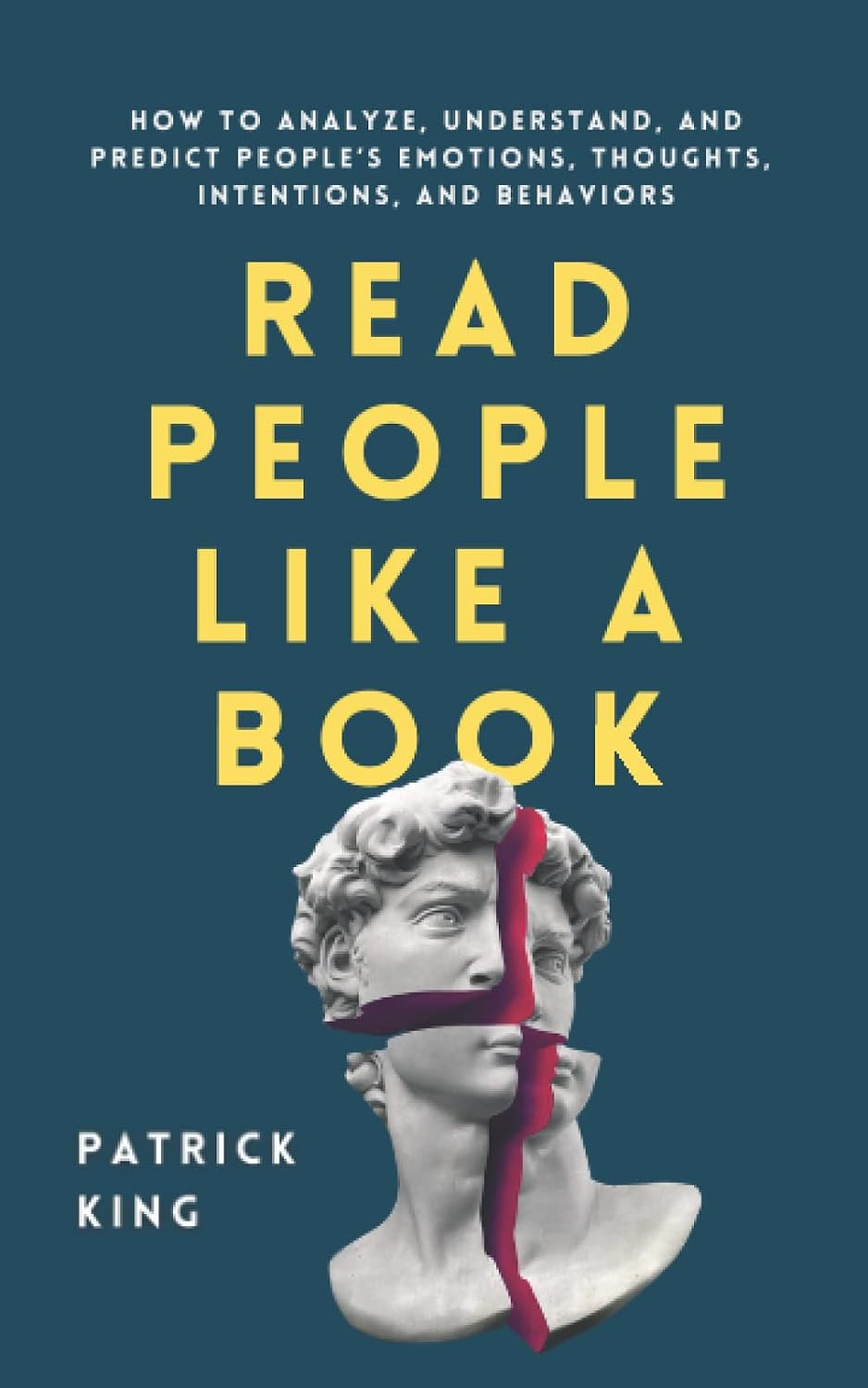
Read People Like a Book: How to Analyze, Understand, and Predict People’s Emotions, Thoughts, Intentions, and Behaviors is a nonfiction book by American author and social-interaction specialist Patrick King. The book was published in 2020 and focuses on interpreting human behavior through motivation, body language, personality frameworks, conversational behavior, observation, and lie detection.
King’s central premise is that understanding people requires more than watching isolated gestures or facial expressions. Human behavior is influenced by a combination of motivation, personality, past experience, emotional state, context, verbal communication, and non-verbal signals. The book therefore presents “reading people” as a process of assembling multiple pieces of information rather than attempting to decode a single supposedly universal gesture.
The book was published by PKCS Media in December 2020 in an edition of approximately 275–278 pages, although pagination and publication details vary among editions. Google Books lists a 275-page PKCS Media edition dated December 11, 2020, while Open Library records editions published by PKCS Media and independently published editions with different pagination and ISBNs.
The book belongs to the popular psychology, communication, personal development, and social-skills genres. Its subject matter overlaps with social psychology, personality psychology, non-verbal communication, emotional intelligence, interpersonal communication, and deception detection.
Bibliographic information
| Field | Information |
|---|---|
| Author | Patrick King |
| Full title | Read People Like a Book: How to Analyze, Understand, and Predict People’s Emotions, Thoughts, Intentions, and Behaviors |
| Country | United States |
| Language | English |
| Genre | Nonfiction; popular psychology; self-help; communication |
| Subject | Human behavior, social interaction, personality, body language, communication |
| Publisher | PKCS Media, Inc. |
| Publication period | 2020 |
| Common publication date | December 2020 |
| Length | Approximately 275–278 pages, depending on edition |
| ISBN-13 | 978-1647432232 for a PKCS Media edition |
| Other edition ISBNs | 978-8579327070 and other edition-specific identifiers |
| ASIN | B08QBB3MTG for one Amazon edition |
| Author’s field | Social interaction and communication coaching |
| Related subjects | Psychology, interpersonal relations, emotional intelligence, social skills |
Bibliographic databases record several editions of the work. Open Library lists a PKCS Media hardcover edition with ISBN 978-1647432232 and 276 pages, while another edition is recorded as independently published with ISBN 979-8579327079.
Google Books lists a PKCS Media edition published in December 2020 with 275 pages and classifies the book under social science.
Author
Patrick King
Patrick King is an American author, social-interaction specialist, and communication coach based in San Francisco, California. His work focuses on communication, social skills, relationships, dating, emotional intelligence, and interpersonal behavior.
Author biographies associated with his books describe King as a social interaction specialist and conversation coach. He has been featured in publications and media outlets including GQ, Forbes, NBC News, Business Insider, Inc., Men’s Fitness, Real Simple, and CreativeLive.
King has written extensively about communication and relationships. His bibliography includes works concerning social intelligence, conversation, likability, introversion, listening, dating, and personal development. His approach generally combines psychological concepts with practical communication advice intended for a general readership.
A recurring theme in King’s work is that social ability is not simply an innate personality characteristic. Instead, communication can be studied, practiced, and improved.
His background in law school is also mentioned in author biographies accompanying his books. Goodreads describes him as having completed three years of law school before developing his writing and coaching career.
King’s later publications have continued to address social intelligence and interpersonal communication. Google Books, for example, identifies him as the author of Science-Based Social Skills, published by PKCS Media in 2025.
Publication history
Read People Like a Book appeared in 2020 in several editions and formats.
Google Books records a PKCS Media edition dated December 11, 2020, with 275 pages.
Open Library records another edition dated December 19, 2020, published by Patrick King/independently published, with ISBN 979-8579327079 and 278 pages.
A separate PKCS Media edition is catalogued with ISBN 978-1647432232 and 276 pages.
The differences illustrate why bibliographic information for independently and digitally distributed books should normally be associated with a particular edition rather than treated as one universal specification.
Premise
The book begins with a deceptively simple question:
Can human beings learn to understand other people more accurately?
King’s answer is essentially yes—but not by relying on one magical technique.
The book argues for a layered approach to social observation.
A person’s behavior can be influenced by:
- underlying motivations
- emotional states
- personality
- past experiences
- physical and social environment
- verbal communication
- body language
- facial expressions
- conversational patterns
- expectations
- cultural background
- social roles
- immediate circumstances
This produces a central idea that runs through the book:
A single signal is rarely enough. Meaning emerges from patterns and context.
The book’s published description emphasizes body language, human psychology, lie detection, and the relationship between people’s experiences and their behavioral patterns.
Structure of the book
The book’s contents are organized around several major areas of human behavior and observation.
The principal sections include:
- Introduction
- Why You Are Probably Doing It Wrong
- The Problem of Objectivity
- Motivation as a Behavioral Predictor
- The Body, the Face, and Clusters
- Personality Science and Typology
- Lie Detection 101 and its Caveats
- Using the Power of Observation
The chapter material includes discussions of motivation, the “shadow,” childhood influences, pleasure and pain, needs, ego defense, facial expressions, body language, behavioral clusters, the Big Five personality model, MBTI, Keirsey’s temperaments, the Enneagram, deception detection, cognitive load, thin-slicing, observation, and questioning.
Core concepts
Motivation as a behavioral predictor
One of the book’s foundational ideas is that behavior becomes easier to understand when the reader asks why a person might want something.
The same outward action can have different meanings depending on motivation.
For example, someone who works extremely long hours might be motivated by:
- ambition
- financial necessity
- fear of failure
- desire for recognition
- enjoyment
- family responsibility
- avoidance of another problem
The visible behavior is identical, but the psychological explanation can be very different.
King therefore places motivation before interpretation.
Behavioral model
             MOTIVATION
                 │
                 ▼
              DESIRE
                 │
                 ▼
             DECISION
                 │
                 ▼
              ACTION
                 │
                 ▼
             BEHAVIOR
                 │
                 ▼
             OBSERVABLE
               PATTERN
This is a conceptual representation of the book’s approach rather than a scientific causal model.
The role of past experience
The book emphasizes that people do not encounter the present as blank slates.
Previous experiences can influence:
- expectations
- fears
- preferences
- defensive reactions
- relationship patterns
- communication styles
- habits
Consequently, understanding someone’s history can sometimes explain behavior that appears irrational when viewed in isolation.
A person’s reaction to criticism, for example, may be influenced by previous experiences of rejection, authority, failure, or humiliation.
The practical implication is important:
Behavior makes more sense when placed inside a person’s larger story.
The “shadow” and hidden motives
King discusses the idea of the shadow, a concept associated particularly with Carl Jung’s analytical psychology.
In the book, the concept is used to explore aspects of personality that people may suppress, deny, or prefer not to acknowledge.
A person may consciously describe themselves as calm while frequently reacting with anger.
Someone may regard themselves as generous while becoming unusually resentful when others receive recognition.
Such contradictions can be psychologically informative.
The broader lesson is not that people are secretly dishonest, but that self-perception and actual behavior do not always perfectly coincide.
Pleasure and pain
Another framework in the book is the idea that behavior is often connected to the pursuit of rewards and avoidance of negative experiences.
People may move toward:
- pleasure
- status
- belonging
- security
- recognition
- achievement
- intimacy
and away from:
- rejection
- humiliation
- uncertainty
- physical discomfort
- financial loss
- social exclusion
- failure
This produces a useful behavioral question:
What is this person trying to gain, and what are they trying to avoid?
Needs and behavior
The book also draws on the familiar concept of hierarchical human needs.
The exact interpretation of human needs varies among psychological theories, but King’s presentation uses needs as a framework for understanding why different people can respond differently to the same situation.
A person concerned primarily with safety may behave differently from someone whose immediate concern is status, belonging, achievement, or self-expression.
Conceptual needs pyramid
                 ┌───────────────┐
                 │ Self-growth   │
                 │ / fulfillment │
                 └───────▲───────┘
                         │
                 ┌───────┴───────┐
                 │ Achievement / │
                 │   esteem      │
                 └───────▲───────┘
                         │
                 ┌───────┴───────┐
                 │ Belonging /   │
                 │ relationships │
                 └───────▲───────┘
                         │
                 ┌───────┴───────┐
                 │ Safety /       │
                 │ security       │
                 └───────▲───────┘
                         │
                 ┌───────┴───────┐
                 │ Basic needs    │
                 └───────────────┘
The pyramid should be viewed as an explanatory device rather than a claim that every person’s needs develop in a fixed sequence.
Body language
Body language is one of the most visible subjects associated with Read People Like a Book.
King discusses:
- facial expressions
- posture
- gestures
- physical positioning
- movement
- eye behavior
- personal space
- changes in physical behavior
However, an important principle in the book is that body language should not be interpreted in isolation.
For example, crossed arms can mean many things:
- discomfort
- cold temperature
- habit
- concentration
- defensiveness
- relaxation
The gesture itself does not determine the explanation.
Context is necessary.
The principle of behavioral clusters
One of the book’s most useful concepts is the idea of reading clusters rather than isolated signals.
Instead of:
Gesture X = emotion Y
the reader is encouraged to consider:
Gesture + facial expression + words + context + baseline behavior + timing
The cluster model
                 CONTEXT
                    │
                    ▼
       ┌────────────┼────────────┐
       │            │            │
    WORDS         FACE         BODY
       │            │            │
       └────────────┼────────────┘
                    │
                    ▼
             BEHAVIORAL
               CLUSTER
                    │
                    ▼
          POSSIBLE INTERPRETATION
                    │
                    ▼
            TEST WITH QUESTIONS
This approach is more cautious than treating body language as a dictionary in which every movement has a fixed meaning.
Facial expressions
The face can communicate emotional information, but the book emphasizes observation rather than simplistic decoding.
Relevant signals may include:
- changes in facial tension
- smiling
- frowning
- eye movement
- changes in expression
- brief emotional reactions
- mismatch between facial expression and spoken words
The key consideration is change.
A person’s ordinary expression establishes a baseline. A sudden deviation from that baseline can be more informative than a behavior observed without context.
Personality science
A major section of the book introduces several personality frameworks.
These include:
- the Big Five personality traits
- the Myers–Briggs Type Indicator (MBTI)
- Keirsey’s temperament model
- the Enneagram
The book uses these models as tools for thinking about differences between people.
The Big Five
The Big Five model is based on five broad dimensions commonly abbreviated as OCEAN:
| Trait | General dimension |
|---|---|
| O — Openness | Openness to experience, ideas, imagination |
| C — Conscientiousness | Organization, responsibility, self-discipline |
| E — Extraversion | Sociability, activity, assertiveness |
| A — Agreeableness | Cooperation, warmth, interpersonal orientation |
| N — Neuroticism | Emotional reactivity and vulnerability to negative affect |
The Big Five is substantially more established within contemporary personality psychology than some of the other typological systems discussed in popular psychology.
For readers using the book as an introduction, this distinction matters: the different frameworks do not all have the same empirical status.
Myers–Briggs Type Indicator
The book also discusses the Myers–Briggs Type Indicator (MBTI) and Jung-derived personality preferences.
MBTI classifies individuals into four preference dimensions and combines them into 16 types.
The system has become extremely popular in workplaces and popular culture.
However, readers should distinguish its popularity from the scientific strength of personality models such as the Big Five. MBTI is better treated as a descriptive or conversational framework than as a definitive measurement of personality.
Keirsey temperaments
The book introduces Keirsey’s temperament model, which groups personality patterns into four broad temperaments.
The framework attempts to describe differences in communication, decision-making, and behavior.
Its value within the book is primarily practical: it gives readers another vocabulary for thinking about differences in how people approach situations.
The Enneagram
The Enneagram is another personality framework discussed in the book.
It describes nine broad personality patterns and focuses heavily on motivation, emotional tendencies, and recurring psychological strategies.
Like MBTI, the Enneagram is widely used in popular self-development and coaching contexts but does not have the same level of empirical support as mainstream trait-based personality psychology.
This distinction is important for an encyclopedia article because a framework can be culturally influential without being scientifically validated to the same degree.
Personality models compared
Conceptual map
                    PERSONALITY
                         │
       ┌─────────────────┼─────────────────┐
       │                 │                 │
     TRAITS            TYPES          MOTIVATIONAL
       │                 │              PATTERNS
       │                 │                 │
    BIG FIVE          MBTI            ENNEAGRAM
       │                 │                 │
       └─────────────────┼─────────────────┘
                         │
                         ▼
                 BEHAVIORAL CLUES
The book’s approach is therefore eclectic: it draws from several models rather than depending on one theory of personality.
Lie detection
One of the most attention-grabbing sections of Read People Like a Book concerns deception detection.
The book does not present lie detection as a simple ability to observe a person’s eyes or gestures and immediately determine whether they are lying.
Instead, it discusses uncertainty and the importance of conversation.
The chapter includes concepts such as:
- establishing behavioral baselines
- asking questions
- observing changes
- increasing cognitive demands
- using unexpected questions
- looking for inconsistencies
- considering the broader context
The published contents explicitly identify the problem of uncertainty as part of the lie-detection discussion.
Why lie detection is difficult
Human deception is complicated because nervousness does not automatically mean dishonesty.
A truthful person can be:
- anxious
- frightened
- embarrassed
- confused
- socially uncomfortable
A dishonest person can also appear:
- calm
- confident
- persuasive
- relaxed
Therefore:
Nervousness ≠ lying
and:
Confidence ≠ truthfulness
This is one of the most important cautions for readers applying the book’s ideas.
Cognitive load
The book discusses cognitive load as one possible tool in conversational deception detection.
The underlying idea is that constructing and maintaining a deceptive story can require mental effort.
Questions that require additional thinking may therefore make inconsistencies easier to detect.
However, this should not be interpreted as a guaranteed lie detector.
Simplified model
Question
   │
   ▼
Recall information
   │
   ├──► Genuine memory
   │
   └──► Construct / maintain deception
                 │
                 ▼
           Additional mental
               demands
                 │
                 ▼
       Possible inconsistencies
The word possible is important. A behavioral clue is evidence to investigate, not proof.
The importance of conversation
A particularly useful aspect of the book is its emphasis on asking questions.
Rather than attempting to become a silent “human scanner,” the reader can actively interact with people.
Questions can reveal:
- values
- preferences
- memories
- motivations
- priorities
- inconsistencies
- emotional reactions
- self-perception
This transforms people-reading from passive observation into an interactive process.
Thin-slicing
The book discusses thin-slicing, the idea of making judgments from relatively small amounts of information.
Human beings routinely make rapid assessments from limited observations.
This can be useful because humans are capable of recognizing patterns quickly.
But it also creates a major danger:
fast judgments can be wrong.
A useful reader therefore needs two abilities:
- the ability to notice quickly;
- the willingness to revise the initial interpretation.
The second ability is arguably just as important as the first.
Objectivity and bias
The book’s introduction addresses what it describes as the problem of objectivity.
This is central to the entire subject.
People do not observe others like perfectly neutral cameras.
Their interpretations are influenced by:
- previous experiences
- expectations
- stereotypes
- mood
- personal preferences
- attraction
- fear
- social status
- cultural assumptions
Consequently, reading another person also requires monitoring the observer.
Observer-effect model
             PERSON
                │
                ▼
             BEHAVIOR
                │
                ▼
            OBSERVER
                │
       ┌────────┼────────┐
       │        │        │
    Biases   Experience Expectations
       │        │        │
       └────────┼────────┘
                ▼
          INTERPRETATION
This is one of the book’s most important conceptual safeguards.
Context
Context is essential to interpreting behavior.
The same behavior can mean different things in different environments.
For example:
Silence
could indicate:
- thoughtfulness
- boredom
- anger
- respect
- nervousness
- exhaustion
- cultural convention
Without context, the observer is forced to guess.
With context, several possibilities can be eliminated.
The book consequently encourages readers to think in terms of probabilities and patterns rather than certainty.
Baseline behavior
A useful concept in behavioral observation is the establishment of a baseline.
Instead of asking:
“Is this behavior strange?”
ask:
“Is this behavior different from this person’s normal behavior?”
For example, someone may normally speak rapidly and use extensive gestures. Their gestures therefore have limited diagnostic value.
If that same person suddenly becomes unusually still and quiet during one particular subject, the change itself may deserve attention.
Baseline principle
NORMAL BEHAVIOR
      │
      ▼
   BASELINE
      │
      ▼
CHANGE FROM BASELINE
      │
      ▼
INVESTIGATE CONTEXT
      │
      ▼
ASK QUESTIONS
      │
      ▼
REVISE INTERPRETATION
Reading people without becoming judgmental
A major practical danger in people-reading is premature labeling.
If someone avoids eye contact, an observer might immediately conclude:
“They are lying.”
A more disciplined observer asks:
- Is this normal for them?
- What is happening in the environment?
- Are they uncomfortable?
- Is there a cultural explanation?
- Are they tired?
- What are they saying?
- Does their behavior contradict other evidence?
The difference is between observation and interpretation.
Observation
“He stopped making eye contact.”
Interpretation
“He must be lying.”
The first is directly observable.
The second is a hypothesis.
That distinction is crucial.
The book’s practical reading system
The ideas in the book can be condensed into a multi-stage process.
Step 1 — Establish context
Understand where the interaction is taking place.
Step 2 — Observe the baseline
Determine how the person normally behaves.
Step 3 — Identify motivation
Ask what the person may want or avoid.
Step 4 — Observe clusters
Look at words, face, body, tone, timing, and circumstances together.
Step 5 — Consider personality
Use personality frameworks cautiously as hypotheses rather than labels.
Step 6 — Ask questions
Give the person an opportunity to explain themselves.
Step 7 — Search for consistency
Compare statements with behavior and behavior over time.
Step 8 — Update your interpretation
Treat your first impression as provisional.
Complete framework
        CONTEXT
           ↓
        BASELINE
           ↓
       MOTIVATION
           ↓
      OBSERVATION
           ↓
   BEHAVIORAL CLUSTERS
           ↓
      PERSONALITY
           ↓
       QUESTIONS
           ↓
      CONSISTENCY
           ↓
     INTERPRETATION
           ↓
      RE-EVALUATION
This framework captures the practical spirit of the book while avoiding the idea that people can be “decoded” with certainty.
Human behavior as a pattern-recognition problem
At its deepest level, Read People Like a Book can be understood as a book about pattern recognition.
People generate enormous amounts of information through:
- speech
- word choice
- timing
- posture
- facial expression
- habits
- preferences
- reactions
- relationships
- decisions
The challenge is not simply collecting signals.
The challenge is determining which signals matter.
Signal hierarchy
           RAW SIGNALS
                │
                ▼
          PATTERNS
                │
                ▼
             CONTEXT
                │
                ▼
          MOTIVATION
                │
                ▼
        POSSIBLE MEANING
                │
                ▼
         TEST / VERIFY
This is considerably more useful than the popular idea that every gesture has one predetermined meaning.
Relationship between emotion, thought and behavior
The book repeatedly moves between three levels:
Emotion
What does the person feel?
Thought
What does the person believe or expect?
Behavior
What does the person actually do?
These three levels can agree—or conflict.
For example:
Feeling:     anxiety
                ↓
Thought:     "I may be judged."
                ↓
Behavior:    avoids speaking
But another person experiencing the same anxiety might behave differently:
Feeling:     anxiety
                ↓
Thought:     "I need to prove myself."
                ↓
Behavior:    talks excessively
The same emotion can therefore produce different behaviors depending on personality, experience, goals, and context.
Communication and charisma
Although the title emphasizes “reading” other people, the book’s practical value extends beyond observation.
Understanding other people can improve communication because it allows the reader to adjust:
- tone
- questions
- conversational pace
- level of detail
- emotional sensitivity
- listening behavior
- response timing
This connects the book to King’s broader work on social interaction and communication.
His professional biography emphasizes communication coaching, social skills, emotional intelligence, and human interaction.
Relationship to emotional intelligence
Read People Like a Book overlaps substantially with the concept of emotional intelligence.
A simplified model is:
       EMOTIONAL INTELLIGENCE
                 │
       ┌─────────┴─────────┐
       │                   │
  SELF-AWARENESS      SOCIAL AWARENESS
       │                   │
       ▼                   ▼
 Understand your      Understand other
 own reactions        people's signals
       │                   │
       └─────────┬─────────┘
                 ▼
          BETTER RESPONSE
The book’s people-reading framework emphasizes the second half, but effective social interaction requires both.
A person who understands everyone else but cannot regulate their own reactions may still communicate poorly.
Scientific status and limitations
Read People Like a Book should be read as a popular psychology and self-development book, not as a scientific textbook.
This distinction is particularly important because the book discusses subjects—such as body language, personality typing, micro-expressions, intuition, and deception detection—that are frequently simplified in popular culture.
Body language is contextual
There is no universal dictionary in which one gesture always corresponds to one psychological state.
Personality tests differ in scientific support
The Big Five is an established trait model in personality psychology, while MBTI and the Enneagram have different levels and types of empirical support.
Lie detection is uncertain
No ordinary observer can reliably determine truthfulness from a single gesture or facial expression.
Intuition can be useful and fallible
Human beings can recognize patterns rapidly, but intuitive judgments are also vulnerable to stereotypes and confirmation bias.
Thin-slicing has limitations
Rapid judgments can sometimes be informative, but they can also become premature conclusions.
Criticism and reader reception
The book has received a mixed response from readers.
Goodreads records a large number of ratings and reviews, with an overall rating around 3.4/5 in the records retrieved for this article. The distribution includes substantial numbers of both positive and critical reviews.
Google Play Books presents a more favorable aggregate rating for one edition, reporting 4.2/5 from 532 reviews in the retrieved listing.
Readers who respond positively commonly describe the book as accessible, practical, and easy to understand. Some reviews particularly appreciate its treatment of observation, personality, communication, and social interaction. Google Play reviewers, for example, describe the writing as accessible and useful for improving interaction.
Critical reviews have questioned the depth of some discussions and the degree to which familiar psychological ideas are presented as novel. Other reviewers have objected to particular examples or perceived oversimplifications.
Because reader reviews represent individual experiences rather than controlled evaluations, they are best understood as evidence of reception, not evidence of the scientific validity of the book’s claims.
What makes the book different from a body-language manual?
Despite its title, the book is broader than a conventional body-language guide.
Its framework can be summarized as:
Motivation + personality + context + verbal communication + non-verbal behavior + observation
rather than simply:
Body language = hidden thoughts
That distinction is important.
A person is not merely a collection of gestures.
The same posture, facial expression, or speech pattern can have different meanings depending upon the individual and situation.
A practical example
Imagine a manager notices that an employee becomes unusually quiet during a meeting.
A simplistic approach might be:
“The employee is hiding something.”
The framework encouraged by the book suggests a more careful sequence:
Observation
The employee is quieter than usual.
Baseline
They are normally active in meetings.
Context
The discussion concerns a project they previously criticized.
Motivation
They may fear disagreement, criticism, or professional consequences.
Questions
The manager asks an open-ended question.
New information
The employee explains that they disagree with the proposed timeline.
Revised interpretation
The silence was not necessarily deception; it may have reflected hesitation or concern.
This example illustrates one of the most useful lessons of the book:
Good people-reading reduces uncertainty; it does not magically eliminate it.
A human-centered interpretation
The title Read People Like a Book can initially sound almost mechanical, as though another human being were a puzzle waiting to be decoded.
The more constructive interpretation is different.
People are complicated because they have histories.
They carry memories into conversations. They protect identities. They pursue goals. They fear rejection. They misunderstand themselves. They sometimes contradict themselves. They behave differently when they are tired, frightened, excited, embarrassed, or under pressure.
Seen from that perspective, “reading people” is less about gaining power over them and more about becoming less careless in interpreting them.
That is perhaps the most valuable way to approach the book.
The central model of the book
The ideas can be condensed into one visual:
                 UNDERSTAND THE PERSON
                         │
          ┌──────────────┼──────────────┐
          ▼              ▼              ▼
       HISTORY       MOTIVATION     PERSONALITY
          │              │              │
          └──────────────┼──────────────┘
                         ▼
                      CONTEXT
                         │
                         ▼
              WORDS + BODY LANGUAGE
                         │
                         ▼
                 BEHAVIORAL PATTERN
                         │
                         ▼
                  ASK / OBSERVE
                         │
                         ▼
                 TEST YOUR THEORY
                         │
                         ▼
                REVISE IF NECESSARY
The final step—revise if necessary—is crucial.
People-reading becomes dangerous when an observer becomes emotionally attached to the first explanation they construct.
Key ideas at a glance
| Concept | Main question |
|---|---|
| Motivation | What does this person want or avoid? |
| Past experience | What experiences may have shaped this response? |
| Body language | What non-verbal information accompanies the words? |
| Clusters | Do several signals point in the same direction? |
| Baseline | Is this behavior normal for the person? |
| Personality | What relatively stable tendencies might matter? |
| Context | What is happening around the person? |
| Conversation | What can be learned by asking? |
| Consistency | Do words and behavior fit together over time? |
| Objectivity | Could my own biases be affecting the interpretation? |
| Deception detection | Is there evidence of inconsistency, rather than merely nervousness? |
| Empathy | Can I understand the situation from the other person’s perspective? |
Legacy and place in popular psychology
Read People Like a Book belongs to a large body of contemporary popular literature concerned with social intelligence, communication, personality, relationships, and human behavior.
Its appeal lies partly in its promise of turning an everyday activity—interacting with other people—into something that can be consciously studied.
The book also reflects a broader cultural fascination with:
- body language
- personality tests
- emotional intelligence
- lie detection
- charisma
- social skills
- psychological self-improvement
King’s later books continue to explore these subjects. His bibliography includes works on social intelligence, likability, conversation, introversion, communication, listening, and related areas.
Conclusion
Read People Like a Book presents human interaction as a problem of observation, interpretation, and communication.
Its central lesson can be expressed simply:
Do not judge a person from one signal. Look for patterns.
To understand another person more accurately, the book encourages readers to consider motivation, personality, past experience, context, words, body language, and behavioral changes together.
Its strongest contribution is therefore not a secret formula for “reading minds.” Rather, it is the invitation to become a more careful observer.
At the same time, the book is best approached critically. Psychological concepts vary considerably in scientific support, body-language cues are rarely definitive, and deception cannot reliably be identified from a single behavior. The reader’s own assumptions are part of the equation.
Ultimately, the most mature form of people-reading is not certainty.
It is curiosity combined with caution.
See also
- [[Social psychology]]
- [[Personality psychology]]
- [[Emotional intelligence]]
- [[Nonverbal communication]]
- [[Body language]]
- [[Interpersonal communication]]
- [[Social intelligence]]
- [[Deception detection]]
- [[Lie detection]]
- [[Communication skills]]
- [[Human behavior]]
- [[The Laws of Human Nature]]
- [[How to Win Friends and Influence People]]
- [[Influence: The Psychology of Persuasion]]
- [[Thinking, Fast and Slow]]
References
- King, Patrick. Read People Like a Book: How to Analyze, Understand, and Predict People’s Emotions, Thoughts, Intentions, and Behaviors. PKCS Media, 2020. Google Books records a 275-page edition published December 11, 2020.
- King, Patrick. Read People Like a Book. PKCS Media, Inc. Open Library records an edition with ISBN 978-1647432232 and 276 pages.
- Open Library. Read People Like a Book. Records an independently published 2020 edition with ISBN 979-8579327079 and ASIN B08QBB3MTG.
- Google Books. Read People Like a Book. PKCS Media, December 2020. Bibliographic and descriptive information.
- Patrick King author biography. Biographical information concerning King’s work as a social-interaction specialist and communication coach.
- Goodreads. Patrick King author profile and biographical information.
- Google Books. Science-Based Social Skills by Patrick King. Author biography and bibliographic information.
- Google Play Books. Read People Like a Book. Edition information, description, reader ratings and reviews.
- Goodreads. Read People Like a Book. Reader ratings, reviews and publication information.
- Read People Like a Book table of contents and chapter structure.
Further reading
Psychology and human behavior
- Daniel Kahneman, Thinking, Fast and Slow — cognitive biases, judgment, intuition, and decision-making.
- Daniel Goleman, Emotional Intelligence — emotional awareness, self-regulation, empathy, and social functioning.
- Robert Cialdini, Influence — persuasion and social influence.
- Robert Greene, The Laws of Human Nature — historical and strategic interpretations of recurring patterns in human behavior.
- Dale Carnegie, How to Win Friends and Influence People — interpersonal communication and relationship-building.
Personality
- Literature on the Five-Factor Model / Big Five personality traits
- Research on personality assessment and individual differences
- Literature on social cognition and interpersonal perception
Communication
- Research on non-verbal communication
- Interpersonal communication
- Active listening
- Social cognition
- Emotional intelligence
External links
- Patrick King — author and communication coaching website
- Google Books — Read People Like a Book
- Open Library — Read People Like a Book
- Google Play Books — Read People Like a Book
- Patrick King on Audible
Article note
This article is an original encyclopedia-style treatment of Read People Like a Book. It summarizes and interprets the book’s ideas rather than reproducing its text. The descriptions of its framework and chapters are written in original language, while publication and bibliographic information is based on available publisher, library, and bookseller/catalogue records.