


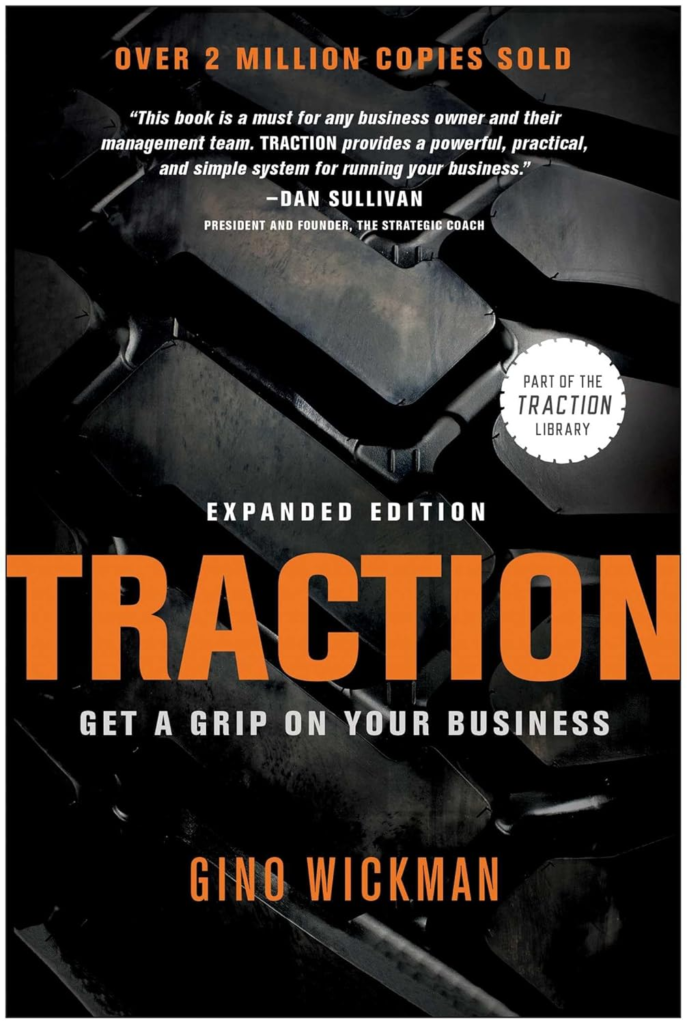
Traction: Get a Grip on Your Business is a business-management book by American entrepreneur and author Gino Wickman. First published in 2007, the book presents the Entrepreneurial Operating System (EOS), a structured management framework intended to help entrepreneurial and small-to-medium-sized businesses improve organizational clarity, accountability, execution, and problem solving. (Simon & Schuster)
Rather than presenting entrepreneurship primarily as a collection of financial or marketing techniques, Wickman treats a company as an integrated operating system. The book argues that many recurring business problems can be understood through six broad areas: Vision, People, Data, Issues, Process, and Traction. (EOS Worldwide)
The book has become the foundational text of the EOS methodology. According to its publisher, more than 2 million copies have been sold. EOS Worldwide currently describes EOS as a framework used by more than 250,000 businesses worldwide, although these figures are claims made by the organization itself rather than independent measures of business performance. (Simon & Schuster)
Bibliographic information
| Field | Details |
|---|---|
| Title | Traction: Get a Grip on Your Business |
| Author | Gino Wickman |
| Subject | Business management, entrepreneurship, leadership, organizational management |
| Original publication | 2007 |
| Publisher | Originally self-published; later editions published by BenBella Books |
| Language | English |
| Pages | Approximately 248 pages in the 2011 edition |
| ISBN | 978-0-9797990-3-1 |
| Central framework | Entrepreneurial Operating System (EOS) |
| Major concepts | Six Key Components, V/TO, Rocks, Scorecard, Issues List, Level 10 Meeting |
Bibliographic records identify the 2011 edition as a 248-page business and entrepreneurship title. (Google Books)
Overview
Traction addresses a problem familiar to many founders: a business can have a good product, capable employees and ambitious plans while still feeling chaotic to the person running it.
Wickman’s central proposition is that entrepreneurial businesses frequently suffer from recurring organizational problems rather than a single catastrophic flaw. These may include unclear priorities, people problems, insufficient accountability, inconsistent processes, unresolved issues and difficulty translating long-term ambitions into weekly action.
The solution proposed in the book is EOS.
EOS is presented as a practical management system rather than an abstract theory of business administration. Its purpose is to establish a common language and operating rhythm within an organization. (Gino Wickman)
The framework is built around six components:
- Vision
- People
- Data
- Issues
- Process
- Traction
The six components are intended to operate together rather than independently.
The EOS model at a glance
                         ┌─────────────┐
                         │    VISION   │
                         │ Where are   │
                         │ we going?   │
                         └──────┬──────┘
                                │
               ┌────────────────┼────────────────┐
               │                │                │
        ┌──────▼──────┐  ┌──────▼──────┐  ┌──────▼──────┐
        │   PEOPLE    │  │    DATA     │  │   ISSUES    │
        │ Who belongs │  │ What do the │  │ What must   │
        │ where?      │  │ numbers say?│  │ be solved?  │
        └──────┬──────┘  └──────┬──────┘  └──────┬──────┘
               │                │                │
               └────────────────┼────────────────┘
                                │
                         ┌──────▼──────┐
                         │   PROCESS   │
                         │ How do we   │
                         │ do things?  │
                         └──────┬──────┘
                                │
                         ┌──────▼──────┐
                         │  TRACTION   │
                         │ How do we   │
                         │ execute?    │
                         └─────────────┘
The official EOS description similarly identifies Vision, People, Data, Issues, Process and Traction as the framework’s six key components. (EOS Worldwide)
Background and development of EOS
Gino Wickman’s interest in business systems developed from his experience working with entrepreneurial companies.
According to the history published by EOS Worldwide, Wickman began developing the system in 2000, initially working with more than 50 clients to refine what he called the Business Accelerator Model & Process. In 2006, the system was renamed the Entrepreneurial Operating System. Wickman and Don Tinney subsequently began developing an implementer network, and Traction was self-published in September 2007. EOS Worldwide was officially launched in 2008. (EOS Worldwide)
The development can be summarized as follows:
| Year | Development |
|---|---|
| 2000 | Wickman begins developing his business-management system |
| 2005 | Don Tinney becomes involved |
| 2006 | The system receives the name Entrepreneurial Operating System |
| 2007 | Traction is published |
| 2008 | EOS Worldwide launches |
| 2012 | Get a Grip is published with Mike Paton |
| 2015 | Wickman publishes Rocket Fuel with Mark C. Winters |
| 2021 | The EOS Life is published |
| 2025–2026 | EOS expands its library around individual components such as Data, People and Issues |
EOS Worldwide’s published history provides these milestones. (EOS Worldwide)
Gino Wickman
Gino Wickman
Gino Wickman is an American entrepreneur, author, speaker and business consultant best known as the creator of the Entrepreneurial Operating System.
EOS Worldwide describes Wickman as a lifelong entrepreneur who took over his family’s business at age 25, helped turn the business around and subsequently sold it. He later devoted his work to helping entrepreneurial companies establish more structured management systems. (EOS Worldwide)
Wickman is the author of several books associated with EOS, including:
- Traction: Get a Grip on Your Business
- Rocket Fuel
- How to Be a Great Boss
- What the Heck Is EOS?
- The EOS Life
His work has therefore developed beyond a single book into a broader body of management literature and an implementation methodology.
The central problem: the entrepreneurial ceiling
One of the book’s important ideas is the entrepreneurial ceiling.
As an organization grows, the informal methods that worked when the company was small may become inadequate.
A founder may initially know:
- every customer,
- every employee,
- every important project,
- every operational problem,
- and almost every financial detail.
As the organization expands, that direct knowledge becomes impossible to maintain.
The company develops more departments, more employees, more customers and more decisions. At this point, the founder may become the central point through which too many decisions have to pass.
Wickman’s framework attempts to replace this dependence on individual memory and intuition with a repeatable organizational system.
The growth problem
SMALL BUSINESS
     │
     ▼
Founder knows almost everything
     │
     ▼
Informal communication works
     │
     ▼
Business grows
     │
     ▼
More people + more decisions + more complexity
     │
     ▼
Old informal system breaks down
     │
     ▼
Confusion / bottlenecks / unresolved issues
     │
     ▼
              EOS
     │
     ▼
Vision + People + Data + Issues
+ Process + Traction
     │
     ▼
More structured execution
This is one reason Traction is particularly focused on entrepreneurial and growing organizations rather than presenting itself as a general textbook of corporate management.
The Six Key Components
1. Vision
The Vision Component concerns organizational direction.
Wickman argues that employees can work extremely hard and still move the organization in different directions if leadership has not established a sufficiently clear vision.
EOS therefore uses a tool called the Vision/Traction Organizer (V/TO).
The V/TO is designed to condense important strategic information into a short document.
It addresses eight broad questions:
- What are our Core Values?
- What is our Core Focus?
- What is our 10-Year Target?
- What is our Marketing Strategy?
- What is our 3-Year Picture?
- What is our 1-Year Plan?
- What are our Quarterly Rocks?
- What are the important Issues?
The official EOS description identifies the V/TO as the principal tool for the Vision Component. (EOS One)
Vision hierarchy
CORE VALUES
     ↓
CORE FOCUS
     ↓
10-YEAR TARGET
     ↓
MARKETING STRATEGY
     ↓
3-YEAR PICTURE
     ↓
1-YEAR PLAN
     ↓
90-DAY ROCKS
     ↓
WEEKLY EXECUTION
The idea is to create a continuous line between the company’s long-term ambition and the work being performed today.
2. People
The second component concerns the organization’s people.
One of the book’s best-known ideas is that organizations need the right people in the right seats.
The concept has two separate dimensions:
Right people
A person should fit the organization’s core values.
Right seats
A person should be appropriately matched to the responsibilities of a particular role.
This distinction is important because an employee may be a good person and a valuable contributor while still being poorly matched to a particular position.
EOS uses tools such as:
- the Accountability Chart
- the People Analyzer
- GWC — Get it, Want it, Capacity
The People Analyzer is intended to help leadership assess whether people demonstrate organizational values, while GWC asks whether an individual:
- gets the role,
- wants the role,
- and has the capacity to perform it.
(EOS One)
A simple representation
                THE RIGHT SEAT
                     ▲
                     │
          ┌──────────┼──────────┐
          │          │          │
       GET IT      WANT IT   CAPACITY
          │          │          │
          └──────────┼──────────┘
                     │
               RIGHT PERSON
The broader management lesson is that organizational structure should not simply reflect the personalities or historical positions of employees. Roles and accountability should be explicit.
3. Data
The Data Component is designed to reduce dependence on subjective impressions.
Wickman advocates using a small number of meaningful measurements to provide leadership with a regular picture of organizational performance.
The principal EOS tool is the Scorecard.
Rather than drowning leadership in hundreds of reports, the idea is to identify a handful of measurable indicators that reveal whether the organization is moving in the desired direction.
Typical metrics might include:
- sales,
- cash flow,
- gross margin,
- customer acquisition,
- customer retention,
- production,
- accounts receivable,
- employee-related metrics.
The exact metrics depend on the organization.
EOS describes the Data Component as reducing the organization to a handful of objective numbers that provide a pulse on the business. (EOS One)
Data principle
Opinions
   ↓
Arguments
   ↓
Different interpretations
   ↓
──────────────
OBJECTIVE DATA
──────────────
   ↓
Common picture
   ↓
Better discussion
   ↓
Decision
The strength of this approach is its simplicity: the scorecard is intended to make important trends visible before they become larger problems.
4. Issues
Businesses inevitably develop problems.
The difficulty, according to Wickman’s framework, is not merely having problems. It is allowing problems to remain unresolved.
EOS therefore introduces an Issues List and an issue-solving process called IDS:
Identify
Define the real problem.
Discuss
Examine the problem without becoming distracted by symptoms.
Solve
Agree on a practical solution and move forward.
The official EOS glossary describes the Issues Component as the discipline of identifying, discussing and solving problems throughout an organization. (EOS Worldwide)
IDS process
              ISSUE
                │
                ▼
           IDENTIFY
                │
                ▼
            DISCUSS
                │
                ▼
              SOLVE
                │
                ▼
          ACTION / OWNER
                │
                ▼
        ISSUE IS RESOLVED
This is deliberately straightforward.
Its underlying assumption is that organizations lose considerable time when people repeatedly discuss the same problem without resolving its underlying cause.
5. Process
The fifth component is Process.
Growing companies often depend heavily on individual employees’ knowledge.
One employee may know how to handle a particular customer problem. Another may know how invoices are processed. A third may understand how new employees are trained.
This creates what might be called organizational memory trapped inside individuals.
Wickman advocates identifying and documenting the company’s core processes so that the organization can operate more consistently.
The objective is not to document every tiny activity.
Instead, the organization identifies its core processes and establishes a consistent way of performing them.
Individual knowledge
        ↓
Documented process
        ↓
Shared organizational knowledge
        ↓
Consistent execution
        ↓
Easier training
        ↓
Greater scalability
EOS describes this as identifying and documenting the core processes that define how the organization operates. (EOS One)
6. Traction
The final component is Traction itself.
This is where vision becomes execution.
A business may have:
- a compelling vision,
- talented employees,
- good data,
- clear processes,
- and a long list of identified problems.
None of these automatically guarantees execution.
The Traction Component therefore introduces discipline and accountability.
Two particularly important EOS concepts are:
- Rocks
- Level 10 Meetings
Rocks
A Rock is a major priority that should be completed within a 90-day period.
Instead of giving an employee or leadership team an enormous annual list, EOS encourages focusing attention on a limited number of important quarterly priorities.
The concept creates a 90-day execution cycle:
             ANNUAL PLAN
                  │
                  ▼
             90-DAY PERIOD
                  │
          ┌───────┴───────┐
          ▼               ▼
       ROCK 1           ROCK 2
          │               │
          └───────┬───────┘
                  ▼
            WEEKLY REVIEW
                  │
                  ▼
              COMPLETION
EOS describes Rocks as the three-to-seven most important priorities for the company and individuals during a 90-day period. (EOS Worldwide)
The important idea is focus.
A company can have 30 things that are important. It cannot give all 30 equal attention.
The Level 10 Meeting
The Level 10 Meeting is one of the most recognizable elements of EOS.
It provides a recurring meeting structure for leadership teams.
The meeting is designed to follow a consistent agenda rather than becoming an informal conversation about whatever problem happens to be most emotionally prominent that week.
A typical EOS meeting rhythm includes:
- Segue
- Scorecard
- Rock review
- Customer and employee headlines
- To-do review
- IDS
- Conclude
The emphasis eventually moves toward IDS, where the leadership team works through the most important issues.
The purpose is to make meetings more predictable and more useful for execution. EOS describes the Level 10 Meeting as part of the weekly rhythm used to maintain accountability and solve issues. (EOS One)
The 90-Day World
One of the practical ideas running throughout Traction is the importance of short execution cycles.
Long-term plans can be inspiring but distant.
A 90-day period is close enough to create urgency while being long enough to accomplish meaningful work.
This creates a repeating cycle:
VISION
   ↓
ANNUAL PLAN
   ↓
90-DAY ROCKS
   ↓
WEEKLY ACCOUNTABILITY
   ↓
MEASUREMENT
   ↓
ISSUE SOLVING
   ↓
RESULTS
   ↓
NEXT 90 DAYS
The model therefore connects strategic planning with operational execution.
How the Six Components fit together
The six components should not be interpreted as six independent management techniques.
Their value, in the EOS model, comes from their interaction.
| Component | Fundamental question | Major EOS tool |
|---|---|---|
| Vision | Where are we going? | V/TO |
| People | Who should do what? | Accountability Chart / People Analyzer |
| Data | What do the numbers tell us? | Scorecard |
| Issues | What problems must be solved? | Issues List / IDS |
| Process | How should work be done? | Core Processes |
| Traction | How will we execute? | Rocks / Level 10 Meeting |
(EOS One)
This produces the central architecture of Traction:
Vision determines direction.
People provide capability.
Data provides visibility.
Issues identifies obstacles.
Process provides consistency.
Traction creates execution.
That relationship is arguably the most important idea in the book.
Major concepts introduced by the book
Vision/Traction Organizer
The V/TO is intended to act as a compact strategic document.
It allows leadership to put major elements of organizational strategy in one place rather than distributing them across separate planning documents.
Accountability Chart
The Accountability Chart clarifies who is accountable for major functions.
It differs from a conventional organizational chart in that its focus is not simply hierarchy but accountability.
The underlying question is:
Who is ultimately accountable for this function?
This can reduce ambiguity when several people contribute to the same activity.
Scorecard
The Scorecard creates a weekly numerical pulse of the business.
Its objective is not to measure everything.
It is to identify the numbers that leadership genuinely needs to see regularly.
Issues List
Instead of allowing problems to remain hidden in email threads, meetings or informal conversations, the Issues List gives them a visible place.
This creates a distinction between:
recognizing a problem
and
solving a problem.
Core Processes
Core processes convert organizational know-how into repeatable systems.
This becomes particularly important as companies grow and new employees join.
Rocks
Rocks transform broad annual goals into a limited set of quarterly priorities.
They provide a mechanism for saying:
These are the things that matter most right now.
Level 10 Meetings
The Level 10 Meeting establishes a recurring management rhythm.
The underlying philosophy is that effective management depends not only on having good ideas but on creating a structure in which those ideas are repeatedly executed and reviewed.
A visual summary of EOS


EOS operating cycle
             ┌─────────────────┐
             │     VISION      │
             │ Long-term       │
             │ direction       │
             └────────┬────────┘
                      │
                      ▼
             ┌─────────────────┐
             │     PEOPLE      │
             │ Right people    │
             │ / right seats   │
             └────────┬────────┘
                      │
                      ▼
             ┌─────────────────┐
             │      DATA       │
             │ Measurable      │
             │ performance     │
             └────────┬────────┘
                      │
                      ▼
             ┌─────────────────┐
             │     ISSUES      │
             │ Identify →      │
             │ Discuss → Solve │
             └────────┬────────┘
                      │
                      ▼
             ┌─────────────────┐
             │    PROCESS      │
             │ Repeatable      │
             │ systems         │
             └────────┬────────┘
                      │
                      ▼
             ┌─────────────────┐
             │    TRACTION     │
             │ Rocks +         │
             │ accountability  │
             └────────┬────────┘
                      │
                      ▼
                 EXECUTION
                      │
                      └──────────────► Review & repeat
The structure of the book
The book’s chapters follow the six components and then bring them together into an implementation journey.
The published table of contents includes sections on the Entrepreneurial Operating System, Vision, People, Data, Issues, Process and Traction, followed by chapters on pulling everything together and getting started. (Moraine Park Online Bookstore)
A simplified structure is:
Part I — Understanding EOS
The book introduces the EOS model and explains why an operating system may be necessary for an entrepreneurial company.
Part II — Vision
The reader learns how to establish organizational direction and answer the eight strategic questions.
Part III — People
The focus shifts to organizational structure, accountability and matching people with roles.
Part IV — Data
The book introduces measurement and the Scorecard.
Part V — Issues
The reader learns how to identify and solve organizational problems.
Part VI — Process
The book discusses documenting and consistently following core business processes.
Part VII — Traction
The focus turns toward execution through Rocks and meeting discipline.
Part VIII — Implementation
The final portion explains how the components can be integrated into a functioning management system.
What makes Traction different from conventional business books?
A large number of business books concentrate primarily on one dimension:
- strategy,
- leadership,
- marketing,
- finance,
- productivity,
- innovation,
- sales,
- or organizational psychology.
Traction takes a different approach.
Its central concern is the operating system connecting these activities.
The book does not claim that a business needs a revolutionary strategy every quarter. Instead, it emphasizes clarity, consistency, measurement, accountability and disciplined execution.
This makes Traction closer to an operating manual for management than a conventional inspirational business book.
The philosophy behind the system
At its heart, EOS is built around a relatively simple proposition:
A company becomes easier to manage when important organizational functions are made explicit.
Instead of relying on:
- memory,
- informal communication,
- personality,
- intuition,
- endless meetings,
- undocumented procedures,
- and constantly changing priorities,
EOS attempts to replace those mechanisms with:
- documented vision,
- defined accountability,
- measurable numbers,
- visible issues,
- documented processes,
- quarterly priorities,
- and recurring meetings.
That simplicity is one of the reasons the framework has proved easy to explain.
It also explains a potential weakness: organizations with unusual structures, highly complex regulatory environments, or very different management philosophies may need to adapt rather than mechanically reproduce every EOS practice.
Criticism and limitations
A Wikipedia-like treatment should distinguish the author’s framework from independently established evidence.
EOS Worldwide describes EOS as a proven framework and reports substantial adoption. Its current website states that EOS has been used by more than 250,000 businesses worldwide. (Gino Wickman)
However, adoption is not the same thing as independent proof of causal effectiveness.
Several practical limitations can be identified when examining the framework:
1. It depends heavily on leadership commitment
EOS cannot compensate for leaders who refuse to establish accountability or consistently follow the agreed management rhythm.
2. Simplification can become oversimplification
Reducing organizational complexity to six components is useful as a management heuristic, but real organizations also involve legal, financial, cultural, technological, competitive and geopolitical variables.
3. Implementation requires discipline
The tools themselves are relatively simple.
The harder task is using them consistently.
A Scorecard that is never reviewed, Rocks that are constantly changed, or meetings that routinely ignore the agreed agenda will not produce the intended management discipline.
4. One operating framework does not fit every organization
A rapidly changing startup, a professional partnership, a manufacturing company, a nonprofit organization and a large multinational corporation may have substantially different organizational requirements.
EOS is primarily designed around entrepreneurial organizations and therefore should be evaluated in that context.
5. The evidence base should be distinguished from testimonials
EOS materials contain numerous accounts from companies and leaders who report positive experiences. Such testimonials can illustrate how users perceive the framework, but they should not automatically be interpreted as independent experimental evidence of EOS’s causal impact.
This distinction is important when evaluating business methodologies objectively.
Reception and influence
Traction has developed a substantial following among entrepreneurs, founders and business leaders.
Its influence extends beyond the book itself because EOS developed into an implementation ecosystem involving professional implementers, training materials, software and additional books.
EOS Worldwide’s history records the creation of an implementer community beginning in the 2000s and subsequent expansion of the EOS book library. (EOS Worldwide)
The publisher currently states that more than 2 million copies of Traction have been sold. (Simon & Schuster)
EOS Worldwide also describes the book as the foundational EOS playbook. (EOS Worldwide)
Traction and the broader EOS library
Traction became the foundation for a larger collection of books.
Among the later EOS-related titles are:
- Get a Grip — Gino Wickman and Mike Paton
- Rocket Fuel — Gino Wickman and Mark C. Winters
- How to Be a Great Boss
- What the Heck Is EOS?
- The EOS Life
- Process!
- People
- Data
- Issues
The later books expand particular aspects of the EOS system or explain it for different audiences. (EOS Worldwide)
Relationship with Get a Grip
An important companion to Traction is Get a Grip.
Where Traction primarily presents the EOS concepts and tools, Get a Grip uses an entrepreneurial-business fable to demonstrate how EOS can be implemented in a fictional organization.
EOS Worldwide describes Get a Grip as an entrepreneurial fable involving Swan Services and the implementation of EOS. (EOS Worldwide)
Consequently:
Traction → explains the system
Get a Grip → illustrates the system in action
Who should read Traction?
The book is particularly relevant to:
- entrepreneurs,
- business owners,
- CEOs,
- founders,
- managing directors,
- leadership teams,
- operations managers,
- department heads,
- and managers of growing companies.
It is especially relevant when a business has reached the point where the founder can no longer personally coordinate every important decision.
Who may find it less useful?
The framework may be less directly applicable to:
- individuals running very small solo businesses,
- organizations with highly fluid project structures,
- businesses that already have mature operating systems,
- organizations whose management philosophy strongly conflicts with EOS principles,
- or readers looking for detailed technical guidance on finance, marketing, product development or industry-specific operations.
In such cases, Traction can still provide useful concepts, but it should not necessarily be treated as a complete management system for every situation.
Key lessons from Traction
The most transferable lessons from the book can be summarized as follows.
1. Vision must be explicit
A vision that exists only in the founder’s head is difficult for an organization to execute.
2. Accountability should be clear
People need to understand not only what they do but what they ultimately own.
3. Measure what matters
A small number of meaningful metrics can be more useful than an overwhelming volume of data.
4. Problems should become visible
An organization cannot solve issues that people are afraid or unable to identify.
5. Solve root problems
Repeatedly discussing symptoms is not the same as solving the underlying issue.
6. Systems reduce dependence on individuals
Documented processes help preserve organizational knowledge.
7. Priorities need limits
Too many simultaneous priorities often mean that nothing receives sufficient attention.
8. Execution requires rhythm
Annual strategy becomes meaningful when converted into shorter cycles of action and accountability.
9. Meetings need purpose
A meeting should produce decisions, actions or problem resolution rather than merely conversation.
10. Simplicity is a management advantage
The book repeatedly attempts to make business management easier to understand by reducing organizational complexity into a manageable framework.
One-page infographic: The Traction philosophy


                         TRACTION
                  Get a Grip on Your Business
                              │
         ┌────────────────────┼────────────────────┐
         │                    │                    │
       VISION               PEOPLE                DATA
         │                    │                    │
   Where are we?        Who does what?       What do numbers
                                                tell us?
         │                    │                    │
         └────────────────────┼────────────────────┘
                              │
                            ISSUES
                              │
                    What must be solved?
                              │
                            PROCESS
                              │
                    How should work happen?
                              │
                           TRACTION
                              │
                  How do we execute?
                              │
                  ┌───────────┴───────────┐
                  │                       │
                ROCKS              LEVEL 10
                  │                 MEETINGS
                  └───────────┬───────────┘
                              │
                         ACCOUNTABILITY
                              │
                           RESULTS
Practical example
Imagine a fictional company called GreenLeaf Manufacturing.
The founders want to double revenue within five years, but employees disagree about priorities.
Using the EOS framework, leadership might establish:
Vision
A five-year growth target and a clearly defined market focus.
People
An accountability structure defining responsibility for sales, production, finance and operations.
Data
A weekly Scorecard containing sales, production, receivables and profitability indicators.
Issues
A visible list of recurring problems, such as delayed production or slow collections.
Process
Documented sales, purchasing, production and customer-service procedures.
Traction
Three or four major quarterly Rocks assigned to specific owners.
The important point is that none of these tools is revolutionary by itself.
The potential value comes from connecting them into one management rhythm.
Why the book remains relevant
The fundamental problem addressed by Traction has not disappeared with technological change.
Businesses still face:
- unclear priorities,
- communication failures,
- accountability gaps,
- excessive meetings,
- unresolved problems,
- inconsistent processes,
- leadership bottlenecks,
- and difficulty converting strategy into execution.
Technology can provide dashboards, project-management software and communication platforms, but technology does not automatically create organizational clarity.
In that sense, Traction is less about a particular piece of software and more about management discipline.
Influence of the book’s terminology
One of the notable characteristics of Traction is the terminology it introduced or popularized within the EOS community.
Terms such as:
- Rocks
- Level 10 Meeting
- V/TO
- right people, right seats
- Scorecard
- Accountability Chart
- IDS
form a common vocabulary among organizations using EOS.
The official EOS glossary now contains canonical definitions for these and other EOS terms. (EOS Worldwide)
This shared vocabulary is itself part of the system’s intended function: if everyone uses the same terminology, leadership conversations can become more concise.
Comparison with traditional strategic planning
| Traditional approach | EOS-oriented approach |
|---|---|
| Long strategic documents | Compact V/TO |
| Many goals | Limited quarterly Rocks |
| Large reporting systems | Small Scorecard |
| Informal problem discussions | Issues List + IDS |
| Employee-dependent knowledge | Documented processes |
| Irregular management meetings | Consistent meeting rhythm |
| Annual review emphasis | 90-day execution cycles |
| Broad responsibility | Explicit accountability |
This is not necessarily a claim that one approach universally replaces the other. Rather, it illustrates the distinctive management philosophy of Traction.
The central message of the book
The deepest message of Traction can be reduced to a simple chain:
CLARITY
   ↓
ALIGNMENT
   ↓
ACCOUNTABILITY
   ↓
FOCUS
   ↓
EXECUTION
   ↓
TRACTION
Wickman’s argument is essentially that entrepreneurs do not necessarily need more ideas.
They often need a system that makes existing priorities visible, assigns ownership, measures progress and forces unresolved problems to be confronted.
That is the conceptual foundation on which EOS is built.
Legacy
Traction occupies an important place in the development of the EOS business methodology.
Originally published in 2007, it became the foundational text for a system that subsequently developed into a broader organization, implementer network, educational library and software ecosystem. EOS Worldwide’s own history traces the system’s development from Wickman’s early work in 2000 through the publication of Traction, the creation of EOS Worldwide, and the later expansion of the EOS library. (EOS Worldwide)
The book’s lasting appeal lies less in a single novel management theory than in its attempt to answer a practical question:
How can a growing entrepreneurial company turn a founder’s vision into a repeatable organizational system?
Its answer is EOS: strengthen Vision, People, Data, Issues, Process and Traction, then establish a recurring rhythm for turning those elements into action.
Author
Gino Wickman
Gino Wickman is an entrepreneur, author and creator of the Entrepreneurial Operating System (EOS). He developed the framework through years of work with entrepreneurial companies and subsequently founded EOS Worldwide with Don Tinney. He is the author of Traction and several subsequent books addressing entrepreneurship, leadership and EOS. (EOS Worldwide)
Wickman’s other major works include Rocket Fuel, How to Be a Great Boss, What the Heck Is EOS? and The EOS Life. (EOS Worldwide)
References
- Wickman, Gino. Traction: Get a Grip on Your Business. EOS / BenBella Books. Bibliographic information and publication details are available through Google Books and the publisher. (Google Books)
- EOS Worldwide. Traction: Get a Grip on Your Business. Official book description and author information. (EOS Worldwide)
- EOS Worldwide. EOS History & Team. Historical timeline of the development of EOS and EOS Worldwide. (EOS Worldwide)
- EOS Worldwide. EOS Glossary. Definitions of the EOS framework and its Six Key Components. (EOS Worldwide)
- EOS Worldwide. The Traction Component. Explanation of Rocks, accountability and the 90-day execution rhythm. (EOS Worldwide)
- EOS One. Traction Book Summary. Overview of the Six Key Components and EOS tools. (EOS One)
- Simon & Schuster. Traction: Get a Grip on Your Business — official publisher/distributor page. (Simon & Schuster)
Further reading
- Get a Grip — Gino Wickman and Mike Paton
- Rocket Fuel — Gino Wickman and Mark C. Winters
- How to Be a Great Boss — Gino Wickman
- What the Heck Is EOS? — Gino Wickman and Tom Bouwer
- The EOS Life — Gino Wickman
- Process! — Mike Paton and Lisa González
- People — Mark O’Donnell, Kelly Knight and CJ Dube’
- Data — Angela Kalemis, Mark O’Donnell and Mark Stanley
- Issues — Jill Young, Mark O’Donnell and Sue Hawkes (EOS Worldwide)
See also
- Entrepreneurship
- Business management
- Organizational structure
- Strategic planning
- Business process management
- Leadership
- Performance measurement
- Management systems
- Organizational accountability
- Rocket Fuel
- Get a Grip
- Entrepreneurial Operating System
External links
Official Traction book page — EOS Worldwide
Gino Wickman’s official website
Publisher page — Simon & Schuster
Editorial note
Unlike a conventional book-summary article, this article treats Traction as a business-management work and the origin point of EOS, separating Wickman’s framework and EOS Worldwide’s claims about adoption from independently verifiable bibliographic facts. That distinction is important for a reference-style encyclopedia: the article can explain what EOS claims to do without presenting those claims as independently established scientific conclusions.