



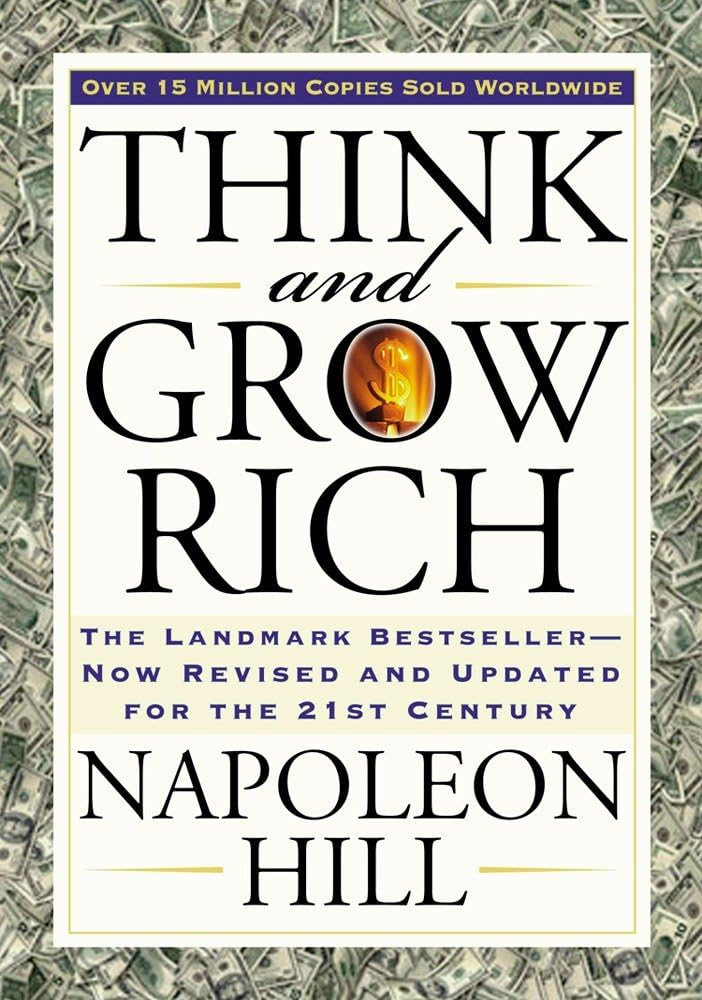
Think and Grow Rich is a personal-development and success book by Napoleon Hill, first published in March 1937. It is one of the most influential works in the early modern self-help and personal-success genre and is particularly associated with ideas such as definiteness of purpose, desire, faith, autosuggestion, specialized knowledge, imagination, organized planning, decision, persistence, the Master Mind, and personal achievement.
Hill presents the book as the result of many years of studying successful people. The book draws on stories involving prominent American industrialists, entrepreneurs, inventors, and business figures, including Andrew Carnegie, Thomas Edison, Henry Ford, and others. The Napoleon Hill Foundation describes the book as a summary of Hill’s philosophy of success and identifies the original 1937 edition as the version it recommends for readers seeking the original text.
Unlike a conventional investment or business textbook, Think and Grow Rich is primarily concerned with the mental and behavioral conditions that Hill believed precede achievement.
Its central proposition can be expressed simply:
A clearly defined desire, combined with belief, planning, persistent action, and organized cooperation, can transform an idea into achievement.
The word “think” in the title is therefore important. Hill was not merely advocating positive thinking. His larger argument was that thoughts become useful when they are converted into definite goals, plans, decisions, persistence, and action.
Book information
| Field | Details |
|---|---|
| Title | Think and Grow Rich |
| Author | Napoleon Hill |
| First published | March 1937 |
| Original language | English |
| Country | United States |
| Genre | Personal development, self-help, success literature |
| Primary subjects | Achievement, wealth, motivation, goal setting, leadership |
| Major concepts | Desire, faith, autosuggestion, specialized knowledge, imagination, planning, decision, persistence, Master Mind |
| Original edition | 1937 |
| Major later edition | 1960 edited edition and numerous later editions |
| Associated organization | Napoleon Hill Foundation |
| Historical setting | United States, Great Depression era |
| Author’s lifespan | 1883–1970 |
The Napoleon Hill Foundation states that the first edition was printed in March 1937 and describes its current 1937 edition as a reproduction of Hill’s personal copy of the first edition.
Overview
Think and Grow Rich is built around a sequence of principles that Hill presents as a philosophy of achievement.
The book does not begin with investment strategies, accounting, or technical business methods.
Instead, it begins with a question about desire.
Hill argues that major achievements generally begin as ideas, ambitions, or clearly defined purposes before they become physical results.
The basic progression is:
THOUGHT
   ↓
DESIRE
   ↓
DEFINITENESS OF PURPOSE
   ↓
FAITH
   ↓
PLAN
   ↓
ACTION
   ↓
PERSISTENCE
   ↓
ACHIEVEMENT
This diagram is an editorial representation of the book’s overall logic rather than a quotation from Hill.
The book’s fourteen main chapters in the original structure move through the major principles and conclude with a discussion of overcoming the “six ghosts of fear.” Bibliographic records and reproductions of the original table of contents confirm the sequence of the chapters.
The central idea: thought must become action
The title can easily be misunderstood.
Think and Grow Rich is sometimes reduced to the idea that simply thinking about wealth will cause wealth to appear.
That is not an adequate description of the book.
Hill repeatedly connects thought with:
- desire
- decision
- planning
- specialized knowledge
- organized effort
- persistence
- cooperation
- action
A more accurate representation is:
       THINK
         ↓
     DEFINE
         ↓
       PLAN
         ↓
       ACT
         ↓
     PERSIST
         ↓
       LEARN
         ↓
      ADAPT
         ↓
      ACHIEVE
This distinction matters.
The book is best understood as a philosophy of purposeful achievement, expressed through the language of its era.
The thirteen principles of Think and Grow Rich
Hill organizes the core philosophy into thirteen principles, which he presents as steps toward riches and achievement.
They are:
- Desire
- Faith
- Autosuggestion
- Specialized Knowledge
- Imagination
- Organized Planning
- Decision
- Persistence
- The Power of the Master Mind
- Sex Transmutation
- The Subconscious Mind
- The Brain
- The Sixth Sense
A final chapter addresses the six ghosts of fear.
The thirteen-principle framework
                 ACHIEVEMENT
                     ▲
                     │
              ┌──────┴──────┐
              │             │
          INNER DRIVE     OUTER ACTION
              │             │
       Desire + Faith     Planning
       Autosuggestion     Decision
       Imagination        Persistence
       Subconscious       Master Mind
              │             │
              └──────┬──────┘
                     │
              SPECIALIZED
                KNOWLEDGE
                     │
                     ▼
                ACHIEVEMENT
The original table of contents identifies the thirteen major principles and the final chapter on fear.
1. Desire
The starting point of all achievement
Hill begins with Desire.
But he does not use desire merely to mean wanting something.
His concept is closer to a definite, emotionally charged objective.
A vague wish:
“I want to be successful.”
is fundamentally different from a specific objective:
“I want to achieve a clearly defined result, and I am prepared to organize my effort around it.”
Hill’s philosophy therefore starts by converting a wish into a definite purpose.
Desire as a starting mechanism
The progression can be represented as:
WISH
 ↓
CLEAR DESIRE
 ↓
DEFINITE PURPOSE
 ↓
PLAN
 ↓
ACTION
The strength of Hill’s argument lies less in the mystical language surrounding desire and more in the practical observation that unclear goals produce unclear action.
The six steps for turning desire into reality
One of the most practical sections of the book is Hill’s formula for turning desire into a definite objective.
The process can be summarized as:
1. Define exactly what you want.
            ↓
2. Decide what you will give in return.
            ↓
3. Establish a definite date.
            ↓
4. Create a definite plan.
            ↓
5. Write the objective clearly.
            ↓
6. Read and reinforce it regularly.
The purpose is to transform a general ambition into something that can guide daily decisions.
Desire versus fantasy
An important distinction can be drawn between desire and fantasy.
Fantasy stops at imagining the desired outcome.
Hill’s model continues:
DESIRE
  +
PLAN
  +
EFFORT
  +
PERSISTENCE
  =
PROGRESS
This is one of the more practical ways to interpret the book for a modern reader.
2. Faith
Visualization of and belief in attainment
The second principle is Faith.
Hill defines faith as belief in the attainment of one’s desire.
He places considerable importance on cultivating confidence in the possibility of achieving a goal.
The mechanism he describes is:
REPEATED THOUGHT
       ↓
EMOTIONAL ACCEPTANCE
       ↓
BELIEF
       ↓
CONFIDENT ACTION
Modern readers may interpret this idea psychologically rather than literally.
Belief in one’s ability to succeed can influence:
- motivation
- persistence
- willingness to take action
- response to setbacks
- attention to opportunities
However, belief by itself does not guarantee an external outcome.
Visualization
Hill frequently encourages readers to form a vivid mental picture of the desired result.
Visualization can serve several practical purposes:
- clarifying an objective
- maintaining motivation
- reinforcing attention
- making a goal emotionally meaningful
- encouraging consistent action
It is important, however, not to confuse visualization with a scientifically established mechanism by which thoughts automatically cause external events.
That stronger interpretation goes beyond what modern evidence can establish.
3. Autosuggestion
Influencing the subconscious mind
The third principle is Autosuggestion.
Hill uses the term to describe deliberate repetition of thoughts and statements intended to influence one’s subconscious patterns.
The basic mechanism is presented as:
REPETITION
    ↓
THOUGHT
    ↓
EMOTION
    ↓
BELIEF
    ↓
BEHAVIOR
Hill believed that repeated thoughts could influence the subconscious mind and therefore behavior.
The modern reader can interpret this more conservatively as a form of self-directed mental conditioning, although Hill’s own explanation is broader and sometimes metaphysical.
Affirmations and autosuggestion
The book’s approach resembles what contemporary readers often call:
- affirmations
- self-talk
- visualization
- mental rehearsal
The practical question is whether the repeated statement changes behavior.
For example:
“I am going to become successful”
is less actionable than:
“I will develop one valuable skill, practice it consistently, and use it to create measurable opportunities.”
The second formulation connects belief with behavior.
4. Specialized Knowledge
Knowledge must become useful
Hill distinguishes between general knowledge and specialized knowledge.
His argument is not that general education is worthless.
Rather, he suggests that achievement often depends on knowledge that can be organized and applied toward a definite purpose.
Examples might include:
- engineering knowledge
- accounting
- sales
- medicine
- marketing
- programming
- law
- management
- finance
The principle can be represented as:
KNOWLEDGE
    ↓
SPECIALIZATION
    ↓
APPLICATION
    ↓
VALUE
    ↓
RESULT
Knowledge is not enough
A person can possess enormous amounts of information without producing meaningful results.
Hill’s framework emphasizes the conversion of knowledge into action.
INFORMATION
     ↓
UNDERSTANDING
     ↓
SPECIALIZED SKILL
     ↓
APPLICATION
     ↓
VALUE CREATION
This is one of the book’s most durable ideas because it remains relevant in an economy where information itself is increasingly abundant.
5. Imagination
The workshop of the mind
Hill describes Imagination as the workshop in which ideas are created.
He distinguishes between two broad forms:
Synthetic imagination
Combining existing ideas, knowledge, and experience in new ways.
Creative imagination
The more intuitive or inspirational form through which new ideas are believed to emerge.
A useful modern interpretation is:
EXISTING KNOWLEDGE
       +
EXPERIENCE
       +
CURIOSITY
       ↓
IMAGINATION
       ↓
NEW IDEA
       ↓
EXPERIMENT
       ↓
POSSIBLE VALUE
The first part of this model is easily recognizable in modern innovation and entrepreneurship.
Hill’s broader claims about creative imagination entering through a quasi-intuitive or metaphysical process belong more specifically to his philosophical worldview.
Ideas as economic assets
One of Hill’s recurring themes is that wealth often begins with an idea.
Examples include:
- a new product
- a new service
- a better process
- a new business model
- a new distribution method
- a new way of solving an existing problem
The important transition is:
Idea → organized execution → value
An idea without execution remains an idea.
6. Organized Planning
The crystallization of desire into action
Desire becomes useful only when converted into a plan.
Hill therefore devotes considerable attention to organized planning.
A practical interpretation is:
GOAL
 ↓
CURRENT POSITION
 ↓
RESOURCES
 ↓
STRATEGY
 ↓
TASKS
 ↓
TIMELINE
 ↓
EXECUTION
 ↓
REVIEW
Planning gives desire a structure.
The importance of a team
Hill does not suggest that every achievement must be accomplished alone.
He repeatedly emphasizes the importance of obtaining:
- knowledge
- advice
- expertise
- cooperation
- specialized skills
This naturally leads into the concept of the Master Mind.
7. Decision
The mastery of procrastination
Hill’s seventh principle is Decision.
He associates successful people with the ability to make decisions firmly and avoid unnecessary delay.
The opposite behavior is indecision:
OPTION
 ↓
DOUBT
 ↓
MORE DOUBT
 ↓
DELAY
 ↓
MISSED OPPORTUNITY
Hill’s alternative is:
INFORMATION
 ↓
JUDGMENT
 ↓
DECISION
 ↓
ACTION
 ↓
FEEDBACK
 ↓
ADJUSTMENT
The second model is closer to how decision-making works in complex real-world environments: decisions are made, evidence accumulates, and plans can be adjusted.
Decision does not mean stubbornness
An important modern interpretation is that decisiveness should not mean refusing to change one’s mind.
There is a difference between:
indecision
and
evidence-based revision.
A strong decision-maker can commit to a course of action while remaining willing to change it when new evidence demonstrates that the original assumption was wrong.
8. Persistence
Sustained effort
Hill’s eighth principle is Persistence.
Persistence is the ability to continue working toward a meaningful objective despite:
- setbacks
- rejection
- criticism
- temporary failure
- uncertainty
- slow progress
The principle can be illustrated as:
GOAL
 ↓
ACTION
 ↓
SETBACK
 ↓
LEARNING
 ↓
ADJUSTMENT
 ↓
ACTION
 ↓
SETBACK
 ↓
PERSISTENCE
 ↓
PROGRESS
The important word here is progress.
Persistence should not mean repeating exactly the same failed strategy forever.
Effective persistence combines endurance with learning.
Persistence versus blind stubbornness
This distinction is especially important when reading a book written in the 1930s.
Persistence is useful when:
- the goal remains worthwhile
- evidence supports continued effort
- the strategy can be improved
- resources are available
- risks remain acceptable
Persistence becomes counterproductive when it turns into an unwillingness to recognize reality.
9. The Power of the Master Mind
Collective intelligence and cooperation
The Master Mind is one of Hill’s most famous concepts.
He describes it as a coordinated group of people who combine their knowledge, experience, and efforts toward a definite purpose.
A modern interpretation might resemble:
- advisory groups
- entrepreneurial teams
- professional networks
- peer groups
- mentors
- mastermind groups
- collaborative problem-solving teams
The basic model is:
PERSON A
   +
PERSON B
   +
PERSON C
   +
SPECIALIZED KNOWLEDGE
   ↓
COLLECTIVE INTELLIGENCE
   ↓
BETTER IDEAS
   ↓
GREATER CAPACITY
Hill also gave the Master Mind a more spiritual or energetic interpretation. That aspect belongs to the historical philosophy of the book rather than to an established scientific theory.
Why the Master Mind idea remains relevant
The underlying practical observation is straightforward:
No individual knows everything.
A capable team can combine:
- technical knowledge
- business experience
- creativity
- financial judgment
- social skills
- market knowledge
This idea has obvious relevance to modern entrepreneurship.
10. Sex Transmutation
A controversial chapter
One of the most unusual chapters in Think and Grow Rich is “The Mystery of Sex Transmutation.”
Hill argues that sexual energy can be redirected or “transmuted” into forms of creative and productive energy.
The chapter reflects the psychological and cultural language of the period in which the book was written.
Hill associates sexual energy with:
- enthusiasm
- creativity
- ambition
- persistence
- charisma
- achievement
Modern readers should treat this section as part of Hill’s personal philosophy, not as a scientifically established law of human motivation.
11. The Subconscious Mind
Hill’s eleventh principle concerns the subconscious mind.
He argues that repeated thoughts and emotional patterns can influence the subconscious and therefore behavior.
The model is:
REPEATED THOUGHT
       ↓
EMOTION
       ↓
MENTAL HABIT
       ↓
BEHAVIOR
       ↓
RESULT
Modern psychology recognizes that habits, expectations, attention, learning, and automatic processes can influence behavior.
However, Hill’s specific claims about the subconscious should not be treated as equivalent to modern scientific models of cognition.
12. The Brain
A broadcasting and receiving station for thought
Hill’s chapter on The Brain uses a striking metaphor.
He describes the brain as a kind of broadcasting and receiving station for thought.
This language reflects Hill’s philosophical and quasi-metaphysical worldview.
A modern interpretation can be made more cautiously:
BRAIN
 ↓
PROCESS INFORMATION
 ↓
GENERATE IDEAS
 ↓
INTERPRET EXPERIENCE
 ↓
GUIDE BEHAVIOR
The metaphor is memorable, but the stronger claim that the brain literally broadcasts thoughts into an external universal system should be regarded as a philosophical belief rather than established neuroscience.
13. The Sixth Sense
The door to the temple of wisdom
The thirteenth principle is the Sixth Sense.
Hill presents it as a higher form of intuition that can help a person recognize opportunities, possibilities, or solutions.
The chapter is closely connected with Hill’s ideas about:
- intuition
- imagination
- subconscious processing
- inspiration
- “Infinite Intelligence”
The concept can be interpreted in two different ways.
Philosophical interpretation
A mysterious or spiritual source of insight.
Psychological interpretation
The human capacity to recognize patterns and make intuitive judgments based on accumulated experience.
The second interpretation is compatible with modern discussions of intuition, although it should not be treated as a complete explanation of Hill’s original concept.
The Six Ghosts of Fear
The final major section of the book examines fear.
Hill identifies six major fears:
- Fear of poverty
- Fear of criticism
- Fear of ill health
- Fear of loss of love
- Fear of old age
- Fear of death
He argues that fear can interfere with decision-making, ambition, persistence, and action.
The framework can be summarized as:
FEAR
 ↓
DOUBT
 ↓
INDECISION
 ↓
INACTION
 ↓
MISSED OPPORTUNITY
The alternative is:
FEAR
 ↓
RECOGNIZE IT
 ↓
ANALYZE IT
 ↓
MAKE A DECISION
 ↓
TAKE RESPONSIBLE ACTION
This is arguably one of the most psychologically accessible sections of the book for a modern reader.
The complete Think and Grow Rich formula
The book can be compressed into a single conceptual chain:
                 DEFINITE DESIRE
                        ↓
                      FAITH
                        ↓
                  AUTOSUGGESTION
                        ↓
             SPECIALIZED KNOWLEDGE
                        ↓
                   IMAGINATION
                        ↓
               ORGANIZED PLANNING
                        ↓
                    DECISION
                        ↓
                  PERSISTENCE
                        ↓
                 MASTER MIND
                        ↓
              SUBCONSCIOUS MIND
                        ↓
                     BRAIN
                        ↓
                  SIXTH SENSE
                        ↓
                   ACHIEVEMENT
This is an interpretive diagram based on Hill’s sequence of principles.
The role of Andrew Carnegie
Andrew Carnegie occupies a central position in Hill’s account of how his philosophy developed.
Hill claimed that Carnegie encouraged him to study successful people and identify common principles behind their achievements.
According to Hill’s narrative, this assignment eventually contributed to the research program from which his philosophy developed.
The Carnegie story became a foundational part of Hill’s personal mythology and publishing narrative.
However, modern readers should distinguish between:
Hill’s account of his relationship with Carnegie
and
historically independently verified details of that relationship.
The story is important for understanding Hill’s philosophy, but it should not automatically be treated as documentary proof of every claim made in the narrative.
The “Law of Success” connection
Think and Grow Rich did not emerge in isolation.
It followed Hill’s earlier work, particularly The Law of Success.
Hill’s earlier philosophy was considerably longer and more detailed.
Think and Grow Rich condensed and popularized many of those ideas for a broad audience.
The Napoleon Hill Foundation describes Think and Grow Rich as a concise presentation of the philosophy developed through Hill’s earlier work.
The relationship between thought and achievement
The book’s philosophy is sometimes summarized as:
“Thoughts become things.”
That phrase captures part of the popular interpretation of Hill, but it can oversimplify the book.
A closer representation of Hill’s actual framework is:
THOUGHT
   +
DESIRE
   +
BELIEF
   +
KNOWLEDGE
   +
PLAN
   +
ACTION
   +
PERSISTENCE
   +
COOPERATION
   ↓
ACHIEVEMENT
This is an important distinction.
The book does not merely celebrate passive optimism.
It repeatedly emphasizes organized effort.
Desire, purpose and action
One of the book’s strongest practical themes is the conversion of vague ambition into a definite purpose.
Compare:
Vague
“I want to become successful.”
with:
Definite
“I want to achieve a specific measurable objective by a defined date, and I will develop a concrete plan and provide the necessary effort to pursue it.”
The second statement creates something that can actually be planned.
This is where Hill’s philosophy intersects with modern goal-setting practices.
The psychology of persistence
Persistence is closely connected to emotional commitment.
Hill argues that people are more likely to persist when the objective matters deeply to them.
The model can be expressed as:
IMPORTANT GOAL
      ↓
EMOTIONAL COMMITMENT
      ↓
MOTIVATION
      ↓
EFFORT
      ↓
FEEDBACK
      ↓
ADAPTATION
      ↓
PERSISTENCE
A weakly held goal can disappear when the first obstacle arrives.
A meaningful goal has a stronger chance of surviving setbacks.
Financial wealth versus broader riches
Despite its title, Hill’s conception of “riches” is broader than money alone.
The Foundation’s own description of the book points toward wealth that can include relationships, family, business associations, harmony, and peace of mind in addition to material wealth.
This broader conception is important.
The book can therefore be read as being about:
- financial wealth
- achievement
- personal development
- leadership
- relationships
- purpose
- confidence
- contribution
rather than simply becoming wealthy.
The book’s view of success
Hill’s concept of success is built around several interacting dimensions.
             SUCCESS
                │
     ┌──────────┼──────────┐
     │          │          │
   PURPOSE    ACTION    PERSISTENCE
     │          │          │
     └──────────┼──────────┘
                │
          COOPERATION
                │
             LEARNING
                │
                ▼
            ACHIEVEMENT
This is a broader model than simply measuring success by income.
Human relationships and achievement
The Master Mind principle demonstrates that Hill did not view achievement as entirely individual.
He repeatedly emphasizes:
- cooperation
- alliances
- advice
- specialized expertise
- leadership
- relationships
This creates a useful counterpoint to the book’s emphasis on individual desire.
The philosophy is simultaneously:
“Know what you want.”
and
“Recognize that you may need other people to achieve it.”
Specialized knowledge in the modern economy
Hill’s distinction between general and specialized knowledge is particularly relevant in the modern digital economy.
A person today can acquire general information almost instantly.
The competitive advantage often comes from:
- deep expertise
- ability to solve difficult problems
- domain knowledge
- communication
- judgment
- execution
- combining multiple fields
The principle can therefore be updated without changing its basic logic:
GENERAL KNOWLEDGE
        ↓
   SPECIALIZATION
        ↓
     PRACTICE
        ↓
      SKILL
        ↓
   APPLICATION
        ↓
      VALUE
Imagination and entrepreneurship
Hill treats imagination as the source of new possibilities.
Entrepreneurship often requires exactly this process:
- identify a problem
- imagine a solution
- test the idea
- learn from the market
- improve the product
- create value
In that sense, Hill’s emphasis on imagination can be read as an early popular formulation of a principle now familiar in entrepreneurship:
New value often begins with seeing a possibility that does not yet exist in its finished form.
Decision-making and procrastination
Hill regards indecision as a major obstacle.
Procrastination often appears in subtle forms:
- endless research
- waiting for perfect conditions
- repeatedly changing goals
- asking for everyone’s approval
- fearing criticism
- avoiding commitment
His solution is not reckless action.
It is definite decision followed by organized action.
A modern interpretation would add an important qualification:
Make decisions with the best available information, then update them when meaningful new evidence appears.
Persistence and feedback
The book was written in an era when persistence was often celebrated as a moral virtue in itself.
Modern readers can make the principle more useful by combining persistence with feedback.
TRY
 ↓
MEASURE
 ↓
LEARN
 ↓
ADJUST
 ↓
TRY AGAIN
 ↓
MEASURE
 ↓
LEARN
This produces a healthier interpretation of persistence than simply repeating the same action regardless of evidence.
Fear and the entrepreneur
Fear of failure is particularly relevant to entrepreneurship.
Starting a business can involve:
- financial uncertainty
- criticism
- rejection
- loss of status
- social pressure
- uncertainty about the future
Hill’s discussion of fear therefore has relevance beyond personal motivation.
The practical lesson is not that fear should disappear.
It is that fear should not automatically become the decision-maker.
The book’s historical context
Think and Grow Rich appeared in 1937, during a period of major economic and social change in the United States.
The Great Depression had deeply affected employment, business, savings, and social expectations.
The book’s emphasis on self-reliance, ambition, opportunity, and individual achievement therefore appeared within a historical environment in which economic security was far from guaranteed.
This context helps explain some of the book’s strong language about poverty, success, independence, and personal responsibility.
It also explains why some of its assumptions feel distinctly twentieth-century when read today.
Style and structure
The book combines several literary forms:
- motivational writing
- biography
- anecdote
- business philosophy
- personal development
- success stories
- metaphysical speculation
Rather than building a conventional evidence-based argument, Hill frequently teaches through stories.
A typical pattern is:
SUCCESSFUL PERSON
       ↓
STORY
       ↓
LESSON
       ↓
GENERAL PRINCIPLE
       ↓
APPLICATION TO READER
This storytelling structure is one reason the book has remained memorable.
Famous figures used as examples
Hill draws on stories involving figures such as:
- Andrew Carnegie
- Thomas Edison
- Henry Ford
- Alexander Graham Bell
- Charles M. Schwab
- Theodore Roosevelt
- Edwin C. Barnes
- and other successful figures of his era
The purpose is to demonstrate how the principles supposedly operated in real lives.
However, modern readers should distinguish between:
historical evidence about these individuals
and
Hill’s interpretation of their lives.
The anecdotes function primarily as illustrations of Hill’s philosophy.
Criticism and limitations
The influence of Think and Grow Rich should not be confused with universal acceptance of all of its claims.
The book has several important limitations.
1. It is not a scientific textbook
Hill presents many psychological and metaphysical ideas in confident language.
Some of these ideas were not developed according to modern standards of psychological or scientific research.
Concepts such as:
- Infinite Intelligence
- thought transmission
- the brain as a broadcasting station
- the Sixth Sense
- sexual transmutation
belong to Hill’s philosophical system rather than established scientific theory.
2. Positive thinking does not guarantee wealth
One of the most common modern interpretations of the book is:
“Think positively and money will come.”
That is too simplistic.
Financial outcomes depend on many factors, including:
- skills
- resources
- economic conditions
- market demand
- access to capital
- timing
- networks
- luck
- institutions
- health
- geography
- social circumstances
Mental attitude can influence behavior, but it does not eliminate external constraints.
3. Survivorship bias
Many of Hill’s examples focus on people who achieved significant success.
This creates a potential survivorship bias.
If we study only successful people, we may notice characteristics they share without seeing how many unsuccessful people possessed the same characteristics.
For example:
SUCCESSFUL PEOPLE
     ↓
Desire
Persistence
Confidence
Action

BUT ALSO:

UNSUCCESSFUL PEOPLE
     ↓
May have had
similar qualities
without similar outcomes
This is an important limitation of success literature based primarily on biographies and anecdotes.
4. The role of luck is underemphasized
Hill’s philosophy places strong emphasis on personal agency.
Modern readers should supplement that perspective with an understanding that chance and circumstances also influence outcomes.
Two people can make similarly intelligent decisions and receive very different results because of:
- timing
- economic cycles
- unexpected events
- market changes
- health
- family circumstances
- technological disruption
- luck
5. Wealth is not purely psychological
Financial success requires more than mindset.
It may require:
- capital
- marketable skills
- financial discipline
- business competence
- investment knowledge
- access to opportunities
- risk management
The book is strongest when treated as a framework for motivation and purposeful action, not as a complete explanation of wealth creation.
What remains useful today
Despite its limitations, several ideas from Think and Grow Rich remain highly recognizable and practically useful.
Definite purpose
People generally act more effectively when they know what they are trying to accomplish.
Planning
Ambition becomes more useful when translated into specific actions.
Specialized knowledge
Valuable expertise can create opportunities.
Imagination
Innovation requires the ability to see possibilities that do not yet exist.
Decision
Excessive hesitation can prevent action.
Persistence
Long-term projects inevitably encounter setbacks.
Cooperation
Complex achievements often require teams and networks.
Self-reflection
Understanding one’s fears and habits can improve decision-making.
These ideas can be separated from the book’s more speculative claims and applied in a contemporary framework.
Think and Grow Rich as a personal operating system
A modern reader can visualize the book as a system:
                 PURPOSE
                    ↓
                 DESIRE
                    ↓
                  FAITH
                    ↓
                KNOWLEDGE
                    ↓
               IMAGINATION
                    ↓
                 PLANNING
                    ↓
                DECISION
                    ↓
                 ACTION
                    ↓
               PERSISTENCE
                    ↓
             MASTER MIND
                    ↓
                 FEEDBACK
                    ↓
                ADJUSTMENT
                    ↺
The final arrow is important.
Real achievement is rarely a straight line.
It is normally a cycle of:
intention → action → feedback → adjustment → further action.
A modern interpretation of the thirteen principles
| Hill’s principle | Modern practical interpretation |
|---|---|
| Desire | Define a meaningful objective |
| Faith | Develop confidence in the possibility of progress |
| Autosuggestion | Use deliberate self-talk and mental rehearsal |
| Specialized Knowledge | Develop valuable expertise |
| Imagination | Generate new possibilities |
| Organized Planning | Turn goals into executable plans |
| Decision | Commit rather than remain indefinitely undecided |
| Persistence | Continue while learning and adapting |
| Master Mind | Build a strong network or collaborative team |
| Sex Transmutation | Channel strong drives into constructive activity |
| Subconscious Mind | Recognize the influence of habits and repeated thought |
| Brain | Use attention, learning and cognitive resources effectively |
| Sixth Sense | Develop judgment and intuition through experience |
This table is an editorial interpretation, not a replacement for Hill’s original definitions.
A one-page infographic
╔══════════════════════════════════════════════╗
║             THINK AND GROW RICH              ║
║                 NAPOLEON HILL                ║
╠══════════════════════════════════════════════╣
║                                              ║
║  1  DESIRE             Know what you want    ║
║  2  FAITH              Believe it possible  ║
║  3  AUTOSUGGESTION     Reinforce the aim     ║
║  4  KNOWLEDGE          Learn what is needed  ║
║  5  IMAGINATION        Create possibilities  ║
║  6  PLANNING           Build the route       ║
║  7  DECISION           Commit               ║
║  8  PERSISTENCE        Keep moving           ║
║  9  MASTER MIND        Work with others      ║
║ 10  TRANSMUTATION      Channel energy        ║
║ 11  SUBCONSCIOUS       Shape mental habits   ║
║ 12  BRAIN              Think and process     ║
║ 13  SIXTH SENSE        Develop intuition     ║
║                                              ║
║              ↓                               ║
║         PURPOSEFUL ACTION                   ║
║              ↓                               ║
║          ACHIEVEMENT                        ║
╚══════════════════════════════════════════════╝
Desire → Plan → Action → Persistence
One of the most useful simplified versions of the book is:
       DESIRE
          ↓
       PURPOSE
          ↓
        PLAN
          ↓
       ACTION
          ↓
      FEEDBACK
          ↓
     ADJUSTMENT
          ↓
     PERSISTENCE
          ↓
      ACHIEVEMENT
This sequence captures the practical heart of the book without requiring the reader to accept every metaphysical proposition Hill makes.
Fear versus purpose
Hill’s final discussion of fear can be viewed as the counterweight to the thirteen principles.
                    GOAL
                     │
            ┌────────┴────────┐
            │                 │
          FEAR             PURPOSE
            │                 │
        Hesitation          Decision
            │                 │
        Procrastination     Action
            │                 │
          Inaction          Persistence
            │                 │
            ▼                 ▼
       LOST MOMENTUM      PROGRESS
This does not mean that purposeful people never feel fear.
Rather, the useful question is:
Which force is making the decision—the fear or the purpose?
About Napoleon Hill
Oliver Napoleon Hill was born in 1883 in Wise County, Virginia, and died in 1970.
According to the Napoleon Hill Foundation, he began his writing career at approximately age 13 as a “mountain reporter” for small-town newspapers. He later developed a long career as an author, lecturer, and teacher of personal-success philosophy.
Hill became particularly associated with the idea that successful people share identifiable principles that can be studied and taught.
His best-known works include:
- The Law of Success
- Think and Grow Rich
- The Master Key to Riches
- How to Raise Your Own Salary
- Success Through a Positive Mental Attitude (with W. Clement Stone)
- Outwitting the Devil
Hill’s writing career
Hill’s career developed around the idea of identifying common patterns among successful individuals.
He wrote articles, gave lectures, produced books, and developed educational programs based on what he called his Philosophy of Achievement.
His writing became especially influential in the American motivational literature of the twentieth century.
The Napoleon Hill Foundation describes Hill’s work as a cornerstone of modern motivational writing and identifies Think and Grow Rich as his most famous book.
The Napoleon Hill Foundation
The Napoleon Hill Foundation is a nonprofit organization established to preserve and promote Hill’s writings and philosophy.
The Foundation maintains Hill-related archival and educational material and publishes editions of his books.
It currently recommends the Original 1937 Unedited Edition of Think and Grow Rich as the preferred version for readers interested in the original work.
Publication and editions
The first edition was printed in March 1937.
The book has subsequently appeared in numerous editions, revisions, adaptations, and annotated versions.
The Foundation states that its 1937 edition reproduces Hill’s personal copy of the first edition.
The distinction between editions is significant because Hill himself later revised some of his work.
Consequently, readers studying the historical text should identify which edition they are using.
Table of contents
The original structure contains the following major sections:
- Introduction
- Desire: The Starting Point of All Achievement
- Faith: Visualization of, and Belief in, Attainment of Desire
- Autosuggestion: The Medium for Influencing the Subconscious Mind
- Specialized Knowledge
- Imagination: The Workshop of the Mind
- Organized Planning
- Decision: The Mastery of Procrastination
- Persistence: The Sustained Effort Necessary to Induce Faith
- Power of the Master Mind
- The Mystery of Sex Transmutation
- The Subconscious Mind
- The Brain
- The Sixth Sense
- How to Outwit the Six Ghosts of Fear
The exact wording and chapter numbering vary slightly across editions, but the thirteen-principle structure remains recognizable.
Legacy
Think and Grow Rich has become one of the defining books of the modern personal-success genre.
Its influence can be seen in later writing about:
- goal setting
- visualization
- affirmations
- entrepreneurship
- motivation
- leadership
- personal mastery
- financial ambition
- success psychology
Its terminology has also entered popular culture.
Phrases and concepts such as:
definiteness of purpose
Master Mind
autosuggestion
organized planning
persistence
and
six ghosts of fear
remain strongly associated with Hill.
The Napoleon Hill Foundation describes the work as his most popular book and reports exceptionally large cumulative sales for various editions. Such figures are publisher/foundation claims and can vary depending on whether particular editions, revisions, or the wider Hill publishing catalog are counted.
Why the book continues to be read
There is a practical reason Think and Grow Rich has survived for so long.
The book repeatedly asks readers to move from:
wish → decision
idea → plan
plan → action
failure → learning
fear → courage
individual effort → cooperation
That progression remains understandable even when some of Hill’s explanatory language feels dated.
A modern reader does not have to accept every metaphysical claim in the book to find value in the underlying questions:
- What exactly do I want?
- Why do I want it?
- What am I willing to do for it?
- What knowledge do I lack?
- Who can help me?
- What is my plan?
- What will I do when the first plan fails?
- Which fears are controlling my decisions?
Those questions are arguably the most durable part of Hill’s legacy.
Think and Grow Rich in the modern world
The economic world of 1937 was radically different from today’s environment.
Modern readers operate in a world of:
- the internet
- global markets
- digital businesses
- artificial intelligence
- remote work
- social media
- online education
- venture capital
- cryptocurrencies
- creator economies
Yet Hill’s basic framework can still be translated into contemporary language.
For example:
Desire
Define the problem you want to solve.
Specialized knowledge
Learn the skills required.
Imagination
Develop possible solutions.
Planning
Create a practical route.
Master Mind
Build a capable team.
Decision
Choose a direction.
Persistence
Test, learn, improve, and continue.
This interpretation preserves the practical core without requiring the reader to accept every supernatural or metaphysical claim.
Think and Grow Rich versus modern evidence-based self-help
The book belongs to an earlier generation of success literature.
Modern self-help often places greater emphasis on:
- behavioral science
- habit formation
- measurable goals
- cognitive psychology
- statistical evidence
- experimentation
- feedback
- systems thinking
Hill’s work is more philosophical and inspirational.
The two approaches need not be viewed as mutually exclusive.
A contemporary reader can take:
Hill’s emphasis on purpose and persistence
and combine it with:
modern evidence-based methods for planning, behavior change, finance, and decision-making.
Frequently asked questions
Who wrote Think and Grow Rich?
The book was written by Napoleon Hill, an American author and lecturer whose work focused on personal achievement and success philosophy.
When was Think and Grow Rich published?
The first edition was published in March 1937.
What is Think and Grow Rich about?
It is a personal-development book about achievement, wealth, motivation, goal setting, belief, planning, persistence, and cooperation.
What are the thirteen principles?
The thirteen principles are:
- Desire
- Faith
- Autosuggestion
- Specialized Knowledge
- Imagination
- Organized Planning
- Decision
- Persistence
- Master Mind
- Sex Transmutation
- Subconscious Mind
- Brain
- Sixth Sense
Is Think and Grow Rich really about money?
Money is an important theme, but Hill uses “riches” in a broader sense that can include achievement, relationships, peace of mind, and other forms of personal fulfillment.
What does “Think and Grow Rich” mean?
The title reflects Hill’s belief that achievement begins with thought and purpose, but the book’s philosophy also emphasizes planning, knowledge, action, persistence, and cooperation.
Is the book scientifically proven?
No. The book contains a mixture of practical advice, anecdotes, motivational philosophy, and metaphysical claims. Some ideas can be interpreted consistently with modern psychology, but the book itself is not a scientific study.
What is the Master Mind?
It is Hill’s concept of a coordinated group whose members combine knowledge, experience, and effort toward a common objective.
What is autosuggestion?
In Hill’s terminology, autosuggestion is the deliberate repetition of thoughts or statements intended to influence one’s subconscious mental patterns.
What is the Sixth Sense?
Hill describes it as an intuitive or higher form of perception that can provide insight or guidance. It is part of his philosophical system rather than an established scientific mechanism.
What are the six fears?
Hill identifies:
- fear of poverty
- fear of criticism
- fear of ill health
- fear of loss of love
- fear of old age
- fear of death
Is the book still relevant?
Many readers continue to find its ideas about purpose, planning, persistence, learning, decision-making, and cooperation relevant. However, its financial and psychological claims should be interpreted in the historical context in which the book was written.
See also
- Napoleon Hill
- Personal development
- Self-help
- Goal setting
- Motivation
- Entrepreneurship
- Leadership
- Financial literacy
- The Law of Success
- The Master Key to Riches
- Outwitting the Devil
- The 7 Habits of Highly Effective People
- Rich Dad Poor Dad
- How to Win Friends and Influence People
Read more
Works by Napoleon Hill
- The Law of Success
- The Master Key to Riches
- Outwitting the Devil
- How to Raise Your Own Salary
- Success Through a Positive Mental Attitude — with W. Clement Stone
Related subjects
Readers interested in the ideas of Think and Grow Rich may also explore:
- goal-setting theory
- behavioral psychology
- habit formation
- entrepreneurship
- leadership
- financial literacy
- decision-making
- creativity
- negotiation
- organizational behavior
- behavioral finance
References
- Hill, Napoleon. Think and Grow Rich. First edition, March 1937.
- Hill, Napoleon. Think and Grow Rich: The Original 1937 Edition. Napoleon Hill Foundation.
- Napoleon Hill Foundation. Napoleon Hill biography and historical material.
- Google Books. Think and Grow Rich: Original 1937 Edition, bibliographic record and table of contents.
- Open Library. Think and Grow Rich, bibliographic and contents records.
- Napoleon Hill Foundation. Official editions and publication history of Think and Grow Rich.
Editorial note
This article is an original encyclopedia-style account of Think and Grow Rich. It distinguishes Hill’s own philosophy and historical narratives from modern scientific interpretations. The diagrams are explanatory representations created for this article and are not reproduced from the book.
Readers should also distinguish between financial inspiration and financial advice. Think and Grow Rich is a work of personal-success philosophy, not a substitute for professional investment, tax, legal, medical, or psychological advice.
One-sentence summary
Napoleon Hill’s Think and Grow Rich, first published in 1937, presents a thirteen-principle philosophy of achievement centered on definite desire, belief, specialized knowledge, imagination, planning, decision, persistence, cooperation, and the disciplined conversion of thought into purposeful action.