


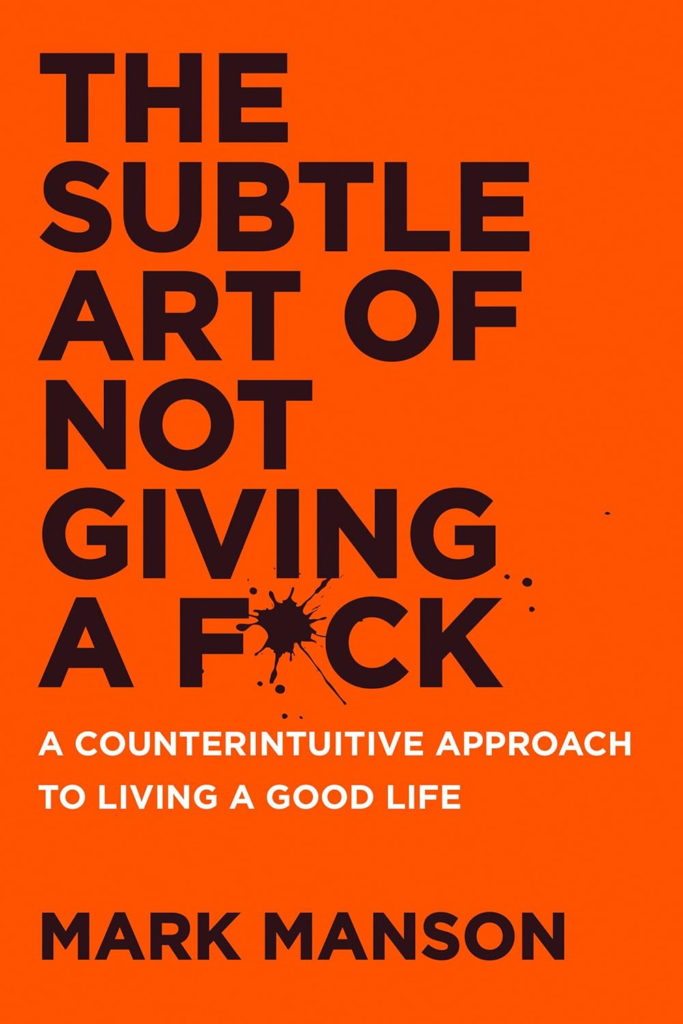
The Subtle Art of Not Giving a F*ck: A Counterintuitive Approach to Living a Good Life is a 2016 nonfiction book by American author and blogger Mark Manson. Published by HarperOne, an imprint of HarperCollins, the book presents an unconventional approach to personal development built around accepting life’s limitations, choosing values carefully, taking responsibility for one’s choices, confronting uncomfortable realities, and accepting suffering as an unavoidable part of a meaningful life.
The deliberately provocative title is central to the book’s argument. Manson does not advocate apathy, indifference, irresponsibility, or emotional detachment. Instead, he argues that human attention and emotional investment are limited resources. A good life therefore requires deciding what is genuinely worth caring about and becoming willing to accept the problems, sacrifices, and uncertainty that accompany those choices.
The book became an international bestseller and one of the most recognizable personal-development titles of the 2010s. It reached No. 1 on the New York Times bestseller list, was translated into numerous languages, and later became the basis for a 2023 documentary film featuring Manson. Manson’s current biography states that his books have sold more than 20 million copies collectively and have been translated into more than 65 languages.
At its heart, The Subtle Art of Not Giving a Fck* is less a book about caring less than a book about caring more selectively.
Bibliographic information
| Field | Details |
|---|---|
| Title | The Subtle Art of Not Giving a Fck: A Counterintuitive Approach to Living a Good Life* |
| Author | Mark Manson |
| Genre | Self-help, personal development, philosophy, psychology |
| Language | English |
| Publisher | HarperOne |
| Publication date | September 13, 2016 |
| Original ISBN | 978-0-06-245771-4 |
| Original edition length | 272 pages in the commonly catalogued hardcover edition |
| Subject | Values, responsibility, happiness, suffering, personal growth |
| Preceded by | — |
| Followed by | Everything Is Fcked: A Book About Hope* |
| Film adaptation | The Subtle Art of Not Giving a #@%! (2023) |
The Library of Congress catalogs the 2016 HarperOne edition as The Subtle Art of Not Giving a Fuck: A Counterintuitive Approach to Living a Good Life, by Mark Manson.
Because different international and reprint editions have different pagination, bibliographic records may list different page counts. Google Books, for example, lists a 2016 HarperCollins edition at 224 pages and another edition at 304 pages.
Overview
The central argument of The Subtle Art of Not Giving a Fck* can be stated surprisingly simply:
A good life does not come from eliminating problems. It comes from choosing problems that are worth having.
Manson begins with a rejection of what he regards as excessive positive-thinking culture.
According to his argument, people are frequently encouraged to believe that they should:
- remain positive,
- pursue constant happiness,
- believe they are exceptional,
- eliminate negative emotions,
- achieve increasingly ambitious goals,
- avoid failure,
- and convince themselves that everything will eventually work out.
Manson considers this approach misleading because life inevitably contains disappointment, failure, uncertainty, rejection, illness, loss, conflict, and death.
Trying to eliminate these experiences does not eliminate suffering.
Instead, it can create another layer of suffering: frustration about the fact that one is suffering.
His alternative is not pessimism.
It is acceptance.
Life contains unavoidable problems. The question is therefore not:
“How can I have no problems?”
but:
“Which problems am I willing to experience because they are connected to something I value?”
The paradox of the title
The phrase “not giving a f*ck” is deliberately provocative.
Manson’s concept does not mean:
- caring about nothing,
- becoming selfish,
- ignoring responsibilities,
- suppressing emotions,
- being rude,
- refusing to help others,
- or becoming emotionally numb.
It means developing the ability to distinguish between things that deserve one’s attention and things that do not.
Human beings have finite:
- time,
- energy,
- attention,
- emotional capacity,
- money,
- relationships,
- and years of life.
Therefore, every commitment implicitly excludes something else.
If everything matters equally, nothing has genuine priority.
The book’s philosophy can consequently be represented as:
              LIMITED ATTENTION
                     │
                     ▼
          ┌─────────────────────┐
          │ WHAT REALLY MATTERS?│
          └──────────┬──────────┘
                     │
            ┌────────┴────────┐
            ▼                 ▼
       WORTH CARING       NOT WORTH
          ABOUT            CARING ABOUT
            │                 │
            ▼                 ▼
         INVEST             RELEASE
            │
            ▼
       ACCEPT THE
       ASSOCIATED
        PROBLEMS
            │
            ▼
      MEANINGFUL LIFE
This selective approach to caring is the book’s central metaphor.
The philosophical background
Although written in the language of contemporary self-help, The Subtle Art of Not Giving a Fck* draws on older philosophical traditions.
Among the thinkers and ideas that influence Manson’s argument are:
- Stoicism
- Existentialism
- Buddhist-influenced acceptance
- Nietzschean ideas about struggle and meaning
- Albert Camus
- Viktor Frankl
- Charles Bukowski
- modern psychological research
Manson does not present a formal academic history of these traditions. Instead, he uses philosophical ideas as practical tools for thinking about modern life.
The resulting philosophy is deliberately hybrid: part self-help, part popular psychology, part existential reflection, and part cultural criticism.
Chapter structure
The book contains nine principal chapters.
| Chapter | Main idea |
|---|---|
| 1. Don’t Try | Stop obsessively chasing positive feelings and accept reality |
| 2. Happiness Is a Problem | Happiness emerges through solving meaningful problems |
| 3. You Are Not Special | Entitlement and exceptionalism can prevent growth |
| 4. The Value of Suffering | Struggle can become meaningful when connected to values |
| 5. You Are Always Choosing | Responsibility and choice remain important even under constraints |
| 6. You’re Wrong About Everything (But So Am I) | Human beliefs are imperfect and should remain open to revision |
| 7. Failure Is the Way Forward | Failure provides information and is part of progress |
| 8. The Importance of Saying No | Boundaries and commitment require rejection of alternatives |
| 9. And Then You Die | Mortality clarifies priorities and gives urgency to life |
Manson himself provides a chapter-by-chapter summary in an official video, confirming this nine-chapter structure.
Chapter 1: Don’t Try
The opening chapter establishes one of the book’s most important paradoxes.
The more desperately someone tries to feel a particular way, the more conscious they become of not feeling that way.
Someone who desperately wants to be happy may constantly monitor whether they are happy.
Someone who desperately wants confidence may constantly notice their insecurity.
Someone who desperately wants to appear successful may become obsessed with how others perceive them.
Manson argues that excessive striving can therefore reinforce the very dissatisfaction it is intended to eliminate.
The chapter draws inspiration from the writer Charles Bukowski, whose unconventional life and writing provide one of the book’s recurring examples.
The basic lesson is not “stop trying.”
It is:
Stop trying to control every emotional outcome.
The Feedback Loop from Hell
One of the book’s most memorable psychological ideas is the Feedback Loop from Hell.
It can be illustrated like this:
        NEGATIVE EXPERIENCE
               ↓
          NEGATIVE FEELING
               ↓
       "I SHOULDN'T FEEL THIS"
               ↓
        MORE ANXIETY / GUILT
               ↓
       "WHY AM I LIKE THIS?"
               ↓
        MORE NEGATIVE FEELING
               ↓
              LOOP
For example:
- A person feels anxious.
- They become upset that they are anxious.
- They interpret anxiety as evidence that something is wrong with them.
- They become more anxious.
- They then worry about being even more anxious.
The original problem becomes secondary.
The person is now suffering because they are suffering.
Manson’s proposed escape is acceptance.
Instead of:
“I must stop feeling anxious.”
the person can begin with:
“I am anxious. What should I do now?”
That shift changes the problem from emotional resistance to practical action.
Chapter 2: Happiness Is a Problem
Perhaps the book’s most important reversal is its treatment of happiness.
Manson argues that happiness should not be understood as the absence of problems.
Instead:
Problems are part of the mechanism through which happiness is experienced.
Consider two lives:
Person A
Has no meaningful challenge but spends the day searching for entertainment.
Person B
Works toward a difficult goal, experiences setbacks, improves skills, develops relationships, and occasionally succeeds.
Person B may experience more frustration.
But that does not necessarily mean Person B has a worse life.
Manson’s point is that struggle can itself become meaningful when it is connected to something important.
The Happiness Equation
A simplified representation of Manson’s philosophy is:
       PROBLEMS
          +
      RESPONSIBILITY
          +
       GOOD VALUES
          +
       ACCEPTANCE
          ↓
   MEANINGFUL PROGRESS
          ↓
      SATISFACTION
The goal is therefore not to create a problem-free existence.
It is to develop the capacity to solve increasingly meaningful problems.
“Problems never disappear”
One of the book’s recurring themes is that solving one problem generally creates another.
For example:
| Achievement | New problem |
|---|---|
| Get a job | Perform well |
| Start a business | Find customers |
| Become successful | Manage expectations |
| Get married | Maintain the relationship |
| Have children | Raise them responsibly |
| Become fit | Maintain the habit |
| Become wealthy | Manage wealth |
| Become famous | Deal with attention |
This is not necessarily a defect in life.
It is simply the nature of life.
The objective becomes choosing problems that are worth solving.
Chapter 3: You Are Not Special
The title of this chapter is intentionally confrontational.
Manson challenges what he regards as the modern tendency toward exceptionalism and entitlement.
The message is not that individuals have no value.
Rather, he argues that believing one is inherently entitled to extraordinary success can create unrealistic expectations.
A person may believe:
“I deserve an exceptional life.”
But when reality inevitably produces ordinary difficulties, disappointment follows.
Manson’s alternative is humility.
You are allowed to want an extraordinary life.
But wanting it does not make you entitled to it.
Entitlement and disappointment
The relationship can be represented as:
HIGH EXPECTATIONS
       +
LOW TOLERANCE FOR DIFFICULTY
       ↓
ENTITLEMENT
       ↓
DISAPPOINTMENT
       ↓
BLAME
       ↓
RESENTMENT
A more resilient pattern is:
REALISTIC EXPECTATIONS
       +
WILLINGNESS TO STRUGGLE
       ↓
RESPONSIBILITY
       ↓
LEARNING
       ↓
PROGRESS
This is one reason Manson repeatedly returns to the value of ordinary struggle.
Chapter 4: The Value of Suffering
Manson does not claim that suffering is automatically good.
His argument is more precise:
Suffering can become meaningful when it is connected to a value worth pursuing.
Examples:
- An athlete accepts physical discomfort because fitness matters.
- A student accepts difficult study because education matters.
- A parent accepts inconvenience because family matters.
- An entrepreneur accepts uncertainty because building something matters.
- A person accepts difficult therapy because psychological growth matters.
The pain does not become pleasant.
Its meaning changes.
Choosing your struggle
Manson asks readers to think beyond the attractive surface of goals.
Instead of asking only:
“What do I want?”
ask:
“What am I willing to struggle for?”
This is arguably one of the book’s strongest practical questions.
Every desirable outcome contains a cost.
WANT SUCCESS?
      ↓
Accept effort + uncertainty + failure

WANT FITNESS?
      ↓
Accept exercise + discipline + discomfort

WANT LOVE?
      ↓
Accept vulnerability + conflict + compromise

WANT FREEDOM?
      ↓
Accept responsibility + uncertainty
The hidden cost is the real test of desire.
Chapter 5: You Are Always Choosing
This chapter deals with responsibility.
Manson distinguishes between fault and responsibility.
A person may not be responsible for causing an event but can still be responsible for how they respond to it.
For example:
A person may not be responsible for being treated unfairly.
But they may still have some responsibility for deciding what to do next.
This distinction is one of the book’s most important.
Fault versus responsibility
                 EVENT
                   │
          ┌────────┴─────────┐
          ▼                  ▼
       WHO CAUSED IT?     WHAT NOW?
          │                  │
          ▼                  ▼
          FAULT          RESPONSIBILITY
                             │
                             ▼
                       AVAILABLE ACTION
Manson’s argument is not that people control everything that happens to them.
They do not.
People experience:
- accidents,
- illness,
- economic circumstances,
- discrimination,
- other people’s decisions,
- natural disasters,
- historical events,
- and countless forms of bad luck.
The claim is instead that responsibility concerns one’s response, not necessarily one’s control over the original event.
The responsibility/fault fallacy
Manson explicitly develops this distinction in his writing about the book.
His argument is that responsibility and fault are different concepts. A person can be affected by something that is not their fault and still have responsibility for the response available to them.
This distinction can be particularly useful in personal development because it prevents two opposite errors:
Error 1: Total self-blame
“Everything bad that happened is my fault.”
Error 2: Total helplessness
“Nothing is my responsibility because I did not cause it.”
Manson’s position occupies the space between them.
Chapter 6: You’re Wrong About Everything (But So Am I)
This chapter addresses human fallibility.
People construct mental models of:
- themselves,
- other people,
- relationships,
- politics,
- work,
- success,
- failure,
- and the future.
These models are necessarily incomplete.
The problem begins when people mistake their interpretation for reality.
Manson encourages readers to remain willing to question their beliefs.
Identity as a story
A person may say:
“I’m not a creative person.”
But that statement may actually mean:
“I tried something creative once, disliked the result, and incorporated the experience into my identity.”
Likewise:
“I’m bad at relationships.”
may be a story derived from a few painful experiences.
The question becomes:
Is this belief useful, accurate, and open to revision?
The danger of certainty
Certainty can feel psychologically comfortable.
But certainty about complex subjects can become an obstacle to learning.
A healthier intellectual position is:
BELIEF
  ↓
EVIDENCE
  ↓
TEST
  ↓
NEW INFORMATION
  ↓
UPDATE BELIEF
This resembles the scientific process more closely than rigid self-definition.
Chapter 7: Failure Is the Way Forward
Manson argues that failure is not merely an unfortunate side effect of progress.
It is frequently part of progress.
A person cannot learn to:
- write,
- invest,
- build a company,
- form relationships,
- communicate,
- play music,
- exercise,
- or develop a new skill
without encountering failure.
The alternative to failure is often not success.
It is inaction.
Failure as information
A useful way to visualize the argument is:
            ATTEMPT
               ↓
        ┌──────┴──────┐
        ↓             ↓
      SUCCESS       FAILURE
        │             │
        ↓             ↓
     REINFORCE       LEARN
                      │
                      ↓
                    ADAPT
                      │
                      ↓
                    RETRY
                      │
                      └──────→ ATTEMPT
Failure therefore becomes feedback.
This does not mean every failure is beneficial.
Some failures are devastating.
Some involve consequences that cannot simply be reversed.
Manson’s broader point is that refusing all risk in order to avoid failure also prevents many forms of learning.
Chapter 8: The Importance of Saying No
The ability to say no is central to Manson’s theory of values.
Every yes consumes some resource.
If you say yes to:
- one project,
- one relationship,
- one social commitment,
- one business opportunity,
you are simultaneously saying no to something else.
Therefore, saying no is not merely rejection.
It is prioritization.
Commitment and values
Suppose someone claims that family is their highest priority.
But their schedule contains:
- 70-hour workweeks,
- constant social obligations,
- endless digital distractions,
- no time for family,
then their behavior communicates a different hierarchy of values.
Manson therefore asks readers to examine behavior rather than merely declarations.
The Commitment Equation
VALUES
   ↓
CHOICES
   ↓
TRADE-OFFS
   ↓
BOUNDARIES
   ↓
COMMITMENT
   ↓
MEANING
A meaningful life requires saying no because meaningful commitments require exclusion.
Chapter 9: And Then You Die
The final chapter introduces mortality as a framework for understanding priorities.
Death is not treated simply as a frightening event.
It is also a limit.
Because life is finite, choices matter.
If people had infinite time, every opportunity could theoretically be pursued.
They do not.
Therefore:
Choosing becomes unavoidable.
Mortality as a decision filter
             FINITE LIFE
                  │
                  ▼
            LIMITED TIME
                  │
                  ▼
          LIMITED ATTENTION
                  │
                  ▼
             CHOICES
                  │
                  ▼
              VALUES
                  │
                  ▼
             PRIORITIES
Manson’s use of mortality is therefore existential rather than merely morbid.
Death provides a boundary around life.
And boundaries make priorities visible.
The Value of Mortality
A person who remembers that life is finite may become more conscious of:
- relationships,
- time,
- meaningful work,
- personal values,
- experiences,
- contribution,
- and the opportunity cost of distraction.
The point is not to think about death constantly.
It is to recognize that time cannot be recovered.
Good values and bad values
One of the book’s most important frameworks concerns values.
Manson argues that some values are more constructive than others.
He generally distinguishes between values that are:
Healthier
- grounded in reality
- constructive
- within one’s influence or control
and values that are:
Less healthy
- dependent on external validation
- destructive
- largely outside one’s control
Manson later expanded this framework explicitly on his website, describing good values as evidence-based, constructive, and controllable, and contrasting them with emotion-based, destructive, and uncontrollable values.
Examples of value transformation
| Less useful value | More constructive alternative |
|---|---|
| Being universally liked | Being honest and respectful |
| Looking successful | Doing meaningful work |
| Being richer than others | Building financial stability |
| Never failing | Learning from failure |
| Always being right | Seeking truth |
| Being admired | Acting with integrity |
| Being famous | Creating something useful |
| Winning every argument | Understanding reality |
The important distinction is not that one value is universally “good” and another universally “bad.”
It is that some values are more controllable and constructive foundations for daily decision-making.
The Control Test
A central practical question is:
Can I meaningfully control this?
For example:
Mostly controllable
- effort
- honesty
- preparation
- boundaries
- learning
- response to criticism
- whether you keep a promise
Less controllable
- other people’s opinions
- popularity
- reputation
- exact outcomes
- whether everyone likes you
- market conditions
- other people’s behavior
Manson’s framework suggests that building one’s identity around uncontrollable outcomes creates unnecessary instability.
The “Give a Fuck” Budget
The title can also be understood as a resource-allocation model.
Imagine that you have a fixed daily budget of emotional attention.
You can spend it on:
- family,
- health,
- meaningful work,
- friendships,
- learning,
- reputation,
- social media,
- strangers’ opinions,
- trivial conflicts,
- comparison,
- celebrity gossip,
- internet arguments.
The budget is finite.
Therefore:
                 YOUR ATTENTION
                       │
          ┌────────────┼────────────┐
          ↓            ↓            ↓
       PEOPLE        PURPOSE       NOISE
          │            │            │
          ↓            ↓            ↓
       INVEST       INVEST       REDUCE
This is the practical meaning of selective caring.
The Paradox of Acceptance
One of the book’s deepest ideas is that acceptance can produce change.
This appears contradictory.
If you accept reality, why would you change it?
Because acceptance removes the energy spent fighting reality’s existence.
For example:
Denial:
“I shouldn’t have this problem.”
Acceptance:
“I have this problem. What can I do about it?”
The second statement may create more practical power.
Acceptance is not resignation
This distinction is essential.
Resignation
“Nothing can be done.”
Acceptance
“This is the situation. Now what can be done?”
Acceptance acknowledges reality.
Resignation abandons agency.
Manson advocates the former, not the latter.
The Feedback Loop of Acceptance
        REALITY
           ↓
       ACCEPT IT
           ↓
      SEE CLEARLY
           ↓
      CHOOSE RESPONSE
           ↓
          ACT
           ↓
       LEARN / ADAPT
           ↓
      NEW REALITY
This is one of the most useful ways to interpret the book.
Personal responsibility
Responsibility is another major pillar.
Manson repeatedly returns to the idea that people cannot always control what happens, but they can often influence how they respond.
This produces a distinction between:
victimhood as an explanation
and
victimhood as an identity.
Someone may genuinely experience unfair treatment.
Acknowledging that reality does not require surrendering all future agency.
The book’s practical question is:
What part of this situation is mine to deal with?
Responsibility and agency
             LIFE EVENT
                 │
        ┌────────┴────────┐
        ▼                 ▼
    OUTSIDE YOUR       WITHIN YOUR
      CONTROL            INFLUENCE
        │                 │
        ▼                 ▼
     ACCEPT             ACT
        │                 │
        └────────┬────────┘
                 ▼
             RESPONSE
This does not eliminate structural, social, economic, or interpersonal constraints.
It simply identifies the area in which individual action may still be possible.
The “You’re Not Special” argument
This phrase can initially sound insulting.
Within Manson’s framework, however, its purpose is to challenge the expectation that life should automatically provide exceptional treatment.
The argument is essentially:
You are valuable, but the universe does not owe you an extraordinary outcome.
This can be psychologically liberating.
If success is not guaranteed, failure becomes less of a personal cosmic injustice.
If everyone experiences difficulties, difficulties become less evidence of personal defect.
Ordinary struggle becomes normal.
The role of failure
The book treats failure differently from conventional motivational literature.
Instead of:
“You can achieve anything if you believe strongly enough.”
Manson’s approach is closer to:
“You will fail. The important question is whether you can learn from it.”
That distinction matters.
It replaces unlimited optimism with conditional realism.
The importance of boundaries
Saying no is particularly important in relationships.
A person who never says no may appear generous.
But chronic inability to establish boundaries can eventually create:
- resentment,
- exhaustion,
- passive aggression,
- dishonesty,
- emotional withdrawal.
Healthy boundaries therefore protect relationships rather than necessarily damaging them.
Relationships and values
The book’s philosophy also applies to romantic relationships.
A relationship inevitably involves:
- compromise,
- misunderstanding,
- conflict,
- vulnerability,
- responsibility,
- disappointment.
The question is not whether a relationship can be completely free from problems.
It cannot.
The better question is:
Are these problems worth having for this relationship?
This is another expression of Manson’s central philosophy.
The relationship between happiness and meaning
Manson distinguishes between immediate pleasure and deeper satisfaction.
A pleasurable experience may feel good now.
A meaningful experience may involve difficulty but produce a stronger sense of purpose.
For example:
| Immediate pleasure | Meaningful investment |
|---|---|
| Watching entertainment | Creating something |
| Avoiding conflict | Resolving conflict |
| Spending impulsively | Building financial security |
| Eating whatever feels good | Maintaining health |
| Seeking approval | Living according to values |
| Avoiding failure | Learning a difficult skill |
The book does not claim that pleasure is bad.
Rather, pleasure alone is not an adequate definition of a good life.
The role of discomfort
Discomfort is unavoidable.
The relevant question is what the discomfort is for.
DISCOMFORT
    │
    ├── Meaningless → Reduce or avoid where possible
    │
    └── Meaningful → Learn to tolerate and use
For example, exercising can be uncomfortable.
Studying can be uncomfortable.
Starting a business can be uncomfortable.
Having an honest conversation can be uncomfortable.
But discomfort does not automatically make these activities bad.
A practical decision-making framework
Manson’s ideas can be translated into a simple sequence:
1. What am I currently caring about?
Identify where your attention is going.
2. Is this actually important?
Separate genuine priorities from social pressure.
3. Is this value controllable?
If the outcome depends almost entirely on other people, reconsider whether it should define your self-worth.
4. What problem comes with this value?
Every meaningful commitment has costs.
5. Am I willing to pay that cost?
This is the real test of commitment.
6. What responsibility is mine?
Separate your responsibility from what you cannot control.
7. What can failure teach me?
Treat mistakes as information where possible.
8. What should I say no to?
Protect the values you claim are important.
The Manson Decision Matrix
| Question | If “Yes” | If “No” |
|---|---|---|
| Does this matter deeply? | Consider investing | Reduce attention |
| Can I influence it? | Take responsibility | Practice acceptance |
| Does it support my values? | Continue | Reconsider |
| Is the struggle worthwhile? | Accept the cost | Find another path |
| Can I learn from failure? | Experiment | Reduce avoidable risk |
| Does this commitment require a boundary? | Say no where necessary | Continue |
| Will this matter in the long term? | Prioritize | Let go |
The book’s approach to success
Traditional self-help often begins with:
What do you want to achieve?
Manson asks a different question:
What kind of problems are you willing to experience?
That is a significant shift.
For example:
Want to become a writer?
Accept:
- rejection,
- editing,
- criticism,
- uncertainty,
- long periods without recognition.
Want to become an entrepreneur?
Accept:
- financial risk,
- ambiguity,
- difficult customers,
- failed ideas,
- responsibility.
Want a strong marriage?
Accept:
- disagreement,
- compromise,
- vulnerability,
- emotional work,
- responsibility.
The attractive outcome is only half the equation.
The unwanted cost is the other half.
The “Choose Your Struggle” model
                 DESIRED LIFE
                      │
                      ▼
                DESIRED OUTCOME
                      │
                      ▼
             REQUIRED STRUGGLE
                      │
             ┌────────┴────────┐
             ▼                 ▼
       WILLING TO PAY?     NOT WILLING
             │                 │
             ▼                 ▼
         COMMIT            RECONSIDER
             │
             ▼
          PRACTICE
             │
             ▼
         PROGRESS
This is perhaps the clearest single visual representation of the book’s philosophy.
The book’s writing style
One reason The Subtle Art of Not Giving a Fck* became so culturally recognizable is its presentation.
Manson deliberately combines:
- profanity,
- humor,
- anecdotes,
- philosophical references,
- personal stories,
- psychological concepts,
- blunt observations,
- provocative chapter titles,
- conversational language.
The style contrasts sharply with the polished and frequently inspirational language associated with conventional self-help books.
Manson’s own site describes the book as a self-help work for people who dislike conventional self-help, while emphasizing its deliberately irreverent tone.
The profanity is therefore not simply decoration.
It is part of the book’s rhetorical strategy.
Why the profanity matters
The title immediately signals that this is not a conventional motivational book.
It performs several functions:
1. Attention
The title is difficult to ignore.
2. Positioning
It differentiates the book from traditional inspirational literature.
3. Tone
It tells the reader that the author intends to speak bluntly.
4. Philosophy
It embodies the book’s argument that social approval should not automatically determine one’s choices.
The unusual title also contributed to a broader publishing trend in the 2010s in which profanity appeared more frequently in book titles.
Criticism and limitations
A serious encyclopedia entry should also consider what the book does not establish.
1. “Not caring” can be misunderstood
The most obvious risk is literal interpretation.
Taken without context, the title might encourage:
- apathy,
- selfishness,
- irresponsibility,
- emotional suppression,
- disregard for other people.
That is not the book’s central argument.
The book is more accurately described as an argument for selective concern.
2. The framework can oversimplify structural problems
Manson emphasizes individual responsibility.
That can be useful for personal agency, but individual responsibility has limits.
People’s lives are also shaped by:
- economic circumstances,
- social class,
- discrimination,
- family conditions,
- health,
- geography,
- political institutions,
- education,
- culture,
- historical circumstances,
- random events.
Not every problem can be solved through better values or personal choice.
The book is therefore strongest as a framework for personal reflection, not as a complete theory of social inequality or structural disadvantage.
3. Acceptance can be misapplied
Acceptance is useful when it means acknowledging reality.
But there is a risk of confusing acceptance with passivity.
For example:
Healthy acceptance:
“This is my current situation. What can I change?”
Unhealthy resignation:
“This is my situation, so nothing matters.”
Manson’s broader philosophy supports the first interpretation, but readers applying the ideas should maintain the distinction.
4. The book is not a clinical psychology manual
Although Manson discusses psychological research, the book is written for a general audience rather than as a clinical or academic psychology text.
Its frameworks should not be treated as diagnostic tools.
Conditions such as:
- depression,
- anxiety disorders,
- trauma-related disorders,
- obsessive-compulsive disorder,
- addiction,
- severe grief,
can involve factors that go far beyond ordinary philosophical reframing.
A philosophical self-help book is not a substitute for professional mental-health care when such care is needed.
5. “Good values” remain partly philosophical
Manson proposes useful criteria for evaluating values, particularly whether they are constructive, evidence-based, and controllable.
But questions about what constitutes a good life are ultimately philosophical as well as psychological.
Different traditions may prioritize:
- family,
- autonomy,
- spirituality,
- community,
- achievement,
- justice,
- pleasure,
- service,
- knowledge,
- creativity.
The book encourages readers to examine their values rather than providing a universally accepted moral system.
6. The blunt style can overshadow the ideas
For some readers, the profanity makes the philosophy accessible and memorable.
For others, it can feel repetitive or unnecessarily provocative.
The same rhetorical strategy that makes the book distinctive can therefore also limit its appeal.
Reception
The book became a major commercial success.
Publishers Weekly’s bestseller records show it reached the No. 1 position on its hardcover nonfiction list in August 2017 after remaining on the list for many months.
Google Books describes the work as a No. 1 New York Times bestseller and, in later editions, reports sales exceeding 10 million copies.
Manson’s current author biography reports that his books collectively have sold more than 20 million copies, have been translated into more than 65 languages, and have reached No. 1 in more than a dozen countries.
The book’s success was partly driven by the contrast between its aggressive title and its more serious underlying themes.
Why the book became culturally significant
The book appeared during a period when social media, personal branding, productivity culture, and motivational content were becoming increasingly prominent.
People were exposed to constant messages about:
- success,
- happiness,
- productivity,
- wealth,
- fitness,
- entrepreneurship,
- relationships,
- personal optimization.
Manson’s response was essentially:
What if the problem is not that people care too little, but that they care about too many things that do not matter?
That question resonated particularly strongly with readers who felt exhausted by constant self-improvement.
The book and “toxic positivity”
Manson’s criticism of excessive positivity is one of the book’s most visible themes.
He argues that constantly insisting on positive thinking can produce an ironic result.
"I MUST ALWAYS BE POSITIVE"
             ↓
     NEGATIVE EMOTION
             ↓
      "I AM FAILING"
             ↓
         SHAME
             ↓
     MORE NEGATIVITY
A more realistic approach is:
NEGATIVE EXPERIENCE
        ↓
     ACCEPT IT
        ↓
   UNDERSTAND IT
        ↓
   CHOOSE RESPONSE
        ↓
      ACT
The distinction is between denying negative experience and responding constructively to it.
Comparison with conventional self-help
| Conventional self-help tendency | Manson’s counterargument |
|---|---|
| Think positively | Accept negative realities |
| Believe you are exceptional | Accept that you are ordinary |
| Chase happiness | Solve meaningful problems |
| Avoid failure | Use failure as feedback |
| Get everything you want | Choose what is worth wanting |
| Seek approval | Focus on values |
| Eliminate discomfort | Choose worthwhile discomfort |
| Control outcomes | Focus on what you can influence |
| Say yes to opportunities | Learn to say no |
| Avoid thinking about death | Use mortality to clarify priorities |
This table captures the book’s intentionally counterintuitive structure.
A broader philosophical interpretation
The book can be read as an argument for existential responsibility.
Existentialist philosophy often begins with an uncomfortable premise:
Human beings must make choices in a world that does not provide guaranteed meaning.
Manson translates this abstract philosophical problem into everyday language.
You have limited time.
You cannot control everything.
You will experience pain.
You will make mistakes.
Other people will disappoint you.
You will disappoint other people.
Eventually, you will die.
Therefore:
What will you choose to care about?
This is the deeper question beneath the provocative title.
Mortality and meaning
The final chapter gives the entire book a different perspective.
Suppose a person has:
- unlimited money,
- unlimited status,
- unlimited possessions,
- unlimited social approval.
But no meaningful relationships and no meaningful purpose.
Has the person necessarily built a good life?
Manson’s answer is essentially no.
Material success is not automatically meaningful.
Meaning comes from the values to which a person chooses to devote limited time.
The “Good Life” framework
The book’s ideas can be synthesized into five stages:
             1. ACCEPT REALITY
                     ↓
             2. CHOOSE VALUES
                     ↓
          3. ACCEPT THE STRUGGLE
                     ↓
          4. TAKE RESPONSIBILITY
                     ↓
          5. LET GO OF THE REST
                     ↓
             MEANINGFUL LIFE
This is not presented as a scientific equation.
It is a conceptual summary of Manson’s philosophy.
What the book ultimately asks
Rather than asking:
“How can I become happy all the time?”
Manson asks questions such as:
- What is genuinely important to me?
- What am I willing to suffer for?
- What am I pretending not to know?
- What am I blaming others for?
- Which problems are worth solving?
- What should I stop caring about?
- Which values are controlling my life?
- Which of my beliefs might be wrong?
- What am I unwilling to say no to?
- If my time were limited, would I spend it differently?
These questions are more important to the book than any individual productivity technique.
The Subtle Art philosophy in one infographic
╔══════════════════════════════════════════════════╗
║       THE SUBTLE ART OF NOT GIVING A F*CK        ║
║                    MARK MANSON                    ║
╠══════════════════════════════════════════════════╣
║                                                  ║
║          YOU HAVE LIMITED ATTENTION              ║
║                     │                            ║
║                     ▼                            ║
║            CHOOSE WHAT MATTERS                   ║
║                     │                            ║
║                     ▼                            ║
║              CHOOSE GOOD VALUES                 ║
║                     │                            ║
║                     ▼                            ║
║        ACCEPT THE PROBLEMS THEY CREATE           ║
║                     │                            ║
║                     ▼                            ║
║              TAKE RESPONSIBILITY                 ║
║                     │                            ║
║                     ▼                            ║
║             ACCEPT FAILURE                       ║
║                     │                            ║
║                     ▼                            ║
║               SAY NO                             ║
║                     │                            ║
║                     ▼                            ║
║             ACCEPT MORTALITY                      ║
║                     │                            ║
║                     ▼                            ║
║             LIVE INTENTIONALLY                    ║
║                                                  ║
╚══════════════════════════════════════════════════╝
The book’s central paradoxes
Manson structures much of the book around paradoxes.
| Apparent contradiction | Underlying idea |
|---|---|
| Stop trying to be happy → become happier | Acceptance reduces unnecessary struggle |
| Accept problems → live better | Problems are unavoidable |
| Accept failure → improve | Failure provides information |
| Say no → create more freedom | Boundaries protect priorities |
| Accept limitations → gain agency | Reality becomes easier to work with |
| Accept that you are ordinary → grow | Reduced entitlement improves learning |
| Think about death → appreciate life | Finitude clarifies priorities |
| Care less → care more deeply | Selectivity concentrates attention |
These paradoxes explain why the book calls its approach counterintuitive.
The role of ordinary life
One of the book’s less obvious messages is that a meaningful life does not have to look extraordinary.
A person does not need:
- worldwide fame,
- millions of dollars,
- an extraordinary career,
- constant adventure,
- social-media recognition,
to live meaningfully.
A meaningful life can be built around ordinary commitments:
- raising children,
- maintaining friendships,
- doing useful work,
- caring for a partner,
- creating something,
- helping a community,
- learning,
- practicing a craft,
- maintaining health.
The question is not whether the life looks impressive from outside.
The question is whether it reflects values that the person genuinely considers important.
Mark Manson: Author biography
Mark Manson is an American author, blogger, entrepreneur, and commentator on personal development, psychology, culture, relationships, and philosophy.
He became widely known through his website MarkManson.net, where he developed a style of personal-development writing characterized by blunt language, humor, psychological concepts, philosophical ideas, and skepticism toward conventional motivational advice.
His breakthrough book, The Subtle Art of Not Giving a Fck*, transformed his online audience into a global readership.
Manson’s official biography currently describes him as a three-time No. 1 New York Times bestselling author. His books have sold more than 20 million copies collectively and have been translated into more than 65 languages.
His writing has appeared in publications including The New York Times, TIME, Forbes, The Guardian, BBC, CNN, GQ, Vox, and Fast Company.
His later work has expanded beyond traditional books into podcasts, YouTube, newsletters, courses, and digital products.
Mark Manson’s major books
| Year | Work | Broad subject |
|---|---|---|
| 2016 | The Subtle Art of Not Giving a Fck* | Values, responsibility, happiness |
| 2019 | Everything Is Fcked: A Book About Hope* | Hope, meaning, psychology |
| 2023 | Will | Memoir and collaboration with Will Smith |
| — | The Subtle Art Journal | Reflection and exercises based on the book |
Manson’s official website describes The Subtle Art of Not Giving a Fck* as his breakthrough bestseller and continues to offer related resources and a journal based on the book’s themes.
The 2023 documentary film
The book was adapted into a feature-length documentary titled **The Subtle Art of Not Giving a #@%! **.
The film was released in 2023 and stars Manson himself. It was directed by Nathan Price and distributed by Universal Pictures. Universal’s listing describes it as a documentary combining Manson’s ideas with personal stories and humor.
The adaptation extended the book’s ideas into a visual medium and introduced the philosophy to audiences who may not have read the original book.
The book’s continuing influence
The influence of The Subtle Art of Not Giving a Fck* is visible in the vocabulary of contemporary personal development.
Its themes have contributed to popular discussions surrounding:
- boundaries,
- emotional acceptance,
- personal responsibility,
- values,
- mental resilience,
- failure,
- purpose,
- selective attention,
- realistic optimism,
- existential psychology.
Its influence is partly attributable to its ability to translate relatively old philosophical questions into contemporary language.
The ancient question—
“What makes a life worth living?”
—is presented in the language of a modern blog.
That combination is a major part of the book’s appeal.
What readers can take from the book
The most useful lessons can be condensed into ten questions:
1. What actually matters to me?
Not what looks impressive.
Not what gets approval.
What genuinely matters?
2. What am I giving too much attention to?
Some problems deserve attention.
Others merely consume it.
3. Which values control my decisions?
Look at behavior, not declarations.
4. Are my values within my influence?
If not, consider whether they should define your self-worth.
5. What problems am I willing to have?
Every meaningful goal carries costs.
6. What am I avoiding?
Avoidance often reveals the location of fear.
7. What can I learn from failure?
Failure is information when examined honestly.
8. What do I need to say no to?
A meaningful yes often requires a meaningful no.
9. What responsibility belongs to me?
Separate responsibility from blame.
10. If life is finite, how should I spend it?
This is the question beneath all the others.
One-page summary
                 THE SUBTLE ART
                       │
                       ▼
              LIFE HAS PROBLEMS
                       │
                       ▼
           YOU CANNOT CARE ABOUT
                  EVERYTHING
                       │
                       ▼
             CHOOSE YOUR VALUES
                       │
                       ▼
       CHOOSE PROBLEMS WORTH SOLVING
                       │
                       ▼
          ACCEPT RESPONSIBILITY
                       │
                       ▼
             EXPECT FAILURE
                       │
                       ▼
               LEARN FROM IT
                       │
                       ▼
               SAY NO OFTEN
                       │
                       ▼
             ACCEPT LIMITATIONS
                       │
                       ▼
             REMEMBER MORTALITY
                       │
                       ▼
               LIVE INTENTIONALLY
See also
- [[Mark Manson]]
- [[Everything Is F*cked: A Book About Hope]]
- [[Self-help]]
- [[Personal development]]
- [[Positive psychology]]
- [[Existentialism]]
- [[Stoicism]]
- [[Viktor Frankl]]
- [[Charles Bukowski]]
- [[Albert Camus]]
- [[Personal values]]
- [[Happiness]]
- [[Meaning of life]]
- [[Personal responsibility]]
- [[Emotional resilience]]
- [[Self-acceptance]]
- [[Failure]]
- [[Goal setting]]
- [[Mindfulness]]
- [[Mental health]]
Further reading
Readers interested in the ideas developed in The Subtle Art of Not Giving a Fck* may find the following subjects useful:
Existential philosophy
The works of Albert Camus, Friedrich Nietzsche, and other existential thinkers provide a broader philosophical background for questions of meaning, mortality, responsibility, and freedom.
Viktor Frankl
Frankl’s Man’s Search for Meaning explores the relationship between suffering, meaning, responsibility, and human resilience. It provides a substantially different historical and psychological context for some of Manson’s arguments.
Stoicism
Stoic philosophy explores the distinction between what is and is not within one’s control, a distinction that strongly resembles Manson’s emphasis on controllable values.
Positive psychology
Positive psychology provides a more empirical research tradition for studying well-being, strengths, meaning, relationships, and human flourishing.
Acceptance-based approaches
Contemporary psychological approaches such as Acceptance and Commitment Therapy examine the relationship between psychological flexibility, values, acceptance, and meaningful action. These are clinical frameworks and should not be treated as identical to Manson’s popular philosophy.
References
- Manson, Mark. The Subtle Art of Not Giving a Fck: A Counterintuitive Approach to Living a Good Life*. HarperOne, 2016. Library of Congress catalog record.
- Manson, Mark. The Subtle Art of Not Giving a Fck*. Google Books, HarperCollins editions.
- Manson, Mark. “The Subtle Art of Not Giving a F*ck.” Official author website.
- Manson, Mark. “The Responsibility/Fault Fallacy.” MarkManson.net.
- Manson, Mark. “Personal Values: How to Know Who You Really Are.” MarkManson.net.
- Manson, Mark. “The Most Important Question of Your Life.” MarkManson.net.
- Publishers Weekly. Bestseller records for The Subtle Art of Not Giving a Fck.*
- Manson, Mark. Author biography and media kit.
- Universal Pictures. The Subtle Art of Not Giving a #@%! 2023 documentary information.
- Manson, Mark. Official author summary of The Subtle Art of Not Giving a Fck.*
External links
- Mark Manson — Official Website
- The Subtle Art of Not Giving a F*ck — Official Book Page
- Mark Manson — Author Biography
- Library of Congress — Bibliographic Record
- Google Books — Book Record
- Universal Pictures — 2023 Documentary
Editorial perspective
The most interesting thing about The Subtle Art of Not Giving a Fck* is that the book’s provocative title can easily obscure its much more traditional philosophical question.
Manson is not really telling readers to stop caring.
He is asking them to care deliberately.
That distinction matters.
A person who cares about everything eventually becomes overwhelmed. A person who tries to avoid every unpleasant experience eventually becomes afraid of ordinary life. A person who defines success entirely through external approval becomes dependent on something they cannot control. And a person who expects a meaningful life to be free of suffering will repeatedly interpret normal difficulties as evidence that something has gone wrong.
Manson’s alternative is less glamorous.
Choose what matters.
Accept that it will be difficult.
Take responsibility for your part.
Expect to be wrong.
Expect to fail.
Learn to say no.
Stop demanding that reality behave according to your preferences.
And remember that the supply of time is finite.
There is something almost old-fashioned about this message beneath the deliberately outrageous language. The book ultimately returns to questions that philosophy has been asking for centuries:
What should I value?
What kind of suffering is worth enduring?
What is actually within my control?
What responsibilities do I have?
What should I let go?
And what should I do with the limited time I have?
That is why the book is better understood not as a manifesto for apathy, but as an argument for intentional attention.
The subtle art is not learning how to stop caring.
It is learning what deserves your care in the first place.