


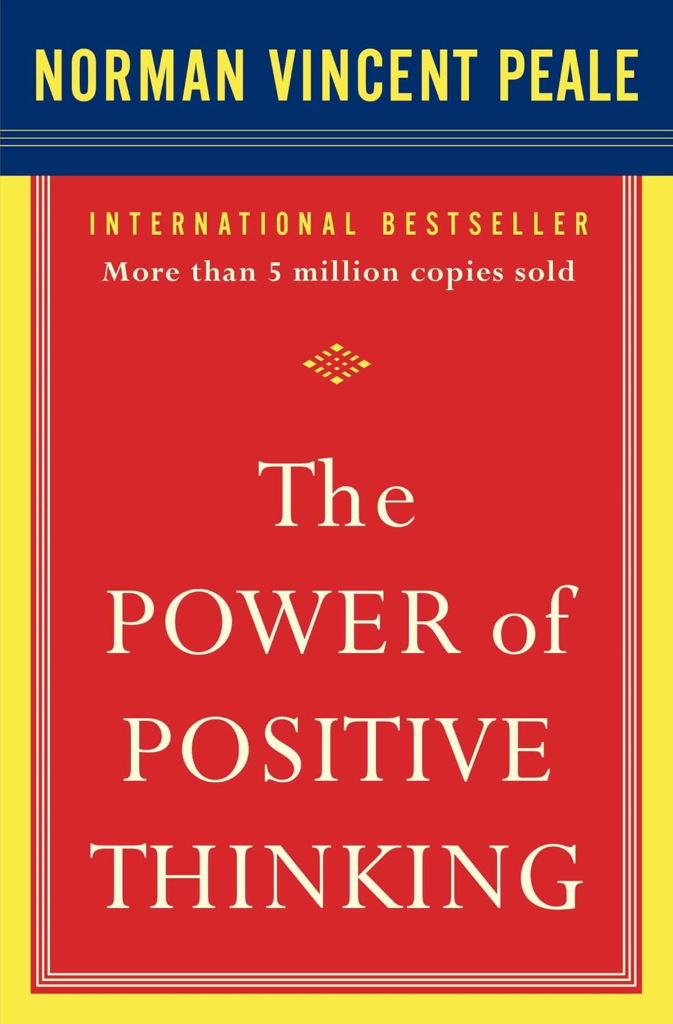
The Power of Positive Thinking: A Practical Guide to Mastering the Problems of Everyday Living is a self-help book by American minister and author Norman Vincent Peale. First published in 1952, the book combines Christian faith, practical advice, motivational psychology, visualization, prayer, affirmations, and personal anecdotes to present a philosophy of constructive and optimistic thinking. It became one of the best-known works in the history of modern self-help literature.
Peale’s central proposition is that a person’s habitual patterns of thought can strongly influence confidence, behaviour, resilience, relationships, and the way everyday difficulties are approached. He encourages readers to replace defeatist thinking with faith, constructive self-talk, mental imagery, prayer, disciplined habits, and a deliberate expectation of possibility.
The book is notable because its concept of “positive thinking” is explicitly religious. Peale does not present optimism simply as secular motivation. His system is rooted in Christianity and repeatedly draws on the Bible, prayer, belief in God, and the idea of a higher spiritual power.
That religious foundation is essential to understanding the book accurately.
At the same time, The Power of Positive Thinking became influential far beyond church settings. Its vocabulary of confidence, visualization, positive self-talk, and expectation helped shape the popular self-improvement culture that later became associated with motivational speaking, personal development, and success literature.
Book Information
| Field | Details |
|---|---|
| Title | The Power of Positive Thinking |
| Full title | The Power of Positive Thinking: A Practical Guide to Mastering the Problems of Everyday Living |
| Author | Norman Vincent Peale |
| First published | 1952 |
| Original publisher | Prentice-Hall |
| Language | English |
| Country | United States |
| Genre | Self-help, Christian non-fiction, motivational literature |
| Primary subjects | Positive thinking, faith, confidence, worry, personal development |
| Author’s profession | Protestant minister, writer, lecturer |
| Major setting of author’s career | Marble Collegiate Church, New York City |
| Related work | How to Stop Worrying and Start Living by Dale Carnegie |
| Major themes | Faith, confidence, optimism, prayer, visualization, resilience |
The first edition appeared in 1952. Later editions have different pagination and, in some cases, different introductory material and presentation. Google Books records editions containing chapters such as “Believe in Yourself,” “A Peaceful Mind Generates Power,” “How to Have Constant Energy,” “Try Prayer Power,” “How to Create Your Own Happiness,” and “How to Break the Worry Habit.”
What Is The Power of Positive Thinking About?
At its simplest, the book asks the reader to reconsider the relationship between thought, belief, behaviour, and possibility.
Peale argues that people can become trapped by habitual thoughts such as:
- “I cannot do it.”
- “I am not good enough.”
- “Things will go wrong.”
- “I always fail.”
- “There is no solution.”
- “Other people are better than me.”
His response is not simply:
“Think happy thoughts.”
His system is more specific.
He recommends deliberately cultivating confidence through:
belief → positive self-talk → visualization → prayer → action → persistence
For Peale, positive thinking is ultimately inseparable from faith.
The reader is encouraged to believe not merely in personal ability but in the support and power of God.
This is one of the book’s defining characteristics and also one of the major reasons the book has been interpreted differently by religious readers, secular self-help readers, psychologists, and critics.
The Central Philosophy
Peale’s philosophy can be represented as a chain:
          THOUGHTS
             ↓
          BELIEFS
             ↓
        EXPECTATIONS
             ↓
          BEHAVIOR
             ↓
           ACTION
             ↓
          RESULTS
             ↓
        NEW BELIEFS
The argument is that habitual negative beliefs can create hesitation, fear, and self-defeating behaviour, whereas constructive beliefs can encourage action and persistence.
But there is another element above this chain in Peale’s system:
                 FAITH
                   ↓
        ┌──────────┴──────────┐
        ↓                     ↓
     THOUGHTS              PRAYER
        ↓                     ↓
     BELIEF  ←───────────────┘
        ↓
      ACTION
        ↓
      HOPE
This spiritual dimension separates Peale’s philosophy from many later secular interpretations of positive thinking.
Historical Context
The Power of Positive Thinking appeared in the United States in the early 1950s.
The period was marked by major social changes:
- post-Second World War economic expansion,
- growing consumer culture,
- Cold War anxiety,
- changing religious life,
- expanding mass media,
- increasing interest in psychology,
- and a strong cultural emphasis on individual achievement.
Peale was particularly well positioned to reach this audience.
He was not simply a writer.
He was a nationally known preacher with experience in newspapers, radio, television, public speaking, and church ministry.
His sermons transformed religious ideas into accessible advice about ordinary problems such as confidence, worry, relationships, work, disappointment, and personal failure.
The book therefore occupied an unusual position between religion and popular self-help.
Norman Vincent Peale
Author Biography
Norman Vincent Peale was born on May 31, 1898, in Bowersville, Ohio, and died on December 24, 1993, at the age of 95. He became one of America’s most prominent Protestant ministers and one of the most influential popular advocates of positive thinking.
Peale attended Ohio Wesleyan University and later studied at Boston University’s School of Theology, where he earned bachelor’s and master’s degrees in sacred theology. He subsequently received a Doctor of Divinity degree from Syracuse University in 1931.
He was ordained as a Methodist minister in 1922.
After serving churches in Brooklyn and Syracuse, Peale became senior minister of Marble Collegiate Church in Manhattan in 1932. He remained there for approximately 52 years, retiring in 1984.
His ministry became nationally prominent.
Marble Collegiate Church reports that during Peale’s ministry, Sunday attendance grew dramatically and that he developed newspaper, radio, and television programs alongside his preaching and writing. The church also credits him with authoring 46 books.
Peale and Ruth Stafford Peale
Peale’s professional and publishing career was closely connected with his wife, Ruth Stafford Peale.
The couple married in 1930 and later became involved in several major publishing and religious projects.
In 1945, Norman and Ruth Peale founded Guideposts, a magazine centered on inspirational and spiritual stories. Syracuse University records describe Ruth as Peale’s partner in establishing the publication and note that Peale remained its editor for nearly five decades.
Their partnership is important to the history of Peale’s public influence because his ideas were distributed through multiple channels:
             NORMAN VINCENT PEALE
                      │
       ┌──────────────┼──────────────┐
       ↓              ↓              ↓
     BOOKS          CHURCH          MEDIA
       │              │              │
       ↓              ↓              ↓
   Readers        Sermons       Radio / TV
       │              │              │
       └──────────────┼──────────────┘
                      ↓
               MASS AUDIENCE
Marble Collegiate Church
Peale’s association with Marble Collegiate Church is fundamental to understanding The Power of Positive Thinking.
He served as senior minister there from 1932 until 1984. The church’s own historical account describes his tenure as a transformative period and identifies The Power of Positive Thinking as one of the major works produced during his ministry.
Peale’s sermons frequently connected:
- Christian faith,
- personal confidence,
- practical behaviour,
- optimism,
- prayer,
- and everyday success.
That combination eventually became the foundation of his best-known writing.
Publication of the Book
The Power of Positive Thinking was published in 1952.
It quickly became Peale’s signature work.
Simon & Schuster, which currently publishes editions of Peale’s work, describes The Power of Positive Thinking as an international bestseller and reports that more than five million copies are in print.
Marble Collegiate Church gives a substantially larger cumulative figure, reporting that the book has sold more than 20 million copies. Different sales figures may reflect different dates, editions, territories, and methods of counting.
The book has also been translated and published internationally.
Its longevity is striking: a book first published in 1952 continues to appear in new editions more than seven decades later.
Structure of the Book
The exact page numbering varies by edition, but the major chapters traditionally include:
- Believe in Yourself
- A Peaceful Mind Generates Power
- How to Have Constant Energy
- Try Prayer Power
- How to Create Your Own Happiness
- Stop Fuming and Fretting
- Expect the Best and Get It
- I Don’t Believe in Defeat
- How to Break the Worry Habit
- Power to Solve Personal Problems
- How to Use Faith in Healing
- When Vitality Sags, Try This Health Formula
- Inflow of New Thoughts Can Remake You
- Relax for Easy Power
- How to Get People to Like You
- Prescription for Heartache
- How to Draw Upon That Higher Power
- Epilogue
Google Books records these chapter titles in editions of the book, including “Believe in Yourself,” “A Peaceful Mind Generates Power,” “How to Break the Worry Habit,” “Power to Solve Personal Problems,” “How to Get People to Like You,” “Prescription for Heartache,” and “How to Draw Upon That Higher Power.”
Chapter-by-Chapter Overview
1. Believe in Yourself
The book begins with self-confidence.
Peale argues that a person’s belief about their own capabilities can influence how they approach challenges.
A person who believes:
“I cannot do this”
may stop trying before the real test begins.
By contrast, a person who believes:
“I can learn how to do this”
is more likely to attempt the task.
Peale strengthens this idea through religious faith. Confidence, in his system, is not merely ego-driven self-belief; it can arise from belief in God.
2. A Peaceful Mind Generates Power
Peale next turns to mental calm.
A constantly agitated mind has difficulty concentrating.
He therefore recommends creating periods of mental quiet through:
- prayer,
- reflection,
- inspirational reading,
- visualization,
- relaxation,
- and deliberate control of negative thoughts.
The broader principle is:
A calmer mind can use its energy more effectively.
3. How to Have Constant Energy
Peale links mental attitude with energy.
He argues that discouragement, resentment, fear, and negative thinking can drain a person’s vitality.
His proposed solution is to develop a more constructive mental and spiritual orientation.
In Peale’s worldview, God is ultimately the source of strength.
This chapter therefore blends psychology, spirituality, and practical advice in a way characteristic of the entire book.
4. Try Prayer Power
Prayer occupies a central place in Peale’s philosophy.
It is not presented merely as a religious ritual.
Peale treats prayer as a practical method of:
- expressing fear,
- seeking guidance,
- creating calm,
- strengthening faith,
- and gaining psychological confidence.
This is one of the clearest examples of the difference between Peale’s philosophy and secular motivational literature.
For Peale, faith is an active psychological resource.
5. How to Create Your Own Happiness
Peale argues that happiness is not entirely dependent upon external circumstances.
The individual can influence happiness through:
- gratitude,
- constructive thinking,
- relationships,
- meaningful activity,
- faith,
- and deliberate attention to positive experiences.
This idea became one of the most recognizable themes in later self-help writing.
6. Stop Fuming and Fretting
This chapter focuses on irritation and worry.
Peale encourages readers to stop mentally replaying:
- arguments,
- disappointments,
- insults,
- frustrations,
- and imagined future disasters.
The important distinction is between solving a problem and emotionally rehearsing the same problem.
If action is possible, act.
If action is not possible, excessive mental repetition may accomplish very little.
7. Expect the Best and Get It
Peale argues that expectations influence behaviour.
A person who expects failure may become hesitant or give up quickly.
A person who expects success may:
- prepare more thoroughly,
- persist longer,
- notice opportunities,
- communicate with greater confidence,
- and recover more quickly from setbacks.
The book therefore places considerable importance on expectation.
8. I Don’t Believe in Defeat
Here Peale challenges the tendency to interpret setbacks as permanent defeat.
Failure, in his framework, is not necessarily the final result.
It may instead become:
- information,
- experience,
- motivation,
- a redirection,
- or an opportunity to try another approach.
This is closely related to the broader self-help concept of resilience.
9. How to Break the Worry Habit
Worry is treated as a habit that can reinforce itself.
A simplified representation of Peale’s argument is:
NEGATIVE THOUGHT
       ↓
    WORRY
       ↓
   FEAR / TENSION
       ↓
  LESS EFFECTIVE ACTION
       ↓
  DISAPPOINTING RESULT
       ↓
MORE NEGATIVE THINKING
Peale attempts to reverse the cycle:
CONSTRUCTIVE THOUGHT
       ↓
     FAITH
       ↓
   CONFIDENCE
       ↓
    ACTION
       ↓
   PERSISTENCE
       ↓
GREATER POSSIBILITY
These diagrams are conceptual interpretations for this encyclopedia article rather than diagrams appearing in Peale’s original book.
10. Power to Solve Personal Problems
Peale emphasizes the importance of approaching personal problems systematically rather than emotionally.
The reader is encouraged to:
- identify the problem;
- avoid exaggerating it;
- consider possible solutions;
- pray or reflect;
- seek advice where appropriate;
- choose a course;
- act.
The combination of faith and practical action is characteristic of Peale’s method.
11. How to Use Faith in Healing
This is one of the most controversial areas of the book for a modern audience.
Peale discusses faith and healing in a strongly spiritual context.
However, modern readers should distinguish between:
spiritual comfort and religious faith
and
evidence-based medical treatment.
The book should not be interpreted as a substitute for diagnosis, medication, surgery, psychotherapy, or other medically appropriate care.
A person with a serious physical or psychological condition should seek qualified professional treatment.
12. When Vitality Sags
Peale turns again to energy and mental attitude.
He argues that discouragement can become physically and psychologically exhausting.
His proposed remedies include:
- relaxation,
- constructive thought,
- prayer,
- activity,
- rest,
- and renewed purpose.
The chapter reflects the book’s broader belief that mental and spiritual life are closely connected.
13. Inflow of New Thoughts Can Remake You
Peale argues that new ideas can alter habitual patterns of thinking.
This concept is important because it shifts positive thinking from a single emotional decision to an ongoing process.
A person who repeatedly exposes themselves to constructive ideas may gradually alter their habitual mental vocabulary.
In modern terms, one could describe the concept as deliberate cognitive input.
14. Relax for Easy Power
Peale argues that excessive tension can reduce effectiveness.
The answer is not necessarily to work harder.
Sometimes the answer is to relax.
This is one of the book’s recurring paradoxes:
Trying too hard can sometimes interfere with performance.
Calmness, according to Peale, can improve concentration and confidence.
15. How to Get People to Like You
The book is not solely about internal thought.
Peale also discusses relationships.
His advice includes behaviours such as:
- remembering people’s names,
- showing genuine interest,
- praising others,
- listening,
- avoiding unnecessary arguments,
- and treating people with respect.
This section overlaps with the interpersonal philosophy that later became closely associated with Dale Carnegie.
16. Prescription for Heartache
Peale recognizes that positive thinking does not eliminate grief.
This section deals with emotional pain and disappointment.
His response is based heavily on:
- faith,
- prayer,
- social connection,
- purposeful activity,
- acceptance,
- and the passage of time.
The underlying message is not that heartbreak should be ignored.
Rather, a painful experience does not have to become the permanent definition of a person’s life.
17. How to Draw Upon That Higher Power
The final major chapter returns to the spiritual foundation of the book.
Peale’s “Higher Power” is explicitly connected with God and Christian faith.
The reader is encouraged to draw strength from a source greater than individual willpower.
This brings the book back to its original premise:
Positive thinking, for Peale, is ultimately a form of faith-informed living.
The Core Formula
The philosophy can be condensed into the following original infographic:
                 BELIEVE
                    ↓
                VISUALIZE
                    ↓
                  PRAY
                    ↓
             SPEAK POSITIVELY
                    ↓
                 ACT
                    ↓
              PERSIST
                    ↓
              LEARN / ADAPT
                    ↓
                 GROW
The crucial point is that Peale’s system is not intended to stop at positive thoughts.
Thought is supposed to lead to behaviour.
Positive Thinking vs Wishful Thinking
One of the most useful ways to understand the book is to distinguish positive thinking from passive wishful thinking.
| Positive Thinking | Wishful Thinking |
|---|---|
| Recognizes a problem | Pretends the problem does not exist |
| Builds confidence | Avoids reality |
| Encourages preparation | Waits for things to happen |
| Supports action | Replaces action |
| Accepts setbacks | Denies setbacks |
| Looks for solutions | Merely hopes |
| Requires persistence | May require little effort |
Peale’s strongest passages generally emphasize faith combined with action, rather than passive optimism.
The Role of Affirmations
Affirmations are an important technique in Peale’s system.
An affirmation is a deliberately repeated statement intended to reinforce a desired belief.
For example:
NEGATIVE SELF-TALK
"I cannot do this."
        ↓
REPLACEMENT
"I can learn to do this."
        ↓
REPETITION
Repeated constructive statement
        ↓
BEHAVIOR
More willingness to act
Peale frequently uses religious affirmations, particularly biblical statements.
The technique is therefore not simply secular motivational self-talk.
Visualization
Peale encourages readers to create mental pictures of desired outcomes.
The basic sequence is:
MENTAL IMAGE
     ↓
EXPECTATION
     ↓
CONFIDENCE
     ↓
ACTION
     ↓
PERSISTENCE
Visualization became a major component of later motivational literature.
Modern readers should nevertheless distinguish between visualization as a motivational technique and claims that simply imagining an outcome guarantees that outcome.
The book’s broader argument is more accurately understood as:
A constructive mental picture can influence how a person approaches an objective.
The Importance of Faith
Faith is perhaps the most important word in the book.
For Peale:
Faith → confidence → courage → action
Christian faith is not merely an intellectual belief.
It becomes a practical source of:
- courage,
- emotional stability,
- hope,
- perseverance,
- forgiveness,
- and confidence.
This explains why removing the religious elements from The Power of Positive Thinking fundamentally changes the philosophy of the book.
Positive Thinking and Christianity
Peale’s philosophy is strongly influenced by Christian teachings.
The book repeatedly uses:
- Biblical passages,
- references to Jesus Christ,
- prayer,
- God,
- religious faith,
- and the concept of a higher spiritual power.
This makes the book different from many modern books marketed simply as “positive thinking.”
Peale’s positive thinking is not fundamentally:
“Believe that you are powerful.”
It is closer to:
Believe that you are supported by a power greater than yourself, and allow that belief to strengthen your action.
The Mind as a Garden
A useful metaphor for Peale’s philosophy is the mind as a garden.
             THE MIND
                │
       ┌────────┴────────┐
       ↓                 ↓
   NEGATIVE           POSITIVE
    INPUT               INPUT
       │                 │
       ↓                 ↓
   Fear / doubt      Faith / hope
       │                 │
       ↓                 ↓
  Discouragement    Confidence
       │                 │
       └────────┬────────┘
                ↓
             BEHAVIOR
The metaphor captures a recurring idea in Peale’s writing:
What repeatedly enters the mind can influence the way a person thinks and behaves.
Worry and Fear
Peale treats worry as one of the greatest enemies of effective living.
Worry can produce:
- indecision,
- mental fatigue,
- fear,
- pessimism,
- reduced confidence,
- and difficulty concentrating.
His response includes:
Faith + positive thinking + action + prayer
Rather than asking only:
“What could go wrong?”
the reader is encouraged to ask:
“What can I do?”
That shift from passive fear to constructive action is one of the most practical ideas in the book.
The Book’s Conceptual “Success Cycle”
        BELIEF
          ↓
      CONFIDENCE
          ↓
        ACTION
          ↓
     PERSISTENCE
          ↓
       EXPERIENCE
          ↓
        LEARNING
          ↓
     STRONGER BELIEF
          ↺
The cycle suggests that confidence and action can reinforce each other.
A person does not necessarily need to feel completely confident before acting.
Sometimes confidence develops because the person acts.
Failure in Peale’s Philosophy
Peale strongly resists the idea that failure is a permanent identity.
Instead of:
“I am a failure.”
the reader is encouraged to think:
“I experienced a failure.”
The distinction is small linguistically but significant psychologically.
The first defines the person.
The second defines an event.
This is one of the book’s most enduring self-development concepts.
Confidence
Peale’s approach to confidence rests on several components:
Self-belief
Believe that improvement is possible.
Preparation
Confidence becomes more useful when accompanied by preparation.
Faith
Trust in a higher spiritual power.
Repetition
Repeatedly reinforce constructive ideas.
Action
Use confidence to do something.
Persistence
Continue after setbacks.
A simplified model is:
        CONFIDENCE
             │
   ┌─────────┼─────────┐
   ↓         ↓         ↓
 BELIEF   PREPARATION  FAITH
   │         │         │
   └─────────┼─────────┘
             ↓
           ACTION
             ↓
        PERSISTENCE
Happiness
Peale’s approach suggests that happiness is influenced not only by external circumstances but also by:
- attention,
- interpretation,
- gratitude,
- relationships,
- faith,
- purpose,
- and habits.
This does not mean that circumstances are irrelevant.
Poverty, illness, grief, discrimination, relationship breakdown, and other external realities can produce genuine suffering.
Peale’s contribution is the narrower proposition that circumstances do not necessarily determine every aspect of a person’s inner response.
The Relationship Between Thought and Action
The book is sometimes summarized as “think positively.”
That description is incomplete.
A more accurate representation is:
             THOUGHT
                ↓
             BELIEF
                ↓
            EMOTION
                ↓
             CHOICE
                ↓
             ACTION
                ↓
             HABIT
                ↓
          LIFE PATTERN
Peale is interested in the entire sequence, not merely the first step.
Major Ideas at a Glance
| Idea | Peale’s Basic Proposition |
|---|---|
| Self-belief | Confidence begins with belief in one’s ability |
| Faith | Spiritual faith can provide strength and courage |
| Prayer | Prayer can create calm, hope, and direction |
| Visualization | Mental images can influence expectations and action |
| Affirmations | Repeated constructive statements can challenge negative self-talk |
| Positive expectation | Expecting possibility can encourage persistence |
| Worry control | Replace repetitive worry with constructive thinking and action |
| Relaxation | Excessive tension can reduce effectiveness |
| Relationships | Kindness and genuine interest strengthen relationships |
| Resilience | Defeat does not have to become permanent |
| Happiness | Mental habits influence how circumstances are experienced |
| Higher power | Human strength can be reinforced by religious faith |
The “Peale Method” in Ten Steps
The following is a modern synthesis of the book rather than a list of ten steps written by Peale himself.
Step 1 — Identify the limiting thought
What are you telling yourself?
Step 2 — Challenge defeatist assumptions
Is the thought a fact or a prediction?
Step 3 — Replace it with a constructive belief
Create a statement that is both hopeful and actionable.
Step 4 — Visualize the desired outcome
Create a clear mental picture.
Step 5 — Pray or reflect
For religious readers, place the problem within a framework of faith.
Step 6 — Decide what action is possible
Positive thinking without action becomes wishful thinking.
Step 7 — Act
Take the smallest useful step.
Step 8 — Persist
Do not interpret the first obstacle as the final verdict.
Step 9 — Learn
Use setbacks as information.
Step 10 — Repeat
Positive thinking, in Peale’s philosophy, is a practice rather than a one-time decision.
A Practical Daily Exercise Inspired by the Book
Morning
Ask:
What do I want to accomplish today?
Then formulate one constructive thought.
During the Day
When a negative thought appears:
Stop → Identify → Reframe → Act
Evening
Ask:
- What went well?
- What did I learn?
- What remains unresolved?
- What can I do tomorrow?
- What should I stop worrying about tonight?
A Modern “Positive Thinking Dashboard”
┌────────────────────────────────────────┐
│       DAILY MENTAL CHECK-IN            │
├────────────────────────────────────────┤
│                                        │
│  NEGATIVE THOUGHT:                     │
│  _________________________________     │
│                                        │
│  FACT:                                  │
│  _________________________________     │
│                                        │
│  CONSTRUCTIVE RESPONSE:                │
│  _________________________________     │
│                                        │
│  ACTION I CAN TAKE:                    │
│  _________________________________     │
│                                        │
│  WHAT I CANNOT CONTROL:                │
│  _________________________________     │
│                                        │
│  REASON FOR HOPE:                      │
│  _________________________________     │
│                                        │
└────────────────────────────────────────┘
This is an original educational framework inspired by themes in Peale’s work.
What Makes the Book Different From Secular Self-Help?
The distinction can be summarized as follows:
| Secular motivational approach | Peale’s approach |
|---|---|
| Self-confidence | Self-confidence + faith |
| Visualization | Visualization + prayer |
| Positive self-talk | Positive self-talk + Biblical affirmations |
| Personal power | Personal effort + divine power |
| Goal achievement | Goal achievement within a spiritual framework |
| Optimism | Faith-based optimism |
This religious foundation is arguably the defining feature of The Power of Positive Thinking.
Criticism and Controversy
The book has attracted substantial criticism, particularly from scholars and health professionals.
Critics have questioned whether positive thinking can be presented as a sufficiently powerful solution to complex human problems.
The central concern is straightforward:
Not every problem is caused by negative thinking.
People face genuine external difficulties involving:
- illness,
- poverty,
- unemployment,
- bereavement,
- discrimination,
- family problems,
- economic instability,
- trauma,
- and social conditions.
Telling someone simply to “think positively” can therefore become inadequate or even insensitive if it is used to dismiss real suffering.
Positive Thinking Is Not a Substitute for Reality
A balanced reading of Peale requires an important distinction:
Constructive optimism
“This is difficult, but there may be something I can do.”
versus:
Denial
“Nothing is wrong, so I don’t need to respond.”
The first can encourage action.
The second can prevent action.
The most useful modern interpretation of Peale’s philosophy therefore treats positive thinking as a mental orientation, not a replacement for facts.
Positive Thinking and Modern Psychology
The modern psychological understanding of thoughts, emotions, and behaviour is considerably more complex than Peale’s framework.
Contemporary psychological approaches do not generally reduce human well-being to simply thinking positive thoughts.
Factors may include:
- genetics,
- learning,
- environment,
- relationships,
- trauma,
- socioeconomic conditions,
- sleep,
- physical health,
- cognition,
- behaviour,
- and social support.
Consequently, Peale’s work is best understood historically as popular self-help literature, rather than as a comprehensive scientific theory of human psychology.
The Question of “Healing”
The book’s discussion of faith and healing requires particular caution.
Peale wrote in an era when popular discussions of spirituality, psychology, and health frequently overlapped.
Modern readers should not interpret the book as establishing that positive thinking or prayer can cure physical diseases.
Faith and prayer can be personally meaningful and may provide emotional or spiritual support, but they should not replace appropriate medical evaluation and treatment.
This distinction is especially important when reading the chapters dealing with physical health.
Influence on Self-Help Culture
Peale’s influence extends far beyond this single book.
The modern personal-development industry frequently uses ideas that resemble concepts popularized by Peale:
- affirmations,
- visualization,
- positive self-talk,
- confidence building,
- success expectations,
- goal-oriented thinking,
- mental rehearsal,
- optimism,
- and motivational language.
It would be inaccurate to attribute all of these ideas solely to Peale; many have older philosophical, religious, psychological, and cultural roots.
However, Peale was one of the major figures who brought this combination of ideas to a huge popular audience.
Peale and Dale Carnegie
Peale’s work is often discussed alongside Dale Carnegie, another major figure in twentieth-century self-help.
Their books overlap in practical optimism but differ in emphasis.
| Dale Carnegie | Norman Vincent Peale |
|---|---|
| Interpersonal relationships | Inner confidence |
| Communication | Faith |
| Social effectiveness | Positive thinking |
| Handling criticism | Prayer |
| Worry management | Spiritual resilience |
| Practical behaviour | Religious belief |
Carnegie’s How to Stop Worrying and Start Living was published in 1948, four years before Peale’s book.
Both authors were interested in the ordinary person’s everyday struggles, but their philosophical foundations were different.
Legacy
Norman Vincent Peale remained a major public figure for much of the twentieth century.
His influence came from a combination of:
church + books + radio + television + journalism + public speaking.
Syracuse University Libraries’ archival biography notes that his radio program The Art of Living ran from 1935 to 1989 and that he and Ruth Stafford Peale founded Guideposts in 1945.
He died on December 24, 1993. Contemporary reporting described him as a globally recognized religious leader and bestselling author whose public career had combined theology, psychology, and motivational teaching.
Why The Power of Positive Thinking Has Endured
There are several reasons for its unusual longevity.
1. Simple language
Peale discusses complicated emotional experiences using everyday language.
2. Stories
The book is filled with anecdotes and case histories.
3. Practical exercises
Readers are frequently given something to try.
4. Spiritual meaning
The book offers more than productivity; it offers a worldview.
5. Hope
Its fundamental message is optimistic.
6. Accessibility
A reader does not need specialist knowledge of psychology or theology to understand the central ideas.
7. Adaptability
The ideas can be interpreted within religious or broader personal-development contexts, although their original foundation is explicitly Christian.
The Book in One Infographic
╔════════════════════════════════════════════════╗
║       THE POWER OF POSITIVE THINKING          ║
║              NORMAN VINCENT PEALE             ║
╠════════════════════════════════════════════════╣
║                                                ║
║              BELIEVE IN YOURSELF              ║
║                       ↓                        ║
║                DEVELOP FAITH                   ║
║                       ↓                        ║
║               CONTROL SELF-TALK               ║
║                       ↓                        ║
║                 VISUALIZE                     ║
║                       ↓                        ║
║                    PRAY                        ║
║                       ↓                        ║
║                    ACT                        ║
║                       ↓                        ║
║                  PERSIST                      ║
║                       ↓                        ║
║                   LEARN                       ║
║                       ↓                        ║
║                   GROW                        ║
║                                                ║
╚════════════════════════════════════════════════╝
The Book’s Central Equation
A useful conceptual equation for the book is:
Faith + Constructive Thought + Action + Persistence = Possibility
This is not a mathematical formula stated by Peale. It is a modern visual summary of his recurring ideas.
What Readers Can Take From the Book
A reader does not have to accept every claim in the book to find useful ideas within it.
Several principles remain broadly understandable:
Replace automatic defeatism
Instead of immediately assuming failure, examine the actual situation.
Separate facts from fears
A prediction is not the same thing as evidence.
Build constructive self-talk
The way a person speaks internally can influence motivation.
Take action
Optimism becomes more useful when it produces behaviour.
Develop resilience
A setback does not necessarily define the future.
Seek support
Peale’s religious framework emphasizes prayer; a modern reader may also recognize the importance of mentors, friends, family, therapists, physicians, teachers, or other appropriate forms of support.
Keep perspective
One difficult chapter does not necessarily determine the entire story of a life.
Frequently Asked Questions
Who wrote The Power of Positive Thinking?
The book was written by Norman Vincent Peale, an American Protestant minister and author.
When was The Power of Positive Thinking published?
It was first published in 1952.
What is the main message of the book?
The book argues that constructive thinking, faith, prayer, confidence, visualization, and persistent action can help people approach everyday problems more effectively.
Is The Power of Positive Thinking a Christian book?
Yes. Its philosophical foundation is explicitly Christian. Peale repeatedly uses God, Jesus Christ, prayer, Biblical passages, and faith as central components of his approach.
Is the book about the Law of Attraction?
Not in the modern commercial sense commonly associated with the phrase “Law of Attraction.” Peale discusses expectation, visualization, and positive thinking, but his framework is fundamentally rooted in Christian faith and prayer.
Does Peale say that positive thinking can solve every problem?
The book frequently presents positive thinking and faith as powerful tools for overcoming difficulties. However, a modern reading should not interpret this as a literal guarantee that positive thinking can eliminate every external problem.
Is the book scientifically proven?
The book is primarily a work of popular self-help and Christian motivational writing, not a scientific psychology textbook. Its anecdotes and recommendations should therefore not be treated as equivalent to contemporary clinical evidence.
Can positive thinking cure illness?
The book contains discussions of faith and healing, but positive thinking or prayer should not be used as a substitute for appropriate medical diagnosis or treatment.
What is Norman Vincent Peale best known for?
He is best known for The Power of Positive Thinking and for his long ministry at Marble Collegiate Church in New York City.
What other organization did Peale help establish?
Norman Vincent Peale and his wife Ruth Stafford Peale founded Guideposts in 1945.
How is Peale different from Dale Carnegie?
Carnegie concentrated heavily on interpersonal relationships, communication, and managing worry, while Peale placed much greater emphasis on Christian faith, positive thinking, prayer, and spiritual confidence.
Read More
Books by Norman Vincent Peale
- The Power of Positive Thinking
- The Art of Living
- A Guide to Confident Living
- You Can If You Think You Can
- The Positive Principle Today
Related Books
- How to Win Friends and Influence People — Dale Carnegie
- How to Stop Worrying and Start Living — Dale Carnegie
- Think and Grow Rich — Napoleon Hill
- As a Man Thinketh — James Allen
- The Magic of Believing — Claude M. Bristol
Related Subjects
- Positive thinking
- Self-help literature
- Christian self-help
- Personal development
- Motivation
- Faith
- Prayer
- Visualization
- Self-confidence
- Resilience
- Stress management
- Success literature
- New Thought
References
- Peale, Norman Vincent. The Power of Positive Thinking: A Practical Guide to Mastering the Problems of Everyday Living. Prentice-Hall, 1952. Bibliographic records identify the original work as a 1952 publication.
- Google Books. The Power of Positive Thinking, Norman Vincent Peale. Edition and contents information.
- Simon & Schuster. Norman Vincent Peale author page and current publication information for The Power of Positive Thinking.
- Marble Collegiate Church. Historical account of Norman Vincent Peale’s ministry and legacy.
- Syracuse University Libraries. Norman Vincent Peale Papers: An Inventory. Biographical and archival information.
- Library of Congress. Bibliographic and historical resources concerning Norman Vincent Peale and his publications.
- The Washington Post. Obituary and biographical account of Norman Vincent Peale, December 26, 1993.
- UPI Archives. “Norman Vincent Peale, evangelist and author, dies at 95,” December 25, 1993.
External Links
- Simon & Schuster — Norman Vincent Peale
- Marble Collegiate Church — History
- Syracuse University Libraries — Norman Vincent Peale Papers
- Google Books — The Power of Positive Thinking
- Library of Congress
Editorial Note
This article is an original encyclopedia-style overview of The Power of Positive Thinking. It summarizes the book’s themes without reproducing its copyrighted text. Chapter names and pagination may vary between editions.
The diagrams, tables, equations, and infographic layouts in this article are original explanatory representations created for this encyclopedia entry; they are not illustrations reproduced from Norman Vincent Peale’s book.
The book should be read in its historical and religious context. Its discussion of faith, healing, psychology, and personal success reflects Peale’s mid-20th-century Christian self-help philosophy and should not be confused with contemporary clinical psychology or medical advice.