


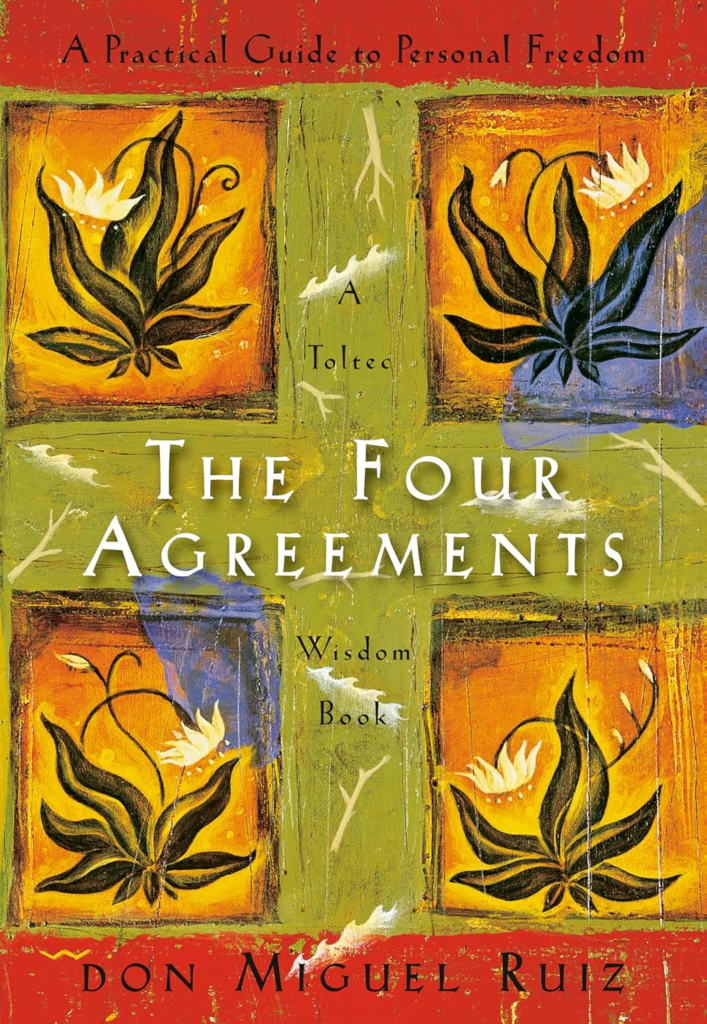
The Four Agreements: A Practical Guide to Personal Freedom is a self-help and spiritual book by Mexican author Don Miguel Ruiz, with Janet Mills credited as a contributor to the work. First published in 1997 by Amber-Allen Publishing, the book presents four behavioral principles that Ruiz describes as a practical code for achieving greater personal freedom, happiness, and peace of mind.
The four principles are:
- Be impeccable with your word
- Don’t take anything personally
- Don’t make assumptions
- Always do your best
Ruiz presents these principles within a broader spiritual framework that he describes as Toltec wisdom. The book argues that much of human suffering comes from beliefs and behavioral patterns that people acquire through what Ruiz calls “domestication”—the process by which individuals learn social expectations, judgments, fears, and ideas about themselves and the world.
Rather than presenting a conventional psychological or academic theory, The Four Agreements uses spiritual teachings, metaphors, stories, and practical advice. Its central proposition is that individuals can change their experience of life by consciously replacing unhelpful internal “agreements” with more constructive ones.
The book became an international bestseller and has remained one of Ruiz’s best-known works. Publisher and bibliographic sources describe it as a New York Times bestseller for more than a decade and report that it has been published in dozens of languages.
Book information
| Field | Details |
|---|---|
| Title | The Four Agreements: A Practical Guide to Personal Freedom |
| Author | Don Miguel Ruiz |
| Contributor | Janet Mills |
| Original language | English |
| Country of origin | United States / Mexican author |
| Genre | Self-help, spirituality, personal development |
| Subject | Personal freedom, beliefs, behavior, happiness, relationships |
| Publisher | Amber-Allen Publishing |
| First published | 1997 |
| Series | Toltec Wisdom |
| Original ISBN | 978-1-878424-31-0 |
| Length | Approximately 140–160 pages, depending on edition |
| Original format | Print book |
| Later formats | Paperback, hardcover, ebook, audiobook and illustrated editions |
Bibliographic records identify the 1997 Amber-Allen edition and list Janet Mills as a contributor. Different editions vary in pagination and ISBN.
Overview
At first glance, The Four Agreements is an unusually simple book. Its entire framework can be remembered in four sentences. Yet Ruiz uses those four sentences as entry points into a much larger discussion about identity, fear, communication, relationships, self-judgment and personal responsibility.
The book begins with an important premise: people do not enter adulthood with completely independent ideas about how they should live. From childhood, they absorb rules and expectations from parents, teachers, relatives, religious traditions, communities, institutions and wider culture.
Ruiz describes these learned beliefs as agreements.
An agreement, in the terminology of the book, is not merely a promise made to another person. It can be an internal conclusion about oneself or the world.
For example, a person may gradually come to believe:
- “I am not good enough.”
- “People will reject me if I make mistakes.”
- “I must please everyone.”
- “Other people’s opinions determine my worth.”
- “If someone criticizes me, I must have done something wrong.”
Ruiz’s argument is that such beliefs can become automatic patterns of thought and behavior.
The purpose of the four new agreements is therefore not simply to “think positively.” It is to become more conscious of the assumptions and reactions that govern everyday life.
The central idea: agreements
The word agreement is the organizing concept of the entire book.
Ruiz suggests that human beings construct an internal model of reality through countless agreements. Some are consciously chosen; many are inherited or absorbed without deliberate examination.
The resulting system can be represented as follows:
                  EXPERIENCE
                      │
                      ▼
              ┌───────────────┐
              │ Interpretation│
              └───────┬───────┘
                      │
                      ▼
                 BELIEF
                      │
                      ▼
                AGREEMENT
                      │
                      ▼
                 BEHAVIOR
                      │
                      ▼
                 CONSEQUENCE
                      │
                      └───────────┐
                                  ▼
                            Reinforcement
                                  │
                                  └──► New experience
In Ruiz’s framework, the cycle can operate in either direction.
A limiting belief can reinforce itself through repeated behavior. Conversely, deliberately adopting a different agreement can gradually change the way a person responds to familiar situations.
This is one reason the book focuses less on changing other people and more on changing one’s own responses.
“The Dream of the Planet”
One of the book’s foundational concepts is what Ruiz calls “the dream of the planet.”
This refers to the collective system of beliefs, rules, expectations, values and judgments into which individuals are born.
Children learn what is considered acceptable and unacceptable behavior. They learn concepts such as success, failure, beauty, status, morality, responsibility and social approval.
Ruiz calls this process domestication.
In his presentation, domestication can produce both useful social learning and limiting beliefs. A child may learn how to communicate and cooperate with others, but may also learn fear, shame or rigid ideas about personal worth.
The individual eventually begins to police their own behavior through an internalized system of rewards and punishments.
Ruiz’s basic model
Childhood
   ↓
Family + School + Culture + Society
   ↓
Rules and Expectations
   ↓
Beliefs
   ↓
Personal Agreements
   ↓
Self-Judgment
   ↓
Fear / Guilt / Anxiety / Conflict
The four agreements are presented as an alternative framework for interrupting this process.
The Four Agreements
1. Be impeccable with your word
The first agreement concerns language.
Ruiz treats speech as a form of power. Words can be used constructively—to communicate, encourage and clarify—or destructively—to deceive, insult, manipulate or attack.
The principle therefore asks readers to become more deliberate about how they use language.
What the agreement emphasizes
According to Ruiz’s framework, being impeccable with one’s word involves:
- speaking honestly;
- avoiding unnecessary gossip;
- avoiding deliberately harmful speech;
- communicating clearly;
- avoiding destructive self-talk;
- using language in a constructive manner.
The idea extends beyond conversations with other people. Ruiz places particular emphasis on the words people direct toward themselves.
A person who repeatedly tells themselves that they are worthless, incapable or destined to fail may eventually begin to behave according to those statements.
Communication cycle
             THOUGHT
                ↓
              WORD
                ↓
             ACTION
                ↓
           CONSEQUENCE
                ↓
            REPUTATION
                ↓
         RELATIONSHIPS
The agreement therefore treats language not as a minor social skill but as an important component of personal behavior.
Practical interpretation
In everyday life, the principle can be applied through simple questions:
Before speaking:
Is it true?
Is it necessary?
Is it constructive?
Am I communicating or merely reacting?
The book’s emphasis is not on becoming silent. It is on becoming more conscious of speech.
2. Don’t take anything personally
The second agreement addresses other people’s opinions and behavior.
Ruiz argues that people frequently interpret other people’s words and actions as statements about their own identity.
A criticism becomes “I am a failure.”
Someone’s anger becomes “They hate me.”
A friend’s silence becomes “I must have done something wrong.”
A rejection becomes “There is something fundamentally wrong with me.”
Ruiz challenges this interpretation.
He argues that other people’s behavior is shaped by their own experiences, beliefs, emotions and perceptions.
The basic distinction
OTHER PERSON'S WORLD
        │
        ├── beliefs
        ├── fears
        ├── expectations
        ├── experiences
        └── emotions
                │
                ▼
        THEIR BEHAVIOR
                │
                ▼
      YOUR INTERPRETATION
                │
                ▼
        YOUR EMOTIONAL
           RESPONSE
The second agreement attempts to create greater distance between what another person does and what you conclude about yourself.
This does not mean that every criticism is meaningless.
A useful distinction is:
Not taking something personally does not mean refusing to learn from it.
A person can hear criticism, examine it objectively and change their behavior when appropriate—without allowing the criticism to become a judgment about their entire identity.
Example
Imagine a manager says:
“Your report contained several errors.”
Two interpretations are possible.
Personal interpretation:
“I am incompetent.”
Non-personal interpretation:
“There are errors in my report. I should identify them and improve the process.”
The external event is similar. The internal response is radically different.
3. Don’t make assumptions
The third agreement concerns interpretation and communication.
Human beings frequently fill gaps in information with assumptions.
Someone does not return a phone call.
A person may immediately think:
“They are angry with me.”
Someone looks serious during a meeting.
The interpretation becomes:
“They don’t like my idea.”
A friend cancels dinner.
The conclusion becomes:
“They don’t value our friendship.”
The problem is that the conclusion may have little relationship to reality.
Ruiz therefore encourages readers to ask questions and communicate clearly rather than constructing stories from incomplete information.
Assumption cycle
Incomplete information
        ↓
       Guess
        ↓
     Assumption
        ↓
   Emotional reaction
        ↓
      Behavior
        ↓
 Misunderstanding
        ↓
      Conflict
Alternative cycle
Incomplete information
        ↓
       Pause
        ↓
       Ask
        ↓
     Clarify
        ↓
   Understand
        ↓
     Respond
This is perhaps one of the most immediately practical ideas in the book.
Instead of:
“I know why you did that.”
the reader is encouraged to ask:
“Can you help me understand what happened?”
4. Always do your best
The fourth agreement is different from the first three because it converts them into a daily practice.
Ruiz does not define “your best” as a fixed level of performance.
Instead, he argues that one’s best changes according to circumstances.
A person’s best on a day of good health and adequate sleep will not necessarily be the same as their best when they are exhausted, sick or under severe pressure.
The changing nature of “best”
Energy
  │
  │       /\        Good day
  │      /  \
  │  ___/    \___
  │ /            \       Difficult day
  │/              \__/\__
  └──────────────────────────► Time
The important point is therefore not perfection.
It is consistent effort appropriate to the circumstances.
This concept also connects the fourth agreement with the other three:
Be impeccable with your word
             +
Don't take things personally
             +
Don't make assumptions
             +
Always do your best
             ↓
      PRACTICE THE SYSTEM
             ↓
     Reduced self-judgment
             ↓
    Greater personal freedom
The fourth agreement prevents the first three from becoming another source of perfectionism.
A person who fails to follow one of the agreements perfectly is not expected to condemn themselves. They simply begin again and do their best under the circumstances.
The four agreements at a glance
| Agreement | Central issue | Question to ask |
|---|---|---|
| Be impeccable with your word | Communication | “Are my words truthful and constructive?” |
| Don’t take anything personally | Emotional interpretation | “Does this really define me?” |
| Don’t make assumptions | Misunderstanding | “What do I actually know?” |
| Always do your best | Action and consistency | “What is my best under today’s circumstances?” |
Infographic: The Four Agreements
╔══════════════════════════════════════════════╗
║             THE FOUR AGREEMENTS              ║
║        A PRACTICAL GUIDE TO FREEDOM          ║
╠══════════════════════════════════════════════╣
║                                              ║
║  01  WORD                                     ║
║      Be impeccable with your word             ║
║      ↓                                        ║
║      Speak with awareness                     ║
║                                              ║
║  02  OPINIONS                                 ║
║      Don't take anything personally            ║
║      ↓                                        ║
║      Separate others' behavior from your worth║
║                                              ║
║  03  ASSUMPTIONS                              ║
║      Don't make assumptions                    ║
║      ↓                                        ║
║      Ask. Clarify. Communicate.               ║
║                                              ║
║  04  ACTION                                   ║
║      Always do your best                      ║
║      ↓                                        ║
║      Practice without demanding perfection    ║
║                                              ║
╠══════════════════════════════════════════════╣
║              PERSONAL FREEDOM                 ║
╚══════════════════════════════════════════════╝
Breaking old agreements
After explaining the four principles, Ruiz turns to the problem of changing deeply established patterns.
Simply understanding an idea is not necessarily enough to change behavior.
A person may intellectually know that they should not take criticism personally and still become angry when criticized.
Likewise, someone may know that assumptions are dangerous and nevertheless invent explanations for other people’s behavior.
The book therefore presents personal change as a process of breaking old agreements and replacing them with new ones.
The process
OLD AGREEMENT
      ↓
Recognize the pattern
      ↓
Question the belief
      ↓
Identify its consequences
      ↓
Choose a new agreement
      ↓
Practice repeatedly
      ↓
New response
      ↓
New habit
The approach is deliberately repetitive. The agreements are not presented as something that can simply be read once and permanently mastered.
The role of fear
Fear is one of the recurring themes in Ruiz’s framework.
According to the book, fear can influence people to seek approval, avoid rejection, suppress themselves and interpret ordinary events as threats to their identity.
This produces a pattern in which individuals attempt to control both themselves and other people.
The book’s proposed alternative is greater awareness and personal responsibility.
Rather than asking:
“How can I make everyone treat me the way I want?”
the reader is encouraged to ask:
“How can I control my own response?”
This distinction is central to the book’s concept of personal freedom.
Personal freedom
The word freedom in the title does not primarily refer to political or legal freedom.
It refers to an internal form of freedom.
Ruiz uses the concept to describe freedom from:
- unnecessary self-judgment;
- dependence on other people’s approval;
- automatic assumptions;
- destructive self-talk;
- fear-driven behavior;
- inherited beliefs that no longer serve the individual.
The book therefore defines freedom largely in psychological and spiritual terms.
The “new dream”
Near the end of the book, Ruiz describes an alternative way of living, sometimes presented as a new dream.
The metaphor contrasts two ways of experiencing life:
The old dream
Fear
 ↓
Judgment
 ↓
Guilt
 ↓
Self-criticism
 ↓
Conflict
 ↓
Suffering
The new dream
Awareness
 ↓
Respect
 ↓
Clear communication
 ↓
Personal responsibility
 ↓
Acceptance
 ↓
Freedom
The book does not present this as a scientific model. It is part of Ruiz’s spiritual framework for understanding human experience.
The Toltec background
One of the most important contextual issues surrounding The Four Agreements is its relationship to Toltec tradition.
Ruiz explicitly presents his teachings as based on ancient Toltec wisdom. The book is marketed as a “Toltec Wisdom Book,” and Ruiz’s official website describes the work in these terms.
Historically, the Toltecs were a Mesoamerican culture associated with Tula in present-day Hidalgo, Mexico. Their influence and historical interpretation have been subjects of scholarly discussion, and later Nahua traditions attributed substantial cultural significance to the Toltecs.
However, readers should distinguish between:
- the historical Toltec civilization, studied through archaeology and historical sources; and
- Ruiz’s modern spiritual presentation of “Toltec wisdom.”
The Four Agreements should therefore be understood primarily as a modern spiritual and self-help interpretation rather than as a conventional academic history of Toltec civilization.
This distinction is important because the book’s purpose is not to provide a historical reconstruction of pre-Columbian Mexico. Its purpose is to communicate Ruiz’s philosophy of personal development.
Structure of the book
The original work is organized around a progression from the problem of learned beliefs to the four agreements and finally toward a broader conception of personal freedom.
A catalog record from the University of North Texas lists the following major sections:
- Domestication and the Dream of the Planet
- The First Agreement: Be Impeccable with Your Word
- The Second Agreement: Don’t Take Anything Personally
- The Third Agreement: Don’t Make Assumptions
- The Fourth Agreement: Always Do Your Best
- The Toltec Path to Freedom: Breaking Old Agreements
- The New Dream: Heaven on Earth
- Prayers
The structure is deliberately straightforward. Ruiz introduces a worldview, develops four principles and then returns to the larger question of freedom.
Major themes
1. Personal responsibility
The book repeatedly redirects attention from controlling other people to controlling one’s own reactions.
2. Language
Words are presented as powerful instruments capable of building relationships or causing harm.
3. Emotional independence
Readers are encouraged not to define themselves entirely through other people’s opinions.
4. Communication
The third agreement emphasizes the importance of asking rather than guessing.
5. Self-awareness
The reader is encouraged to notice automatic beliefs and behavioral patterns.
6. Imperfection
The fourth agreement acknowledges that human performance changes from day to day.
7. Freedom from inherited beliefs
The book asks readers to reconsider beliefs that were absorbed rather than consciously selected.
Examples from everyday life
The usefulness of the framework becomes clearer when applied to ordinary situations.
Situation 1: Criticism at work
Automatic response:
“They think I’m incompetent.”
Four-agreement response:
- Listen carefully.
- Don’t turn criticism into an identity judgment.
- Ask what specifically needs improvement.
- Do your best to correct the problem.
Situation 2: An unanswered message
Automatic response:
“They are ignoring me.”
Four-agreement response:
- Recognize that the reason is unknown.
- Avoid constructing a story.
- Ask if clarification is important.
- Continue with your own responsibilities.
Situation 3: Making a mistake
Automatic response:
“I always fail.”
Four-agreement response:
- Describe the actual mistake.
- Avoid exaggeration.
- Learn from it.
- Make a reasonable effort to improve.
Situation 4: An argument
Automatic response:
“I have to prove that I’m right.”
Four-agreement response:
- Listen.
- Separate facts from assumptions.
- Communicate clearly.
- Accept that another person may see the situation differently.
Why the book remains memorable
One reason for the book’s continuing popularity is the simplicity of its framework.
Many self-help systems contain dozens of rules, exercises or techniques. Ruiz reduces his central message to four memorable statements.
This makes the ideas relatively easy to recall during ordinary situations.
The framework also addresses four different stages of everyday life:
          THE FOUR AGREEMENTS

               LANGUAGE
                  │
                  ▼
          "What do I say?"
                  │
                  ▼
          INTERPRETATION
                  │
                  ▼
       "How do I take things?"
                  │
                  ▼
          COMMUNICATION
                  │
                  ▼
       "What am I assuming?"
                  │
                  ▼
             ACTION
                  │
                  ▼
       "What can I do today?"
This gives the book an unusually compact conceptual architecture.
Criticism and limitations
Like many spiritual and self-help books, The Four Agreements is best understood within the genre in which it was written.
It is not a clinical psychology textbook, a controlled scientific study, or a historical academic treatment of Toltec civilization.
Its claims about personal transformation are primarily philosophical and spiritual rather than experimentally established psychological laws.
Readers may therefore find value in the four principles as reflective practices without treating every metaphysical claim in the book as an empirically demonstrated fact.
There is also a potential limitation in applying “don’t take anything personally” too literally. In real relationships and workplaces, feedback can contain important information, and harmful behavior can sometimes require boundaries or intervention. Not taking an event personally does not require ignoring genuine mistreatment.
Similarly, “always do your best” can be interpreted constructively as an antidote to perfectionism, but a reader could also turn it into another demand for constant prod