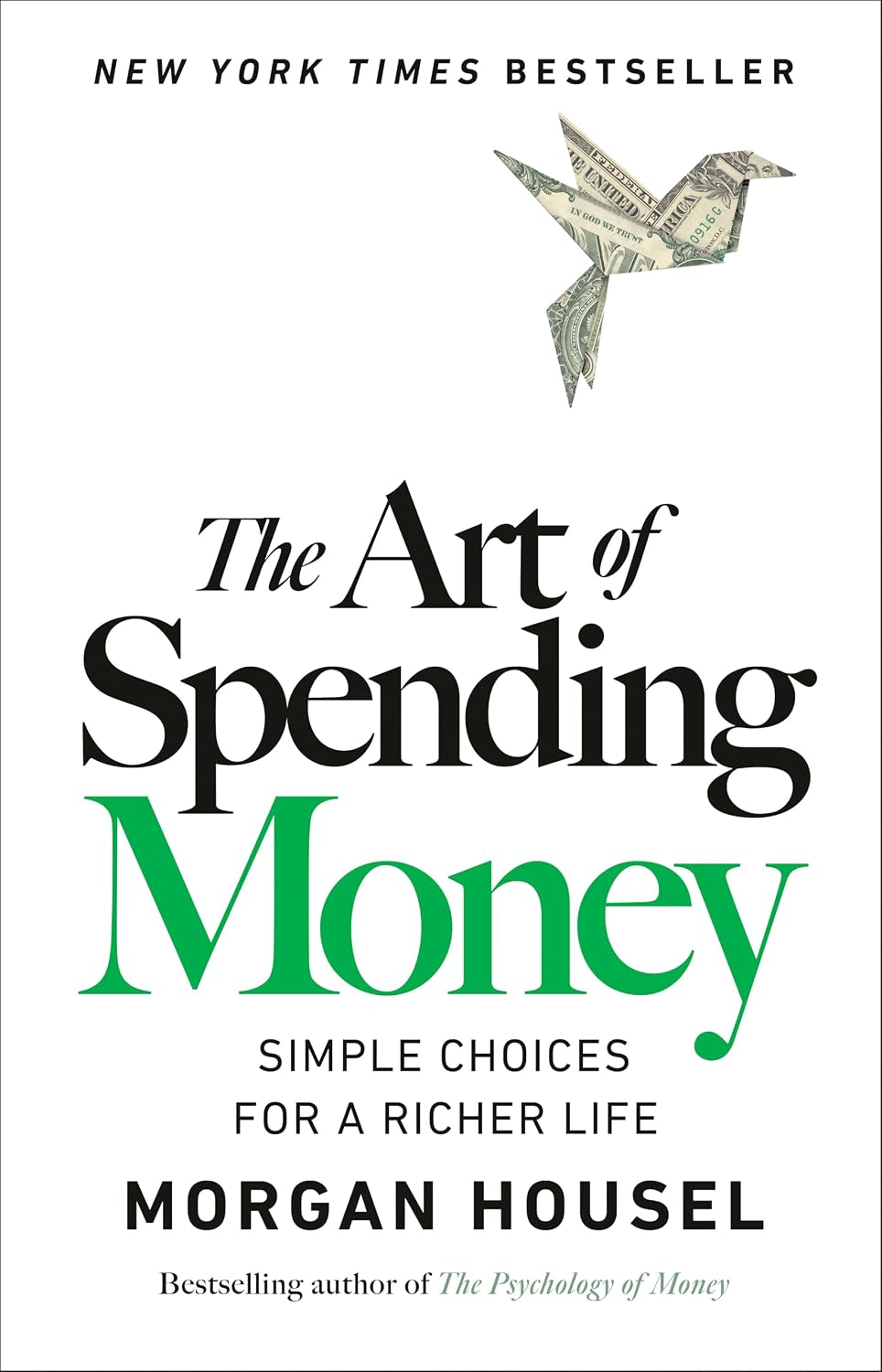
The Art of Spending Money: Simple Choices for a Richer Life is a personal finance and behavioral economics book by American author and investor Morgan Housel. It was published in October 2025 by Harriman House in the United Kingdom and by Portfolio/Penguin in the United States. The book examines the psychological and social dimensions of spending, arguing that using money well is not simply a matter of maximizing wealth or following a budget but of understanding what actually contributes to a person’s happiness, security, freedom and quality of life.
The book is a thematic continuation of Housel’s earlier work on the psychology of money. Whereas The Psychology of Money focuses principally on how people think and behave around saving, investing, risk and wealth, The Art of Spending Money turns its attention toward the other side of personal finance: what people do with wealth once they have it.
Housel argues that people frequently spend money according to social pressures, envy, expectations and status rather than according to what genuinely improves their lives. Conversely, some people become so focused on accumulating wealth that they hesitate to spend money on experiences, relationships, convenience, security or other things that could materially improve their lives.
The book therefore presents spending as a problem of judgment rather than arithmetic.
Its central question is not simply:
“How much can I afford?”
but:
“What is actually worth spending my money on?”
The book explores concepts including expectations, envy, social comparison, identity, status, financial security, patience, opportunity cost, future happiness and the relationship between wealth and well-being. Publisher descriptions emphasize that Housel deliberately avoids conventional budgeting formulas and instead provides psychological tools for understanding one’s relationship with money.
Book information
| Item | Details |
|---|---|
| Author | Morgan Housel |
| Full title | The Art of Spending Money: Simple Choices for a Richer Life |
| Language | English |
| Country | United States |
| Subject | Personal finance, behavioral finance, psychology of money |
| Genre | Business and personal finance nonfiction |
| Original publisher | Harriman House |
| United States publisher | Portfolio/Penguin |
| Publication date | October 7, 2025 |
| United Kingdom edition | October 14, 2025 |
| ISBN-10 | 1804091898 (Harriman House edition) |
| ISBN-13 | 9781804091890 |
| U.S. ISBN-13 | 9780593716632 |
| Length | 250 pages in the Harriman House edition; 256 pages in the U.S. edition |
| Primary subjects | Spending, wealth, happiness, behavioral finance, personal finance |
| Preceded by | Same as Ever |
| Related earlier work | The Psychology of Money |
Bibliographic records list Harriman House’s 2025 edition at 250 pages and the U.S. Portfolio edition at 256 pages. Different international editions have slightly different pagination.
About the author

Morgan Housel is a partner at The Collaborative Fund. He is a two-time winner of the Best in Business Award from the Society of American Business Editors and Writers, winner of the New York Times Sidney Award, and a two-time finalist for the Gerald Loeb Award for Distinguished Business and Financial Journalism. He lives in Seattle with his wife and two kids.
Background
The Art of Spending Money emerged from Morgan Housel’s broader interest in the behavioral side of finance.
Housel’s writing generally emphasizes that financial decisions cannot be understood through mathematics alone. People make financial choices according to their personal histories, emotions, expectations, ambitions, fears and relationships with other people.
His earlier book, The Psychology of Money, became an international bestseller by presenting financial behavior through short stories and observations rather than conventional technical instruction. Harriman House describes that book as a collection of 19 stories exploring the ways people think about money.
The Art of Spending Money extends this perspective into consumption.
The underlying question changes from:
How should I build wealth?
to:
What should wealth allow me to do?
Central premise
The central premise of the book is that having money and knowing how to use money are different skills.
A person can be financially successful and still make poor spending decisions.
Likewise, someone with a modest income can sometimes derive considerable satisfaction from money when it is directed toward things that genuinely matter.
Housel therefore distinguishes between:
wealth accumulation
and
wealth utilization.
The distinction can be represented as:
                 MONEY
                   │
          ┌────────┴────────┐
          │                 │
          ▼                 ▼
       EARNING           INVESTING
          │                 │
          └────────┬────────┘
                   ▼
                 WEALTH
                   │
                   ▼
               SPENDING
                   │
          ┌────────┴────────┐
          │                 │
          ▼                 ▼
      STATUS / ENVY     WELL-BEING
          │                 │
          ▼                 ▼
      SHORT-LIVED       LONGER-
      SATISFACTION      LASTING VALUE
The book is concerned primarily with the final transition: turning financial resources into a better life.
Spending as a psychological problem
Traditional personal-finance advice often treats spending as an optimization problem.
Income is compared with expenses.
Savings are calculated.
Budgets are created.
Debt is measured.
Investment returns are projected.
Housel approaches the problem differently.
He asks why people want particular things in the first place.
The psychological sequence is often:
DESIRE
  ↓
COMPARISON
  ↓
EXPECTATION
  ↓
PURCHASE
  ↓
TEMPORARY SATISFACTION
  ↓
ADAPTATION
  ↓
NEW DESIRE
This cycle can continue indefinitely.
The book’s larger objective is to help readers interrupt it.
Can money buy happiness?
One of the provocative premises of The Art of Spending Money is that the relationship between money and happiness is more complicated than the familiar statement that “money cannot buy happiness.”
The publisher’s description explicitly frames the issue by asking whether money can buy happiness and answers that it can—provided it is used intelligently.
The important distinction is therefore not:
money versus happiness
but:
how money is converted into well-being.
Money can potentially purchase things such as:
- time;
- convenience;
- security;
- experiences;
- health-related resources;
- opportunities;
- autonomy;
- relationships and shared experiences.
But it can also be spent on:
- status competition;
- unnecessary consumption;
- social comparison;
- short-lived pleasures;
- possessions that quickly become ordinary.
The quality of the spending decision therefore matters.
The spending paradox
Housel identifies a paradox at the center of modern wealth:
The ability to spend more does not necessarily increase the ability to enjoy spending.
As income rises, expectations can rise with it.
A person earning more money may simply move into a more expensive version of the same psychological game.
Higher income
      ↓
Higher expectations
      ↓
Higher spending
      ↓
New "normal"
      ↓
No proportional increase
in satisfaction
This is one reason the book emphasizes psychology rather than income alone.
Expectations
Expectations are among the most important forces affecting financial satisfaction.
Two people can have identical incomes and radically different experiences of wealth because their expectations differ.
Consider two simplified cases:
| Person | Income | Lifestyle expectation | Financial feeling |
|---|---|---|---|
| A | High | Very high | “Not enough” |
| B | Moderate | Moderate | “Enough” |
| C | Lower | Low | “Comfortable” |
The table illustrates an important principle:
Financial satisfaction is partly relative to expectations.
An increase in income does not automatically produce an equivalent increase in satisfaction if expectations rise at the same time.
The expectation-income relationship
The book’s argument can be visualized conceptually:
SATISFACTION
   │
   │       ╭───────╮
   │      ╱         ╲
   │     ╱           ╲
   │────╱─────────────╲────────
   │
   └─────────────────────────────
             INCOME
The diagram is conceptual rather than a statistical curve.
The point is that increasing income can produce diminishing psychological benefits when expectations, lifestyle inflation and social comparison rise alongside it.
Envy and admiration
One of Housel’s recurring concerns is the difficulty of distinguishing admiration from envy.
A person may believe they want what another person possesses.
But the deeper desire may actually be:
- recognition;
- status;
- respect;
- security;
- freedom;
- belonging;
- proof of success.
The visible object may therefore be a proxy for something else.
For example:
Luxury car
    ↓
What appears desirable
    ↓
Status?
Recognition?
Freedom?
Identity?
Security?
Admiration?
The book encourages readers to investigate the underlying motivation rather than automatically purchasing the visible symbol.
Status spending
Status is one of the most powerful forces influencing consumption.
People often spend money not because they need something but because the purchase communicates something about them.
Examples can include:
- luxury vehicles;
- designer clothing;
- expensive watches;
- large homes;
- exclusive memberships;
- premium travel;
- prestigious schools;
- conspicuous experiences.
The problem with status consumption is that it depends heavily on other people’s reactions.
A purchase intended to communicate success may therefore create a permanent dependence on social comparison.
Social comparison
Human beings naturally compare themselves with others.
Financially, this can become destructive.
A person’s lifestyle may be objectively comfortable but feel inadequate when compared with someone wealthier.
This produces a phenomenon that can be expressed as:
YOUR LIFE
   ↓
LOOK AT SOMEONE ELSE
   ↓
THEIR BEST VISIBLE MOMENTS
   ↓
COMPARISON
   ↓
FEELING OF INSUFFICIENCY
   ↓
MORE SPENDING
Modern social media can intensify this effect because people are continually exposed to carefully selected images of other people’s lifestyles.
Social debt
The book discusses the concept of social debt, referring broadly to the obligations and pressures created by social expectations.
Money can create commitments that are not visible on a balance sheet.
For example:
- maintaining a certain lifestyle;
- keeping up with friends;
- participating in expensive social activities;
- supporting an image of success;
- accepting expectations created by previous spending.
The result can be a form of financial lock-in.
A person may technically be wealthy while feeling unable to change their lifestyle.
The cost of keeping up
The psychological cost of status competition can exceed the purchase price.
Suppose someone buys an expensive item.
The financial cost may be:
₹X / $X
But the social cost can include:
- maintaining the appearance;
- buying complementary products;
- upgrading later;
- comparing oneself with wealthier peers;
- worrying about losing status.
The true cost can therefore be:
purchase price + future expectations + psychological commitment
The hedonic treadmill
The book’s ideas are closely related to the psychological concept commonly called the hedonic treadmill.
People often adapt to improvements in circumstances.
A new home initially feels exciting.
A new car feels special.
A higher salary feels liberating.
A luxury holiday feels extraordinary.
Over time, however, these experiences can become normal.
The cycle becomes:
NEW PURCHASE
     ↓
EXCITEMENT
     ↓
ADAPTATION
     ↓
NORMALIZATION
     ↓
DESIRE FOR SOMETHING NEW
This does not mean that purchases never create lasting happiness.
Rather, it suggests that novelty alone is an unreliable source of durable satisfaction.
The difference between pleasure and satisfaction
A central distinction in the book is between immediate pleasure and deeper satisfaction.
Pleasure
- immediate;
- often temporary;
- frequently associated with novelty;
- can be repeated but may diminish.
Satisfaction
- may develop slowly;
- can come from relationships;
- can arise from security;
- can be connected with purpose;
- may survive beyond the initial purchase.
Housel’s framework encourages readers to consider the second category more carefully.
Spending on time
One of the most valuable uses of money, according to the book’s broader framework, is the purchase of time.
Money can sometimes reduce activities that consume time without providing meaningful value.
Examples include:
- outsourcing tedious work;
- reducing unnecessary commuting;
- paying for convenience;
- living closer to important activities;
- purchasing tools that save repetitive effort.
The key principle is:
Money can be exchanged for time.
And time cannot be replenished.
The value of convenience
Convenience is sometimes dismissed as an unnecessary luxury.
Housel’s framework challenges that assumption.
If a purchase saves time, reduces stress or removes a recurring burden, its value may exceed its visible monetary cost.
A simplified model is:
FINANCIAL COST
       +
TIME SAVED
       +
STRESS REDUCED
       +
MENTAL ENERGY SAVED
       ↓
TOTAL VALUE
This is especially relevant when evaluating purchases that do not look “financially optimal” in isolation.
Spending for future happiness
Another major theme is the idea that spending can be evaluated according to its future value rather than only its immediate pleasure.
For example, money spent on:
- education;
- health;
- relationships;
- useful tools;
- meaningful experiences;
- financial security;
may create benefits long after the initial transaction.
The relevant question becomes:
How long will this purchase improve my life?
Return on spending
Housel’s approach can be understood as an alternative form of return-on-investment analysis.
Traditional investment:
Money → Asset → Financial return
Spending for well-being:
Money → Experience / time / security / relationship → Life benefit
The second form of return may not appear on a financial statement.
                 MONEY
                   │
       ┌───────────┼───────────┐
       │           │           │
       ▼           ▼           ▼
     TIME       SECURITY    EXPERIENCE
       │           │           │
       └───────────┼───────────┘
                   ▼
             QUALITY OF LIFE
The importance of security
Financial security is itself a form of consumption.
Having sufficient savings can purchase something that cannot be placed neatly on a shopping receipt:
peace of mind.
A large financial reserve can provide:
- freedom to leave a bad job;
- ability to handle emergencies;
- flexibility during economic downturns;
- reduced dependence on others;
- freedom to take calculated risks.
Thus, not spending money can sometimes be a way of spending money well.
The purchase is invisible:
money → optionality
Wealth and optionality
Housel’s earlier work strongly emphasized the value of financial flexibility, and this idea remains relevant to the spending philosophy developed in The Art of Spending Money.
Wealth is not merely a pile of assets.
It can represent choices.
WEALTH
  ↓
OPTIONALITY
  ↓
CHOICES
  ↓
AUTONOMY
  ↓
PEACE OF MIND
This is one reason excessive consumption can undermine the very freedom that wealth is supposed to provide.
The paradox of saving
Saving is normally considered the opposite of spending.
Housel’s framework complicates that distinction.
Saving can itself be a form of spending if what is being purchased is:
- security;
- independence;
- flexibility;
- future opportunities;
- freedom from financial anxiety.
Thus:
Saving is not necessarily refusing to use money.
It can be using money to buy future freedom.
The fastest way to build wealth may be to go slowly
One of the book’s ideas, highlighted by publisher descriptions, is that going slowly can be an effective path to wealth.
The argument reflects Housel’s broader skepticism toward rapid wealth schemes.
A simplified model is:
FAST WEALTH
   ↓
HIGH RISK
   ↓
HIGH EXPECTATIONS
   ↓
POSSIBLE LARGE LOSSES

SLOW WEALTH
   ↓
COMPOUNDING
   ↓
TIME
   ↓
RESILIENCE
   ↓
SUSTAINABLE WEALTH
The concept is consistent with Housel’s broader emphasis on patience, survival and avoiding financial decisions that can permanently damage one’s position.
Compounding and patience
Compound growth is one of the central mechanisms of long-term wealth creation.
But compounding requires time.
A person seeking immediate results may take risks that undermine the very process they are trying to accelerate.
The book therefore places value on:
- patience;
- consistency;
- avoiding ruin;
- moderate expectations;
- long time horizons.
The relationship between spending and investing
Spending and investing are often treated as completely separate activities.
Housel’s framework brings them closer together.
A purchase can be evaluated according to the future value it produces.
For example:
Investment in education
may produce future income.
Investment in health
may produce future capability.
Investment in relationships
may produce future social and emotional value.
Investment in financial security
may produce future freedom.
The distinction between “spending” and “investing” therefore becomes less rigid.
Regret
The book also considers the role of regret in financial decision-making.
Every financial decision involves opportunity cost.
If you spend money on one thing, you cannot spend the same money on another.
If you save money instead of spending it, you may lose an opportunity to enjoy something today.
The challenge is to balance:
present regret
against
future regret.
A useful framework is:
               FINANCIAL CHOICE
                      │
          ┌───────────┴───────────┐
          │                       │
          ▼                       ▼
       SPEND NOW               SAVE NOW
          │                       │
          ▼                       ▼
  Possible future regret   Possible present regret
  "I should have saved"    "I wish I had enjoyed it"
Good financial judgment attempts to minimize the regrets that matter most.
The danger of over-saving
Saving is usually beneficial, but Housel recognizes a potential psychological problem:
saving can become an end in itself.
A person may accumulate money indefinitely without ever defining what the money is supposed to accomplish.
This creates a paradox:
WORK
 ↓
SAVE
 ↓
INVEST
 ↓
ACCUMULATE
 ↓
SAVE MORE
 ↓
WHEN DO I ACTUALLY USE IT?
The book therefore asks readers to define the purpose of wealth.
Enough
The concept of “enough” is central to Housel’s broader philosophy of money.
Without a definition of enough, every financial achievement can become temporary.
A person who earns $100,000 may want $200,000.
Someone with $1 million may want $5 million.
Someone with $5 million may compare themselves with someone who has $50 million.
The number changes.
The psychological problem remains.
MORE
 ↓
MORE
 ↓
MORE
 ↓
MORE
 ↓
NO FINISH LINE
Defining “enough” introduces an endpoint to the competition.
The psychology of lifestyle inflation
Lifestyle inflation occurs when increased income leads to increased spending.
Some lifestyle inflation is rational.
Higher income may genuinely permit:
- better housing;
- better food;
- better healthcare;
- more travel;
- more convenience.
The problem occurs when every increase in income becomes an obligation to increase consumption.
The result can be:
Income ↑
   ↓
Lifestyle ↑
   ↓
Fixed expenses ↑
   ↓
Required income ↑
   ↓
Freedom ↓
A higher salary can therefore paradoxically create less flexibility.
Identity and money
Money is frequently used to express identity.
People purchase things that communicate:
- who they are;
- who they want to become;
- which group they belong to;
- what they value;
- what they want others to believe about them.
This makes spending deeply personal.
The same object can have very different meanings for different people.
The social meaning of consumption
Consumption is not always about utility.
A house, vehicle, watch, restaurant or holiday can have symbolic value.
This produces three different dimensions of value:
                 PURCHASE
                    │
       ┌────────────┼────────────┐
       │            │            │
       ▼            ▼            ▼
    UTILITY       EMOTION       STATUS
       │            │            │
       ▼            ▼            ▼
    Function     Pleasure     Social signal
The book encourages readers to recognize which of these is actually driving a purchase.
Utility versus status
One of the most useful questions arising from the book is:
“Would I still want this if nobody else knew I owned it?”
This question does not mean that status is always bad.
Status can provide:
- social recognition;
- professional credibility;
- belonging;
- access;
- confidence.
But the question helps identify whether the purchase is primarily for oneself or for an imagined audience.
Spending and relationships
Money is often most valuable when it strengthens relationships.
Shared experiences can create memories that last considerably longer than the excitement generated by many physical purchases.
Examples include:
- family travel;
- meals with friends;
- celebrations;
- experiences with children;
- time with parents;
- helping someone important.
The value of such spending cannot easily be measured in monetary terms.
Experiences versus possessions
The book’s framework is broadly compatible with research and psychological observations about the different ways people respond to experiences and material possessions.
Experiences often produce:
- anticipation;
- memories;
- stories;
- shared experiences;
- identity.
Possessions often produce:
- convenience;
- utility;
- comfort;
- status;
- ownership.
Neither category is automatically superior.
The question is whether the purchase creates lasting value for the individual.
A personal spending philosophy
Rather than prescribing a universal budget, the book encourages the development of a personal philosophy.
A useful conceptual framework is:
Spend generously on
Things that:
- genuinely improve your life;
- save significant time;
- improve relationships;
- create meaningful experiences;
- increase security;
- support health;
- align with personal values.
Spend cautiously on
Things primarily driven by:
- envy;
- status competition;
- social pressure;
- temporary novelty;
- fear of missing out;
- other people’s expectations.
Save deliberately for
Things that provide:
- freedom;
- optionality;
- future security;
- independence;
- resilience.
The personal spending equation
A conceptual interpretation of Housel’s ideas can be expressed as:
              VALUE OF SPENDING

     BENEFIT TO YOU
            +
     BENEFIT TO OTHERS
            +
       TIME SAVED
            +
      SECURITY GAINED
            +
     FUTURE VALUE
            -
      STATUS PRESSURE
            -
       SOCIAL DEBT
            -
      FUTURE REGRET
            ↓
       NET LIFE VALUE
This is not a mathematical formula proposed by Housel. It is an editorial synthesis of the book’s central themes.
Spending as a form of life design
At its deepest level, the book treats personal finance as a form of life design.
A financial plan should therefore answer more than:
How much will I save?
It should answer:
- What kind of life do I want?
- How much time do I want?
- What relationships matter most?
- What risks do I want to avoid?
- What experiences matter?
- What level of security is enough?
- What am I willing to sacrifice?
- What am I unwilling to sacrifice?
Money becomes a tool rather than the final objective.
A different definition of wealth
Traditional definitions of wealth emphasize:
Net worth = Assets − Liabilities
Housel’s philosophy adds another dimension:
Practical wealth = Financial resources + freedom + security + time + optionality
The second definition is not an accounting measure.
It is a measure of what financial resources allow a person to do.
Financial freedom
Financial freedom is often described as having enough money not to work.
The book’s broader framework suggests a more useful interpretation:
Financial freedom is the ability to make meaningful choices without being dominated by financial pressure.
That may include:
- choosing where to live;
- choosing when to work;
- leaving an unhealthy environment;
- taking time off;
- helping family;
- pursuing creative work;
- declining opportunities that are not worth the cost.
Spending and autonomy
The highest-value financial purchase may sometimes be autonomy.
Money can give a person the ability to say:
No.
No to:
- an unsuitable job;
- an unnecessary purchase;
- a social obligation;
- a bad investment;
- a lifestyle expectation;
- an unhealthy relationship with status.
In this sense, wealth can increase the power of refusal.
Why more money does not solve every problem
Housel’s approach does not reject wealth.
It questions the assumption that wealth automatically solves psychological problems.
Money can solve financial problems.
It can reduce certain forms of stress.
It can create choices.
But it cannot automatically provide:
- purpose;
- good relationships;
- self-respect;
- emotional maturity;
- meaningful work;
- contentment.
This distinction is fundamental to the book.
Money as a tool
The book ultimately treats money as a means rather than an end.
                MONEY
                  │
                  ▼
             RESOURCES
                  │
        ┌─────────┼─────────┐
        │         │         │
        ▼         ▼         ▼
       TIME     SECURITY   OPTIONS
        │         │         │
        └─────────┼─────────┘
                  ▼
            QUALITY OF LIFE
                  │
                  ▼
              RICHER LIFE
The word “richer” in the title therefore has a broader meaning than simply “wealthier.”
The meaning of “richer”
A richer life can mean:
- richer relationships;
- richer experiences;
- richer use of time;
- richer intellectual life;
- greater freedom;
- greater security;
- greater contentment.
Money can facilitate these outcomes.
It cannot guarantee them.
Comparison with The Psychology of Money
The Art of Spending Money is closely related to Housel’s earlier bestseller The Psychology of Money, but the books address different sides of financial behavior.
| The Psychology of Money | The Art of Spending Money |
|---|---|
| Building wealth | Using wealth |
| Saving | Spending |
| Investing | Consumption |
| Risk | Satisfaction |
| Compounding | Quality of life |
| Financial behavior | Financial psychology |
| Wealth accumulation | Wealth utilization |
| How to become financially successful | How to make financial success meaningful |
The two books can therefore be read as complementary.
The Psychology of Money:
“How should I behave with money?”
The Art of Spending Money:
“What should my money ultimately do for my life?”
Relationship with Same as Ever
Housel’s 2023 book Same as Ever: A Guide to What Never Changes examines recurring patterns in human behavior, risk and decision-making.
The Art of Spending Money continues this interest in human behavior but applies it specifically to personal consumption and financial well-being.
Together, the three books form a broad progression:
THE PSYCHOLOGY OF MONEY
          ↓
How people behave with money
          ↓
SAME AS EVER
          ↓
What human behavior tends to repeat
          ↓
THE ART OF SPENDING MONEY
          ↓
How money can be used to improve life
Reception
The book received substantial attention immediately following its 2025 publication.
The U.S. edition is identified by Penguin Random House as a bestseller, while Pan Macmillan describes the book as an instant Sunday Times No. 1 bestseller and New York Times bestseller.
Its reception reflects Housel’s established audience following the international success of The Psychology of Money.
The book’s appeal lies partly in its departure from conventional personal-finance instruction. Rather than concentrating on budgeting rules, investment formulas or specific financial products, it addresses the psychological reasons people spend and the ways spending can either improve or undermine well-being.
Critical perspective
Although the book has been widely praised and commercially successful, its approach also has limitations.
Individual differences
There is no universal definition of a “richer life.”
What provides satisfaction to one person may be meaningless to another.
A person’s:
- culture;
- age;
- family responsibilities;
- income;
- health;
- geography;
- values;
- risk tolerance
can substantially alter the usefulness of any spending philosophy.
Wealth inequality
Psychological advice about spending can sometimes obscure structural differences in financial circumstances.
A wealthy person’s decision about whether to spend or save is fundamentally different from that of a person struggling to meet basic needs.
For people without adequate income, emergency savings or financial security, questions of optimization may be secondary to basic financial survival.
Subjectivity of happiness
The relationship between spending and happiness is difficult to quantify.
A purchase may appear irrational financially while being deeply valuable emotionally.
Conversely, an expensive purchase can appear reasonable but provide little lasting satisfaction.
The book therefore operates primarily as a framework for reflection rather than a precise scientific formula for maximizing happiness.
The danger of turning meaning into another optimization problem
There is also a paradox in trying to optimize every spending decision.
If a person continually asks:
“Is this the absolute highest-return use of my money?”
money can become another source of anxiety.
The philosophy of the book ultimately points toward judgment and self-awareness rather than perfect optimization.
Major themes
| Theme | Central question |
|---|---|
| Expectations | How much does lifestyle satisfaction depend on what we expect? |
| Envy | Do I actually want this, or do I want what it represents? |
| Status | Am I buying utility or social recognition? |
| Time | Can money buy back valuable time? |
| Security | How much should I spend to reduce financial anxiety? |
| Enough | When should accumulation stop? |
| Experiences | Which experiences create lasting value? |
| Relationships | Can money strengthen important relationships? |
| Future happiness | Which purchases improve life beyond today? |
| Regret | What decision will I wish I had made differently? |
| Freedom | How can wealth increase autonomy? |
| Patience | Why can slow wealth-building outperform the pursuit of quick gains? |
The Art of Spending Money: conceptual framework
                         MONEY
                           │
                           ▼
                    ┌──────────────┐
                    │   DECISION   │
                    └──────┬───────┘
                           │
             ┌─────────────┼─────────────┐
             │             │             │
             ▼             ▼             ▼
           NEED          DESIRE        STATUS
             │             │             │
             └─────────────┼─────────────┘
                           ▼
                     SELF-AWARENESS
                           │
                ┌──────────┼──────────┐
                │          │          │
                ▼          ▼          ▼
              TIME      SECURITY   EXPERIENCE
                │          │          │
                └──────────┼──────────┘
                           ▼
                       WELL-BEING
                           │
                           ▼
                      RICHER LIFE
The “richer life” model
The title’s central concept can be visualized as a multidimensional definition of wealth:
                   RICHER LIFE
                        │
       ┌────────────────┼────────────────┐
       │                │                │
       ▼                ▼                ▼
     MONEY             TIME          RELATIONSHIPS
       │                │                │
       ▼                ▼                ▼
   SECURITY          FREEDOM         BELONGING
       │                │                │
       └────────────────┼────────────────┘
                        ▼
                    CONTENTMENT
Financial wealth is therefore treated as an input into life rather than the final score.
A practical spending hierarchy
An interpretation of the book’s philosophy suggests a hierarchy of spending priorities:
Level 1 — Security
- emergency reserves;
- insurance;
- essential healthcare;
- manageable debt;
- financial resilience.
Level 2 — Time
- convenience;
- reduced commuting;
- outsourcing low-value tasks;
- tools that save time.
Level 3 — Relationships
- family experiences;
- friendships;
- shared activities;
- generosity.
Level 4 — Personal growth
- education;
- skills;
- books;
- meaningful hobbies;
- creative pursuits.
Level 5 — Enjoyment
- travel;
- food;
- entertainment;
- recreation.
Level 6 — Status
Status spending is not inherently wrong, but it deserves greater self-awareness because its value depends heavily on external validation.
Infographic: The hierarchy of valuable spending
              ┌─────────────────────┐
              │       STATUS        │
              └─────────────────────┘
              │     ENJOYMENT       │
              └─────────────────────┘
              │   PERSONAL GROWTH   │
              └─────────────────────┘
              │    RELATIONSHIPS    │
              └─────────────────────┘
              │       TIME          │
              └─────────────────────┘
              │      SECURITY       │
              └─────────────────────┘
The hierarchy is an interpretive visualization, not a ranking explicitly presented by Housel.
A useful question before spending
The philosophy of the book can be condensed into a series of questions:
- Would I want this if nobody else knew I owned it?
- Will this still matter to me in five years?
- Does this purchase buy time or merely consume money?
- Is this improving my life or my social image?
- Will I remember this purchase?
- Does it strengthen an important relationship?
- Does it increase my security or flexibility?
- Am I buying this because I genuinely want it?
- What expectation will this purchase create?
- What future regret am I trying to avoid?
These questions are a practical synthesis of the book’s central themes rather than a verbatim checklist from the author.
Author
Morgan Housel
Morgan Housel is an American author, investor and financial writer known for his work on behavioral finance, investing psychology and the relationship between money and human behavior.
He is a partner at Collaborative Fund and previously worked as a columnist for The Motley Fool and The Wall Street Journal. He has received the Best in Business Award from the Society of American Business Editors and Writers twice, the New York Times Sidney Award, and has been a finalist twice for the Gerald Loeb Award for Distinguished Business and Financial Journalism.
Housel serves on the board of directors of Markel and lives in Seattle with his wife and two children.
His professional writing focuses on the intersection of:
- investing;
- history;
- behavioral finance;
- risk;
- uncertainty;
- wealth;
- psychology.
In an interview discussing his work, Housel described his interest as lying at the intersection of investing history and behavioral finance, particularly the ways people think about risk, opportunity, greed and fear.
Earlier books by Morgan Housel
The Psychology of Money
Published in 2020, The Psychology of Money examines how behavior and emotions influence financial decisions. It uses 19 short stories to explore subjects such as wealth, greed, risk, compounding and financial decision-making.
It established Housel as one of the most widely read contemporary writers on behavioral finance.
Same as Ever
Published in 2023, Same as Ever: Timeless Lessons on Risk, Opportunity, and Living a Good Life examines recurring patterns in human behavior and decision-making.
The book argues that understanding what does not change can be as valuable as attempting to predict what will change.
The Art of Spending Money
Published in 2025, the book extends Housel’s examination of financial psychology from building wealth to using wealth.
Housel’s writing style
Housel’s books are distinguished by a narrative approach to financial subjects.
Rather than relying primarily on formulas, he frequently uses:
- historical anecdotes;
- short stories;
- thought experiments;
- psychological observations;
- examples from ordinary life;
- contrasts between different financial behaviors.
This approach makes his books accessible to readers who may have little formal education in economics or investing.
Publication history
The book was first published in 2025.
Harriman House lists its edition with the title The Art of Spending Money: Simple Choices for a Richer Life, by Morgan Housel.
The U.S. Portfolio edition was released on October 7, 2025, with 256 pages.
The Pan Macmillan UK edition is dated October 14, 2025, and is listed at 250 pages in one international bibliographic record.
Differences in page counts among international editions reflect differences in formatting, front matter and publishing editions rather than different core works.
Reception and commercial performance
The book quickly achieved bestseller status following publication.
Penguin Random House lists it as a bestseller, while Pan Macmillan identifies it as an instant Sunday Times No. 1 bestseller and New York Times bestseller.
Its commercial performance followed the international success of Housel’s earlier The Psychology of Money, which had already established him as a prominent popular writer on financial psychology.
Significance
The significance of The Art of Spending Money lies in its attempt to correct an imbalance in popular personal-finance literature.
Much financial advice asks:
How can you earn more?
How can you save more?
How can you invest better?
Housel adds a fourth question:
How should you use the wealth you have accumulated?
That question is deceptively difficult.
A person can become financially successful without becoming skilled at converting money into happiness, time, security or meaningful experiences.
The book’s central paradox
The central paradox can be summarized as follows:
             WEALTH
                │
                ▼
        MORE ABILITY TO SPEND
                │
                ▼
       MORE OPPORTUNITY FOR
        BOTH GOOD AND BAD
            DECISIONS
                │
        ┌───────┴────────┐
        │                │
        ▼                ▼
   STATUS / ENVY      PURPOSE /
   / EXCESS           WELL-BEING
        │                │
        ▼                ▼
    MORE MONEY        RICHER LIFE
    REQUIRED
Money increases possibilities.
It does not automatically improve judgment.
Legacy and broader influence
Because the book was published in 2025, its long-term literary and intellectual legacy remains developing.
Nevertheless, it represents a significant extension of Housel’s established contribution to popular behavioral finance.
Where conventional personal-finance writing frequently treats wealth as an objective, Housel treats wealth as a tool whose value depends on how it is used.
This makes The Art of Spending Money particularly relevant to discussions of:
- financial independence;
- lifestyle design;
- behavioral economics;
- consumer psychology;
- happiness economics;
- personal finance;
- wealth management;
- financial well-being.
Conclusion
The Art of Spending Money: Simple Choices for a Richer Life is fundamentally a book about what money is for.
Morgan Housel’s argument is not that people should spend freely, nor that saving is unimportant. It is that both spending and saving should serve a larger purpose.
Money can purchase objects.
But its more important uses may be less visible:
time, security, freedom, experiences, relationships and peace of mind.
The book challenges two opposite financial mistakes.
The first is spending to impress people who may not care.
The second is saving indefinitely without ever deciding what the money is supposed to accomplish.
Between those extremes lies the book’s central idea of a richer life.
A person does not necessarily become richer by owning more.
A person may become richer by using money to create more of what makes life valuable.
In that sense, the art of spending money is ultimately not about spending.
It is about knowing what is worth buying—and knowing what is not.
References
- Housel, Morgan. The Art of Spending Money: Simple Choices for a Richer Life. Harriman House, 2025. ISBN 978-1-80409-189-0.
- Housel, Morgan. The Art of Spending Money: Simple Choices for a Richer Life. Portfolio/Penguin, 2025. ISBN 978-0-593-71663-2.
- Harriman House. “The Art of Spending Money — Simple Choices for a Richer Life.” Publisher information.
- Penguin Random House. “The Art of Spending Money by Morgan Housel.” Bibliographic and edition information.
- Penguin Random House Higher Education. “The Art of Spending Money.” Portfolio edition information.
- Pan Macmillan. “Morgan Housel — Author.” Biography and bibliography.
- Harriman House. “Morgan Housel — Author Profile.”
- Collaborative Fund. “Morgan Housel.” Author biography and writings.
- Housel, Morgan. The Psychology of Money: Timeless Lessons on Wealth, Greed, and Happiness. Harriman House, 2020.
- Housel, Morgan. Same as Ever: Timeless Lessons on Risk, Opportunity, and Living a Good Life. Harriman House, 2023.
- Housel, Morgan. Interview with SALT. Discussion of behavioral finance, investing history, risk and human behavior.
- Fayetteville Public Library. Bibliographic record for The Art of Spending Money.
Further reading
Books by Morgan Housel
- The Psychology of Money: Timeless Lessons on Wealth, Greed, and Happiness
- Same as Ever: Timeless Lessons on Risk, Opportunity, and Living a Good Life
- The Art of Spending Money: Simple Choices for a Richer Life
Related subjects
- Behavioral economics
- Behavioral finance
- Personal finance
- Financial psychology
- Wealth management
- Financial independence
- Consumer psychology
- Happiness economics
- Lifestyle design
- Opportunity cost
- Hedonic adaptation
- Social comparison
- Conspicuous consumption
- Financial well-being
- Investing
- Wealth accumulation
See also
- Morgan Housel
- The Psychology of Money
- Same as Ever
- Behavioral economics
- Behavioral finance
- Personal finance
- Financial independence
- Financial well-being
- Consumer behavior
- Consumer psychology
- Happiness economics
- Conspicuous consumption
- Social comparison
- Hedonic adaptation
- Opportunity cost
- Wealth management
- Lifestyle design
External links
- Morgan Housel — Collaborative Fund — author profile and current writings.
- Harriman House — The Art of Spending Money — publisher information.
- Penguin Random House — The Art of Spending Money — U.S. edition and bibliographic information.
- Pan Macmillan — Morgan Housel — author biography and bibliography.
Article classification
Type: Book article
Author: Morgan Housel
Original publication: 2025
Language: English
Genre: Personal finance / business nonfiction
Primary subject: Psychology of spending and financial well-being
Publisher: Harriman House; Portfolio/Penguin
Major themes: Spending, wealth, happiness, expectations, envy, status, time, security, relationships, financial freedom and self-awareness
Related works: The Psychology of Money; Same as Ever