


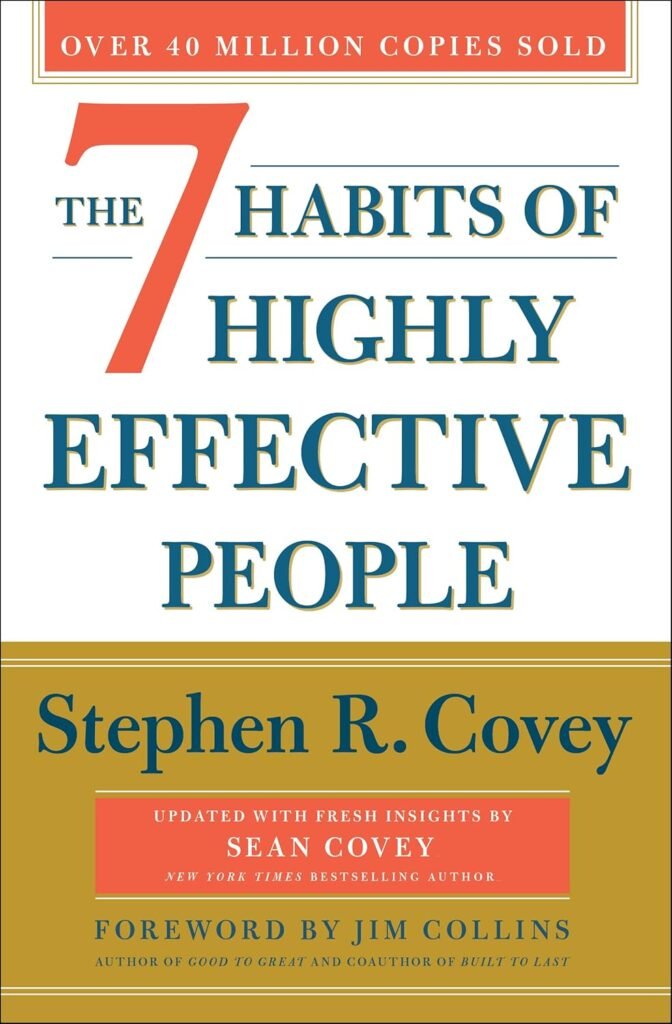
The 7 Habits of Highly Effective People: Powerful Lessons in Personal Change is a personal-development and leadership book by American author and educator Stephen R. Covey. First published in 1989, the book presents a principle-centered framework for personal effectiveness, interpersonal relationships, leadership, and continuous self-renewal.
Rather than treating effectiveness as a collection of productivity tricks, Covey argues that lasting change begins with a person’s underlying paradigms, values, character, and principles. The seven habits therefore progress from personal responsibility and purpose to relationships, collaboration, and renewal.
The book became one of the most widely known works in the modern personal-development and leadership field. According to its publisher, Simon & Schuster, it has sold more than 40 million copies in more than 50 languages. The publisher also describes it as the “#1 Most Influential Business Book of the Twentieth Century,” a distinction that should be understood as a published designation rather than an independently established academic ranking.
The seven habits are:
- Be Proactive
- Begin with the End in Mind
- Put First Things First
- Think Win/Win
- Seek First to Understand, Then to Be Understood
- Synergize
- Sharpen the Saw
The central movement of the book can be summarized as:
Dependence → Independence → Interdependence
Covey’s argument is that effectiveness is not simply about doing more. It is about becoming capable of choosing one’s response, defining what matters, acting according to priorities, building trustworthy relationships, working constructively with differences, and continually renewing one’s capacity.
Book information
| Field | Details |
|---|---|
| Title | The 7 Habits of Highly Effective People |
| Subtitle | Powerful Lessons in Personal Change |
| Author | Stephen R. Covey |
| Genre | Personal development, leadership, business, self-help |
| Original publication | 1989 |
| Original publisher | Simon & Schuster / Free Press editions |
| Original language | English |
| Major framework | Seven habits of effectiveness |
| Primary subjects | Personal effectiveness, leadership, relationships, productivity, character development |
| Major concepts | Paradigms, principles, proactivity, mission, priorities, Win/Win, empathic listening, synergy, renewal |
| Notable later edition | 30th Anniversary Edition |
| Author’s lifespan | 1932–2012 |
Overview
At first glance, The 7 Habits of Highly Effective People appears to be a book about becoming more productive. Its deeper purpose is considerably broader.
Covey distinguishes between external techniques and internal character. A person can learn how to manage a calendar, negotiate, delegate, or set goals, yet still struggle if the underlying way of thinking has not changed.
The book therefore takes an inside-out approach.
Instead of beginning with:
“What technique will make me more successful?”
Covey begins with questions such as:
- What principles govern my decisions?
- How do I see myself and other people?
- What am I ultimately trying to accomplish?
- What deserves my attention?
- How do I behave when circumstances are difficult?
- Can I cooperate with people whose views differ from mine?
- Am I continually renewing myself?
This gives the book a distinctive structure. The first three habits concern personal mastery, the next three concern relationships and collaboration, and the seventh concerns renewal.
The central idea: effectiveness begins from the inside
One of the book’s most important ideas is that meaningful change starts with a change in paradigm.
A paradigm is essentially a person’s mental model or way of interpreting reality.
Two people may encounter the same event but interpret it differently because they are looking through different mental frameworks.
Paradigm → Interpretation → Choice → Action → Result
        PARADIGM
           ↓
      How I see things
           ↓
      How I interpret
           ↓
       How I choose
           ↓
        What I do
           ↓
         RESULT
Covey argues that changing behavior without examining the paradigm underneath it often produces temporary results.
This is why the book repeatedly returns to principles rather than quick techniques.
Character ethic versus personality ethic
Covey contrasts two broad approaches to personal success.
Personality ethic
The personality approach tends to emphasize:
- communication techniques
- social skills
- positive attitudes
- image
- persuasion
- interpersonal techniques
- motivational methods
These tools can be useful, but Covey argues that they become fragile when they are disconnected from character.
Character ethic
The character approach emphasizes qualities such as:
- integrity
- responsibility
- honesty
- fairness
- courage
- humility
- patience
- respect
- long-term thinking
The book’s central proposition is that sustainable effectiveness depends more deeply on who a person becomes than on the techniques that person temporarily employs.
The Seven Habits at a glance
                EFFECTIVENESS
                     │
        ┌────────────┴────────────┐
        │                         │
   PRIVATE VICTORY           PUBLIC VICTORY
        │                         │
   Habits 1–3                 Habits 4–6
        │                         │
   Master Yourself          Work With Others
        │                         │
        └────────────┬────────────┘
                     │
                  HABIT 7
                     │
              RENEW YOURSELF
| Stage | Habits | Main question |
|---|---|---|
| Private Victory | 1–3 | How do I lead myself? |
| Public Victory | 4–6 | How do I work effectively with others? |
| Renewal | 7 | How do I maintain and improve my capacity? |
The Maturity Continuum
Covey places the seven habits on what he calls a Maturity Continuum.
The progression is:
Dependence → Independence → Interdependence
Dependence means essentially:
“You take care of me.”
Independence means:
“I can take responsibility for myself.”
Interdependence means:
“We can accomplish together what neither of us could accomplish alone.”
This distinction is important because Covey does not present independence as the final destination.
A person must first develop personal responsibility, but mature effectiveness eventually involves cooperation with others.
Maturity Continuum
DEPENDENCE
"I need you"
     │
     │ Habits 1–3
     ▼
INDEPENDENCE
"I can do it myself"
     │
     │ Habits 4–6
     ▼
INTERDEPENDENCE
"We can accomplish more together"
Habit 1: Be Proactive
The principle of personal responsibility
The first habit is Be Proactive.
Covey uses proactivity in a broader sense than simply being energetic or taking initiative.
To be proactive means to recognize one’s ability to choose a response.
Circumstances can influence a person, sometimes profoundly, but Covey argues that people retain a degree of responsibility for how they respond.
Stimulus and response
The book introduces an important distinction:
STIMULUS
   ↓
   ?
   ↓
RESPONSE
Between an event and a person’s response lies the opportunity for choice.
A reactive response might sound like:
- “I had no choice.”
- “He made me angry.”
- “That’s just the way I am.”
- “There is nothing I can do.”
A proactive response focuses on what can actually be influenced:
- “What can I do now?”
- “What is within my control?”
- “What response would be consistent with my values?”
This does not mean pretending that difficult circumstances do not exist. It means distinguishing between the circumstances themselves and the choices available within them.
Circle of Concern and Circle of Influence
One of the best-known ideas associated with Habit 1 is the distinction between the Circle of Concern and the Circle of Influence.
Circle of Concern
Things we care about but may not be able to control directly:
- economic conditions
- other people’s opinions
- political events
- weather
- past events
- decisions made by other people
Circle of Influence
Things over which we can exercise some influence:
- our decisions
- our behavior
- our preparation
- our communication
- our use of time
- our response to problems
┌─────────────────────────────────────┐
│          CIRCLE OF CONCERN           │
│                                     │
│       ┌─────────────────────┐       │
│       │ CIRCLE OF INFLUENCE │       │
│       │                     │       │
│       │   What I can        │       │
│       │   influence         │       │
│       │                     │       │
│       └─────────────────────┘       │
│                                     │
│       What concerns me              │
└─────────────────────────────────────┘
Covey argues that effectiveness grows when people invest more attention in their Circle of Influence instead of becoming consumed by everything inside their Circle of Concern.
Habit 2: Begin with the End in Mind
The principle of personal vision
The second habit asks people to begin with a clear picture of the destination before deciding how to travel.
In practical terms, it means defining:
- what success means
- what kind of person one wants to become
- what values should guide decisions
- what one’s important roles are
- what long-term contribution one hopes to make
The habit moves from reaction to intention.
Mental creation before physical creation
Covey describes two forms of creation:
- Mental creation
- Physical creation
A building is normally designed before it is constructed. Similarly, Covey argues that major areas of life benefit from a deliberate mental blueprint.
VISION
  ↓
VALUES
  ↓
GOALS
  ↓
PLANS
  ↓
ACTIONS
  ↓
RESULTS
Without a destination, efficiency can become dangerous.
A person may become extremely efficient at climbing a ladder while discovering that the ladder is leaning against the wrong wall.
Personal mission statement
Habit 2 introduces the idea of a personal mission statement.
A mission statement describes the principles and purposes a person wants to use as a guide for life.
Rather than being merely a list of ambitions, it can address questions such as:
- What matters most to me?
- What kind of person do I want to be?
- What roles are important in my life?
- What principles should guide my decisions?
- What contribution do I want to make?
The mission statement becomes a reference point for decisions.
Habit 3: Put First Things First
The principle of personal management
Habit 3 translates vision into daily behavior.
If Habit 2 answers:
“Where am I going?”
Habit 3 asks:
“What should I do first?”
The emphasis is not merely on managing time but on managing priorities.
Urgent versus important
Covey’s famous Time Management Matrix divides activities into four categories.
| Quadrant | Urgent | Important | Examples |
|---|---|---|---|
| I | Yes | Yes | Crisis, deadline, emergency |
| II | No | Yes | Planning, prevention, relationships, learning |
| III | Yes | No | Interruptions, some meetings, other people’s minor urgencies |
| IV | No | No | Excessive distraction, trivial activities |
The book places particular emphasis on Quadrant II.
The Time Management Matrix
                     URGENT             NOT URGENT
                 ┌───────────────┬──────────────────┐
IMPORTANT        │   QUADRANT I  │    QUADRANT II   │
                 │ Crisis         │ Planning         │
                 │ Deadlines      │ Prevention       │
                 │ Emergencies    │ Relationships    │
                 │               │ Learning         │
                 ├───────────────┼──────────────────┤
NOT IMPORTANT    │ QUADRANT III  │    QUADRANT IV   │
                 │ Interruptions │ Trivial activity │
                 │ Some calls    │ Excessive        │
                 │ Some meetings │ distraction      │
                 └───────────────┴──────────────────┘
Covey argues that many important results are created through activities that are important but not yet urgent.
Examples include:
- exercising before illness forces the issue
- building relationships before a crisis
- learning before a skill becomes necessary
- planning before a deadline
- preventive maintenance before something breaks
This idea has become one of the most recognizable elements of Covey’s work.
The Private Victory
The first three habits form what Covey calls the Private Victory.
They can be summarized as:
Habit 1 → CHOOSE
Habit 2 → CREATE
Habit 3 → PRIORITIZE
Together they represent personal leadership.
A person moves from:
reaction → vision → disciplined action
before attempting to lead effectively with other people.
Habit 4: Think Win/Win
The principle of interpersonal leadership
Habit 4 moves from personal effectiveness to relationships.
Covey proposes Win/Win as a way of thinking about human interaction in which both sides seek an outcome that is mutually beneficial.
It contrasts with several other possible approaches.
| Approach | Basic assumption |
|---|---|
| Win/Win | Both sides can benefit |
| Win/Lose | My success requires your loss |
| Lose/Win | I give in so that you succeed |
| Lose/Lose | Nobody gets what they want |
| Win | I focus primarily on achieving my own result |
Win/Win does not mean that every disagreement can be resolved so that everyone receives everything they originally wanted.
Rather, it is a mindset that searches for mutual benefit where genuine mutual benefit is possible.
Abundance mentality and scarcity mentality
Covey connects Win/Win with two contrasting mentalities.
Scarcity mentality
The world is viewed as if success were a limited pie:
“If you get more, there is less for me.”
Abundance mentality
The possibility of multiple people benefiting is recognized:
“Your success does not automatically diminish mine.”
This distinction can be particularly relevant in:
- partnerships
- management
- negotiation
- family relationships
- education
- teamwork
- business
Habit 5: Seek First to Understand, Then to Be Understood
The principle of empathic communication
Habit 5 deals with communication.
Its central sequence is:
Listen first. Understand second. Respond third.
Covey argues that people frequently listen with the intention of replying rather than understanding.
They may:
- prepare a response while someone else is speaking
- compare the speaker’s experience with their own
- judge the argument immediately
- give advice too quickly
- interpret everything through their own assumptions
Covey calls for a more deliberate form of listening, often described as empathic listening.
The communication sequence
OTHER PERSON SPEAKS
        ↓
     LISTEN
        ↓
   UNDERSTAND
        ↓
   CLARIFY
        ↓
   RESPOND
        ↓
   BE UNDERSTOOD
The principle is simple but demanding:
Understanding should precede persuasion.
This habit is particularly relevant to leadership because a leader cannot respond intelligently to a problem that has not first been understood.
The Emotional Bank Account
Covey uses the metaphor of an Emotional Bank Account to describe trust in relationships.
Just as a financial bank account grows through deposits and decreases through withdrawals, relationships accumulate or lose trust through repeated interactions.
Deposits can include:
- keeping promises
- showing respect
- listening
- clarifying expectations
- apologizing when appropriate
- being loyal
- demonstrating consideration
Withdrawals can include:
- breaking promises
- disrespect
- dishonesty
- ignoring another person’s perspective
- violating expectations
- repeated inconsistency
TRUST

Deposits ↑
───────────────
Respect
Listening
Promises kept
Honesty
Reliability
───────────────
Withdrawals ↓
The metaphor is useful because it shifts attention away from a single conversation and toward the accumulated history of a relationship.
Habit 6: Synergize
The principle of creative cooperation
Habit 6 is Synergize.
Covey uses synergy to describe situations in which differences between people become a source of creative possibility rather than merely a source of conflict.
The basic idea can be represented as:
Person A perspective
        +
Person B perspective
        +
Respect for differences
        ↓
NEW POSSIBILITY
The objective is not simply compromise.
Compromise often means:
“We will each give something up.”
Synergy asks a different question:
“Can our different perspectives help us create a better solution?”
Valuing differences
Synergy depends on the ability to recognize that another person may see something that you do not.
Differences may exist in:
- experience
- personality
- expertise
- culture
- age
- education
- professional background
- problem-solving style
The book treats these differences as potentially valuable resources.
This is particularly relevant in organizations, where complex problems rarely fit neatly inside one person’s knowledge.
The Public Victory
Habits 4–6 constitute what Covey calls the Public Victory.
Habit 4 → MUTUAL BENEFIT
Habit 5 → UNDERSTANDING
Habit 6 → CREATIVE COOPERATION
The progression is significant.
Covey does not suggest that collaboration should simply be imposed on people. Instead, effective interdependence rests on personal responsibility and trust developed through the earlier habits.
Habit 7: Sharpen the Saw
The principle of renewal
The seventh habit is Sharpen the Saw.
Covey uses the image of a person trying to cut wood with a dull saw. Continuing to work harder with the same dull tool may produce less progress than stopping temporarily to sharpen it.
The metaphor applies to human beings.
Continuous activity without renewal can reduce effectiveness.
The four dimensions of renewal
Covey identifies four dimensions:
- Physical
- Spiritual
- Mental
- Social/emotional
The Four Dimensions
                 RENEWAL
                    │
       ┌────────────┼────────────┐
       │            │            │
    PHYSICAL      MENTAL      SOCIAL/
       │            │         EMOTIONAL
   Exercise      Reading       Relationships
   Nutrition     Learning      Service
   Rest          Thinking      Empathy
       │
       └──────── SPIRITUAL ────────
              Values
              Meaning
              Reflection
The precise activities may differ from person to person.
The underlying principle is balance and renewal.
A person who develops professionally but neglects health, relationships, reflection, or learning may eventually reduce the very effectiveness they are trying to increase.
The upward spiral
Habit 7 also completes a larger cycle.
The habits are not intended as a one-time checklist.
They form an ongoing process:
LEARN
  ↓
PRACTICE
  ↓
REFLECT
  ↓
RENEW
  ↓
IMPROVE
  ↓
PRACTICE AGAIN
The idea is that personal development is iterative rather than a destination reached once and permanently secured.
The complete Seven Habits framework
                 EFFECTIVENESS
                      │
                 PRINCIPLES
                      │
             ┌────────┴────────┐
             │                 │
       PRIVATE VICTORY    PUBLIC VICTORY
             │                 │
          Habit 1            Habit 4
        Be Proactive       Think Win/Win
             │                 │
          Habit 2            Habit 5
      Begin With the End   Understand First
             │                 │
          Habit 3            Habit 6
     Put First Things      Synergize
          First
             │                 │
             └────────┬────────┘
                      │
                   Habit 7
              Sharpen the Saw
                      │
                   RENEWAL
P/PC Balance
Another important idea in the book is the distinction between Production (P) and Production Capability (PC).
A person wants results — this is Production.
But the ability to continue producing those results is Production Capability.
For example:
- Results from work = P
- The worker’s health and skills = PC
- Business revenue = P
- The organization’s people and systems = PC
- Academic grades = P
- The student’s learning capacity = PC
If a person focuses exclusively on immediate production, the underlying capability may deteriorate.
The P/PC relationship
          EFFECTIVENESS
               │
       ┌───────┴───────┐
       │               │
       P               PC
   RESULTS          CAPABILITY
       │               │
 What is achieved   Ability to
                    keep achieving
Long-term effectiveness requires attention to both.
Principles versus techniques
One reason the book has remained distinctive is its emphasis on principles.
Covey argues that techniques may change as circumstances change, while certain broad principles remain useful across contexts.
For example:
- technology changes
- workplaces change
- communication platforms change
- management methods change
- economic conditions change
Yet concepts such as responsibility, integrity, trust, respect, prioritization, and renewal remain relevant.
This is also one reason the book is not presented simply as a productivity manual.
The book’s overall architecture
The structure of the book can be viewed as four stages.
| Section | Purpose | Habits |
|---|---|---|
| Paradigms and Principles | Change the way effectiveness is understood | Foundation |
| Private Victory | Develop self-leadership | 1–3 |
| Public Victory | Develop interpersonal effectiveness | 4–6 |
| Renewal | Preserve and expand effectiveness | 7 |
This architecture gives the book a developmental logic rather than treating the seven habits as seven unrelated pieces of advice.
From dependence to interdependence
One of the simplest ways to understand the entire book is to view it as a journey.
DEPENDENCE
"I need others to manage my life."
        ↓
        ↓
INDEPENDENCE
"I can take responsibility for myself."
        ↓
        ↓
INTERDEPENDENCE
"I can cooperate with others
to accomplish something greater."
Covey’s model therefore rejects the idea that mature success means simply becoming completely self-sufficient.
A capable individual can accomplish much alone.
An effective team can accomplish things that no individual could accomplish alone.
Why the book is more than a productivity book
Although the book is frequently placed in the self-help or productivity category, its subject matter extends into several fields.
Psychology
The book examines:
- perception
- habits
- choice
- motivation
- interpersonal behavior
Leadership
It addresses:
- personal leadership
- trust
- communication
- organizational relationships
- collaborative problem-solving
Management
It discusses:
- priorities
- delegation
- important versus urgent activities
- long-term effectiveness
Personal development
It emphasizes:
- values
- goals
- self-discipline
- learning
- renewal
Relationships
It provides frameworks for:
- listening
- mutual benefit
- trust
- conflict
- cooperation
A practical interpretation of the seven habits
The seven habits can be translated into seven practical questions.
| Habit | Practical question |
|---|---|
| Be Proactive | What is within my control? |
| Begin with the End in Mind | What outcome and values should guide me? |
| Put First Things First | What matters most right now? |
| Think Win/Win | How can both sides benefit? |
| Seek First to Understand | Do I genuinely understand the other person’s perspective? |
| Synergize | Can our differences produce a better solution? |
| Sharpen the Saw | How am I renewing my ability to perform? |
Together they create a useful personal operating system:
Choose → Envision → Prioritize → Cooperate → Understand → Create → Renew
Examples of the Seven Habits in everyday life
At work
An employee who practices Habit 1 may stop blaming circumstances and identify actions within their control.
Habit 2 may encourage the employee to define what professional success actually means.
Habit 3 may lead them to spend time on important work rather than constantly responding to messages.
Habits 4–6 become relevant when working with colleagues, clients, managers, and teams.
Habit 7 reminds the employee that productivity without recovery can eventually become counterproductive.
In education
A student might apply the framework by:
- taking responsibility for study habits
- defining a desired academic outcome
- prioritizing important subjects
- cooperating with classmates
- listening to teachers
- learning from different perspectives
- protecting sleep, health, and mental energy
In family life
The same framework can be interpreted in relational terms:
- respond rather than react
- define family values
- prioritize relationships
- seek mutually beneficial solutions
- listen before giving advice
- respect differences
- maintain physical and emotional wellbeing
This illustrates one of Covey’s central claims: effectiveness is not restricted to professional life.
The 7 Habits and modern productivity culture
Modern productivity culture often emphasizes:
- faster work
- automation
- task management
- optimization
- digital tools
- notifications
- calendars
- efficiency
Covey’s framework approaches the issue from a different direction.
It asks:
Efficiency in service of what?
That distinction remains important.
A person can become highly efficient at completing low-value tasks while neglecting the activities that matter most.
The distinction between urgent and important is therefore particularly relevant in an environment filled with constant digital interruptions.
The book’s enduring appeal
Several features help explain why the book has remained widely read.
1. A simple framework
Seven memorable habits provide a structure that readers can recall easily.
2. Broad applicability
The concepts are presented as relevant to:
- individuals
- students
- parents
- managers
- executives
- educators
- organizations
3. Principle-centered approach
The book attempts to move beyond temporary motivational trends.
4. Combination of personal and interpersonal effectiveness
Many productivity books concentrate primarily on individual performance. Covey connects personal effectiveness with relationships.
5. Practical tools
The book includes concepts that can be translated into everyday practices, including:
- mission statements
- priority management
- listening
- relationship-building
- renewal
Criticism and limitations
The book’s influence does not mean that every claim or framework should be treated as universally established.
Several limitations are worth considering.
1. Broad principles are not universal solutions
The seven habits provide a framework rather than a scientific formula for solving every personal or organizational problem.
Different cultures, professions, personalities, and circumstances can require different approaches.
2. “Win/Win” has practical limits
Some conflicts involve genuine incompatibilities.
Not every negotiation has an outcome in which all parties receive everything they want.
In such circumstances, effectiveness may require accepting trade-offs, boundaries, or an agreement to disagree.
3. Personal responsibility can be misunderstood
The emphasis on personal choice can be empowering, but it should not be interpreted as meaning that individuals control all outcomes.
Structural, economic, social, organizational, and health-related circumstances can substantially constrain available choices.
4. The framework is intentionally normative
Covey does not merely describe how successful people behave. He makes a philosophical argument about how people ought to approach effectiveness, relationships, and responsibility.
Readers therefore encounter both practical advice and a particular conception of ethical personal development.
5. The framework is easier to understand than to practice
This may be the most obvious practical limitation.
Knowing the seven habits is easy.
Practicing them consistently is considerably harder.
Influence on leadership education
The seven habits eventually developed beyond the book itself into training programs, educational initiatives, organizational consulting, and leadership-development systems.
FranklinCovey, the organization associated with Covey’s work, continues to offer programs based on the framework. Its modern presentation describes Habits 1–3 as personal mastery, Habits 4–6 as collaboration and synergy, and Habit 7 as renewal.
The organization has also adapted the framework to contemporary workplace issues, including changing technology and artificial intelligence.
30th Anniversary Edition
A major later edition was published to mark the book’s 30th anniversary.
The edition retained Covey’s original material while adding contributions from his son Sean Covey, including personal insights associated with the chapters.
This edition helped introduce the framework to a new generation while preserving the structure of the original work.
Table of contents
The original structure is broadly divided into four major sections.
Part One — Paradigms and Principles
- Inside-Out
- The Seven Habits — An Overview
Part Two — Private Victory
- Habit 1: Be Proactive
- Habit 2: Begin with the End in Mind
- Habit 3: Put First Things First
Part Three — Public Victory
- Paradigms of Interdependence
- Habit 4: Think Win/Win
- Habit 5: Seek First to Understand, Then to Be Understood
- Habit 6: Synergize
Part Four — Renewal
- Habit 7: Sharpen the Saw
- Inside-Out Again
Later editions also include appendices and supplementary material.
About Stephen R. Covey
Stephen Richards Covey (1932–2012) was an American author, educator, leadership consultant, and teacher whose work focused heavily on personal effectiveness, leadership, family relationships, and principle-centered living.
He earned an MBA from Harvard University and a doctorate from Brigham Young University. He subsequently worked as an educator, consultant, speaker, and author.
Covey became particularly associated with the development of the Covey Leadership Center, which later became part of FranklinCovey.
His professional work extended beyond The 7 Habits. Other notable books include:
- Principle-Centered Leadership
- First Things First
- The 8th Habit
- Living the 7 Habits
His influence extended into corporate leadership, education, family development, and organizational training.
According to Simon & Schuster, Covey’s books collectively sold more than 40 million copies in more than 50 languages.
Stephen Covey’s intellectual legacy
Covey’s legacy is closely associated with several recurring themes:
Principles over techniques
Character over image
Responsibility over blame
Purpose over reaction
Importance over mere urgency
Mutual benefit over domination
Understanding over premature persuasion
Cooperation over unnecessary competition
Renewal over exhaustion
These themes appear repeatedly throughout his body of work.
Sean Covey
Sean Covey, Stephen Covey’s son, became an important figure in continuing and adapting the Covey framework.
He is associated with FranklinCovey and has written and contributed to works that translate Covey’s ideas for younger audiences and contemporary organizations.
Among his notable works is The 7 Habits of Highly Effective Teens.
Sean Covey also contributed personal insights to the 30th Anniversary Edition of The 7 Habits of Highly Effective People.
Major concepts associated with the book
| Concept | Meaning |
|---|---|
| Paradigm | A person’s underlying way of seeing and interpreting reality |
| Inside-Out | Beginning change with oneself rather than attempting to change others first |
| Proactivity | Taking responsibility for one’s choices and responses |
| Circle of Influence | Areas where a person can exercise meaningful influence |
| Circle of Concern | Matters that concern a person but may lie outside direct control |
| Personal Mission | A statement of purpose, values, and direction |
| Quadrant II | Important but non-urgent activities |
| Win/Win | Seeking mutually beneficial outcomes |
| Empathic Listening | Listening to understand another person’s perspective |
| Emotional Bank Account | A metaphor for accumulated trust in relationships |
| Synergy | Creating better possibilities through constructive differences |
| P/PC Balance | Balancing current results with the capacity to continue producing results |
| Sharpen the Saw | Continuous renewal of personal capability |
Seven Habits as a personal operating system
One useful way to visualize the entire book is as a personal operating system.
              SEE
               │
        Begin With the
          End in Mind
               │
               ▼
             CHOOSE
               │
          Be Proactive
               │
               ▼
           PRIORITIZE
               │
       Put First Things First
               │
               ▼
           CONNECT
               │
           Think Win/Win
               │
               ▼
          UNDERSTAND
               │
      Seek First to Understand
               │
               ▼
            CREATE
               │
           Synergize
               │
               ▼
            RENEW
               │
       Sharpen the Saw
               │
               └──────────► REPEAT
This interpretation is not a separate claim made by Covey; it is a way of seeing how the seven concepts fit together as a system.
The deeper message of the book
The book’s deeper message is not simply:
“Work harder.”
Nor is it:
“Become more productive.”
Its more fundamental argument is that effectiveness is the consequence of alignment.
A person’s:
- values,
- decisions,
- priorities,
- behavior,
- relationships,
- and capacity for renewal
should reinforce one another.
A person who knows what matters but never acts on it lacks execution.
A person who acts constantly but has no clear purpose lacks direction.
A person who achieves individual success but destroys relationships lacks sustainable interdependence.
A person who achieves continuously without renewal eventually risks exhausting the very capabilities that produced those achievements.
The seven habits attempt to connect these pieces.
A one-page infographic of the framework
╔══════════════════════════════════════════════╗
║       THE 7 HABITS OF HIGHLY EFFECTIVE       ║
║                    PEOPLE                    ║
╠══════════════════════════════════════════════╣
║                                              ║
║  1. BE PROACTIVE                             ║
║     Take responsibility                      ║
║                                              ║
║  2. BEGIN WITH THE END IN MIND               ║
║     Define your destination                  ║
║                                              ║
║  3. PUT FIRST THINGS FIRST                   ║
║     Prioritize what matters                  ║
║                                              ║
║          ↓ PRIVATE VICTORY ↓                 ║
║                                              ║
║  4. THINK WIN/WIN                            ║
║     Seek mutual benefit                      ║
║                                              ║
║  5. SEEK FIRST TO UNDERSTAND                ║
║     Listen before persuading                 ║
║                                              ║
║  6. SYNERGIZE                                ║
║     Create through differences               ║
║                                              ║
║          ↓ PUBLIC VICTORY ↓                  ║
║                                              ║
║  7. SHARPEN THE SAW                          ║
║     Renew yourself continuously              ║
║                                              ║
╚══════════════════════════════════════════════╝
Frequently asked questions
What is The 7 Habits of Highly Effective People about?
It is a personal-development and leadership book that presents seven habits intended to improve personal responsibility, purpose, prioritization, relationships, communication, collaboration, and self-renewal.
Who wrote The 7 Habits of Highly Effective People?
The book was written by Stephen R. Covey, an American author, educator, leadership consultant, and teacher.
When was the book published?
The book was first published in 1989.
What are the seven habits?
They are:
- Be Proactive
- Begin with the End in Mind
- Put First Things First
- Think Win/Win
- Seek First to Understand, Then to Be Understood
- Synergize
- Sharpen the Saw
What does “Be Proactive” mean?
It means taking responsibility for one’s choices and focusing attention on what one can influence rather than simply reacting to circumstances.
What is the Circle of Influence?
It refers to the area of life in which a person can exercise some meaningful influence, as opposed to matters that may concern the person but lie outside direct control.
What is the Time Management Matrix?
It is Covey’s framework for categorizing activities according to whether they are urgent and important. It gives particular attention to activities that are important but not yet urgent.
What does “Win/Win” mean?
Win/Win is an approach to relationships and negotiations that searches for mutually beneficial outcomes rather than assuming that one person’s success requires another person’s loss.
What is Habit 5 about?
Habit 5 emphasizes understanding another person’s perspective before attempting to make oneself understood.
What does “Synergize” mean?
Synergy means using differences in perspective, experience, and expertise to create solutions that may be better than those produced independently.
What does “Sharpen the Saw” mean?
It means regularly renewing one’s physical, mental, emotional/social, and spiritual capacities rather than continuously working without recovery.
Is the book only for business professionals?
No. Its examples and framework can be applied to professional work, education, family life, leadership, relationships, and personal development.
Is The 7 Habits a productivity book?
It includes productivity concepts, particularly through Habit 3, but it is broader than a conventional productivity manual. Its framework includes character, values, relationships, communication, leadership, and renewal.
Legacy
More than three decades after its original publication, The 7 Habits of Highly Effective People remains one of the best-known books associated with modern leadership and personal development.
Its terminology has entered common professional vocabulary. Expressions and concepts such as proactive behavior, Circle of Influence, Quadrant II, Win/Win, synergy, and Sharpen the Saw are now closely associated with Covey’s framework.
Its continuing presence in leadership training and organizational education also reflects an important characteristic of the book: its central ideas are not dependent on a particular technology or workplace trend.
The world in which Covey wrote the original book was very different from today’s world of smartphones, social media, remote work, algorithmic systems, and artificial intelligence. Yet questions about priorities, relationships, attention, responsibility, purpose, and renewal remain recognizable.
That is perhaps the simplest explanation for the book’s longevity.
The tools surrounding us change quickly.
The human problems they are supposed to help us solve often change much more slowly.
See also
- Stephen R. Covey
- FranklinCovey
- Personal development
- Leadership
- Time management
- Goal setting
- Emotional intelligence
- Interpersonal communication
- Habit formation
- Organizational behavior
- First Things First
- Principle-Centered Leadership
- The 8th Habit
- The 7 Habits of Highly Effective Teens
Read more
Readers interested in the ideas developed in The 7 Habits of Highly Effective People may also explore:
- Stephen R. Covey — Principle-Centered Leadership
- Stephen R. Covey, A. Roger Merrill and Rebecca R. Merrill — First Things First
- Stephen R. Covey — The 8th Habit
- Stephen R. Covey — Living the 7 Habits
- Sean Covey — The 7 Habits of Highly Effective Teens
- FranklinCovey’s continuing material on the Seven Habits framework
- Literature on leadership, organizational behavior, communication, habit formation, and time management
References
- Covey, Stephen R. The 7 Habits of Highly Effective People: Powerful Lessons in Personal Change. Simon & Schuster / Free Press, 1989.
- Covey, Stephen R. The 7 Habits of Highly Effective People, 30th Anniversary Edition. Simon & Schuster, with additional insights by Sean Covey.
- Simon & Schuster. The 7 Habits of Highly Effective People — official publisher information and author biography.
- FranklinCovey. The 7 Habits of Highly Effective People — framework, habits, and related learning materials.
- Open Library. Bibliographic record and table of contents for The 7 Habits of Highly Effective People.
- FranklinCovey corporate materials concerning the history and development of the Seven Habits framework.
Editorial note
This article is an original reference-style overview of The 7 Habits of Highly Effective People. It summarizes and explains the book’s principal ideas without reproducing the book’s copyrighted text. Interpretations and explanatory diagrams in this article are presented to help readers understand how the concepts fit together; they should not be treated as quotations from Covey unless explicitly identified as such.
One-sentence summary
Stephen R. Covey’s The 7 Habits of Highly Effective People presents effectiveness as a progression from personal responsibility and purposeful action to mutually beneficial relationships, creative cooperation, and continuous self-renewal.