


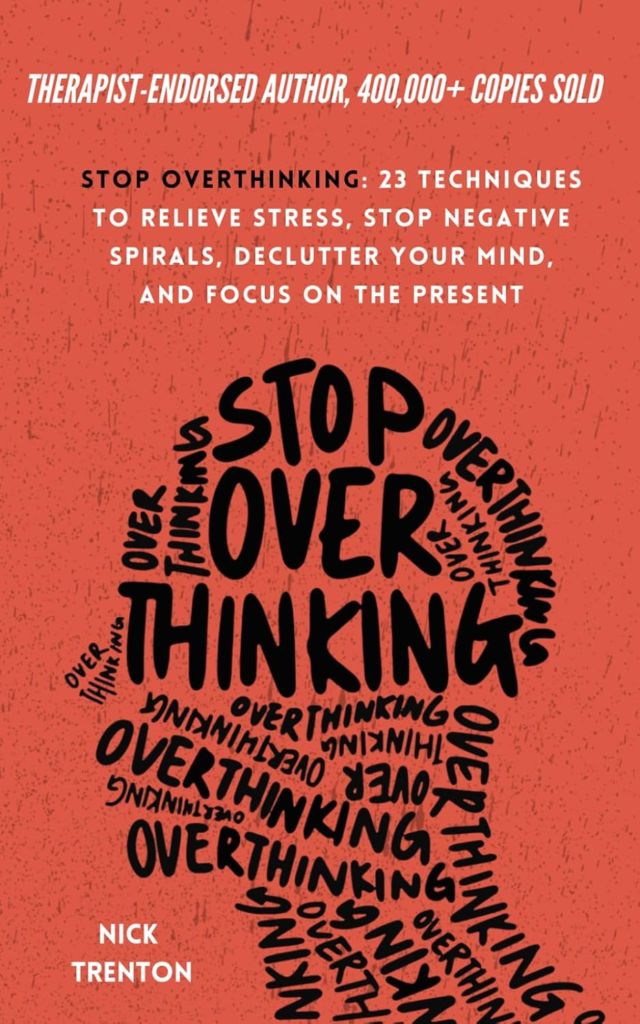
Stop Overthinking: 23 Techniques to Relieve Stress, Stop Negative Spirals, Declutter Your Mind, and Focus on the Present is a self-help and popular psychology book by American author Nick Trenton. First published in 2021, the book examines repetitive negative thinking, stress, anxiety, cognitive distortions, emotional regulation, and difficulties with maintaining attention in the present moment.
Rather than presenting overthinking as simply “thinking too much,” Trenton approaches it as a pattern involving mental habits, environmental inputs, stress responses, distorted interpretations, and attempts to obtain certainty. The book consequently combines cognitive-behavioral concepts with stress-management exercises, relaxation techniques, productivity systems, mindfulness-oriented practices, and strategies for changing self-talk.
The original edition was published by PKCS Media in 2021 and is approximately 190 pages, although pagination varies between editions. Penguin Random House India subsequently published editions of the book, including a 176-page paperback edition in 2023 and later editions.
The book is aimed primarily at general readers who experience rumination, excessive worrying, indecision, mental clutter, stress, or difficulty concentrating. Its central practical proposition is that recurring thought patterns can be examined and interrupted rather than automatically followed.
Book information
| Field | Details |
|---|---|
| Title | Stop Overthinking: 23 Techniques to Relieve Stress, Stop Negative Spirals, Declutter Your Mind, and Focus on the Present |
| Author | Nick Trenton |
| First published | 2021 |
| Original publisher | PKCS Media |
| Original language | English |
| Genre | Self-help, popular psychology, stress management |
| Original length | Approximately 189–191 pages, depending on edition |
| ISBN examples | 9781647432492; 9781647432508 |
| Indian paperback | ISBN 9780143459217 |
| Indian hardback | ISBN 9780143470311 |
| Primary subjects | Overthinking, stress, anxiety, rumination, cognitive distortions, self-talk, emotional regulation |
| Structure | Six major chapters/sections containing numerous techniques |
| Audience | General readers interested in mental clarity, stress management and personal development |
Bibliographic records from Google Books and Open Library identify the original 2021 publication with PKCS Media and describe the book under subjects including stress management, applied psychology, self-management and self-help.
Author
Nick Trenton
Nick Trenton is an author of popular psychology and self-help books whose work focuses heavily on anxiety, overthinking, emotional regulation, self-talk and mental habits.
According to his author biography, Trenton grew up in rural Illinois. He subsequently obtained a Bachelor of Science in Economics and a Master of Arts in Behavioral Psychology. His biography also describes an enduring interest in observing and understanding human behavior.
Trenton has written several books dealing with related subjects, including Calm Your Thoughts, How to Stop Overthinking, Keep Calm, Rewire Your Anxious Brain, The Art of Self Discovery, and Transform Your Self-Talk. His books share a recurring interest in practical methods for changing patterns of thought and emotional response.
His official website describes his work as focusing on practical tools for calming the mind, managing emotions and thinking more clearly under pressure.
It is worth distinguishing Trenton’s academic background from his role as a popular author: Stop Overthinking is written for a general readership and is not an academic psychology textbook or a clinical treatment manual.
Publication history
Stop Overthinking first appeared in 2021.
Google Books lists a PKCS Media edition published on March 2, 2021, at 191 pages, while other bibliographic records identify editions published in March 2021 at approximately 189–190 pages. Differences in pagination reflect different editions and formats.
The book was subsequently published in other countries and languages. Penguin Random House India lists a 2023 paperback edition, a 2023 hardback edition, and a later 2025 hardback edition, demonstrating the book’s continued international publication.
The book has also appeared in translated editions, including German and Tamil editions.
Its continuing publication alongside later works by Trenton illustrates the author’s development of a broader series of books dealing with overthinking, anxiety and emotional self-management.
Overview
At first glance, Stop Overthinking appears to be a book about excessive thinking. Its deeper subject, however, is the relationship between thought, interpretation, emotion and behavior.
The book’s underlying model can be represented as:
EVENT
  ↓
INTERPRETATION
  ↓
THOUGHT
  ↓
EMOTIONAL RESPONSE
  ↓
BEHAVIOR
  ↓
CONSEQUENCE
  ↓
MORE THOUGHT
The difficulty begins when the mental process becomes circular.
For example:
"I made a mistake."
       ↓
"What will people think?"
       ↓
"Maybe I'm not good enough."
       ↓
"What if I make another mistake?"
       ↓
"Maybe everything will go wrong."
       ↓
MORE ANALYSIS
       ↓
LESS ACTION
The person may believe that additional thinking will eventually solve the problem. Instead, the thinking itself can become the problem.
This distinction is one of the most useful ideas running through the book:
Problem-solving thinking moves toward an outcome; rumination repeatedly revisits the same uncertainty.
The book therefore does not advocate eliminating thought altogether. Its practical emphasis is on recognizing when thinking has stopped being useful.
What is overthinking?
Trenton treats overthinking as a pattern involving excessive mental attention, repetitive thought and negative interpretation.
The book particularly focuses on:
- rumination about past events;
- worrying about future possibilities;
- excessive self-analysis;
- imagined conversations;
- replaying mistakes;
- fear of making the wrong decision;
- perfectionism;
- negative self-talk;
- uncertainty;
- emotional reasoning;
- cognitive distortions;
- information overload;
- difficulty switching attention.
A useful distinction is:
| Productive thinking | Overthinking |
|---|---|
| Identifies a problem | Repeats the problem |
| Generates options | Generates endless possibilities |
| Leads toward action | Delays action |
| Uses evidence | Often uses assumptions |
| Accepts uncertainty | Demands certainty |
| Has an endpoint | Has no natural endpoint |
| Solves | Rehearses |
This distinction gives the book much of its practical appeal.
The objective is not to become a person who never thinks. It is to become better at recognizing when thinking is useful and when it has become repetitive mental noise.
The architecture of the book
The book is organized around six broad sections.
1. Overthinking Isn’t About Overthinking
The opening section examines the origins of mental clutter and explores the roles of the individual, environment and mental models.
2. The De-Stress Formula and Then Some
This section introduces stress-management approaches, including the four A’s of stress management, journaling, grounding and narrative externalization.
3. Manage Your Time and Inputs
Trenton connects mental overload with the way people organize information, tasks and attention. The section introduces systems such as the Eisenhower method, SMART goals, Kanban and time blocking.
4. How to Find Instant Zen
The fourth section turns toward physiological relaxation through methods such as autogenic training, guided imagery and progressive muscle relaxation.
5. Rewire Your Thought Patterns
This section introduces cognitive distortions, cognitive restructuring, CBT-oriented self-talk and self-scripting.
6. Newfound Attitudes and Emotional Regulation
The final major section focuses on changing one’s relationship with control, capability, possessions, time and desire, together with emotional regulation techniques such as opposite action.
The published table of contents confirms these themes and techniques.
Chapter 1: Overthinking Isn’t About Overthinking
The book begins by challenging the assumption that overthinking is simply a matter of having too many thoughts.
Trenton considers several possible sources of mental clutter:
- the individual’s habitual thought patterns;
- environmental pressures;
- information overload;
- expectations;
- uncertainty;
- learned mental models.
This creates an important shift.
Instead of asking:
“Why can’t I stop thinking?”
the reader is encouraged to ask:
“What is creating the conditions in which my mind keeps returning to this thought?”
This makes overthinking a system rather than a personality trait.
Mental models
A mental model is an internal framework through which a person interprets events.
Two people can experience the same event and construct very different psychological experiences.
For example:
EVENT:
A colleague does not reply to a message.

PERSON A:
"They are probably busy."
        ↓
Continues working.

PERSON B:
"Did I offend them?"
        ↓
"Are they angry?"
        ↓
"Did I make a mistake?"
        ↓
Checks phone repeatedly.
The external event is identical.
The internal interpretation is different.
This illustrates one of the book’s recurring themes: the meaning assigned to an event can become more psychologically powerful than the event itself.
Consequences of overthinking
Trenton connects excessive rumination with a range of practical problems, including:
- stress;
- anxiety;
- indecision;
- reduced concentration;
- emotional exhaustion;
- negative self-talk;
- procrastination;
- sleep difficulties;
- avoidance;
- difficulty remaining present.
The book’s practical concern is not merely that overthinking feels unpleasant. It is that it can interfere with action.
A person can spend enormous amounts of mental energy preparing to act without actually acting.
This creates a paradox:
More thinking
      ↓
More uncertainty
      ↓
More analysis
      ↓
More hesitation
      ↓
Less action
      ↓
More uncertainty
The loop feeds itself.
Chapter 2: The De-Stress Formula
The second section moves from understanding the problem to reducing the physiological and psychological conditions that encourage repetitive thinking.
Among the techniques discussed are:
- the four A’s of stress management;
- stress diaries;
- journaling;
- the 5-4-3-2-1 grounding technique;
- narrative therapy and externalization.
These techniques differ considerably, but they share a common purpose: interrupt automatic mental momentum.
The four A’s of stress management
The four A’s approach generally categorizes responses to stress as:
                STRESSOR
                   │
       ┌───────────┼───────────┐
       ↓           ↓           ↓
     AVOID       ALTER       ACCEPT
       │           │           │
       └───────────┼───────────┘
                   ↓
                  ADAPT
The basic principle is that not every stressor should be handled in the same way.
Sometimes a stressor can be avoided.
Sometimes it can be changed.
Sometimes it must be accepted.
And sometimes the person’s response must adapt to the situation.
The value of the framework lies in encouraging the reader to ask:
“What kind of problem is this?”
rather than automatically treating every problem as something that must be mentally solved.
Stress diaries and journaling
Trenton recommends structured observation of stress rather than allowing stressful experiences to remain vague.
A simple stress record might look like:
| Question | Example |
|---|---|
| What happened? | Received unexpected criticism |
| What did I think? | “I’m failing” |
| What did I feel? | Anxiety |
| What did I do? | Avoided replying |
| What could I control? | Asking for clarification |
| What happened afterward? | Problem remained unresolved |
This converts an apparently enormous psychological problem into a series of observable components.
The 5-4-3-2-1 grounding technique
The book discusses the well-known grounding exercise involving sensory attention.
A simplified version is:
5 things you can see
        ↓
4 things you can touch
        ↓
3 things you can hear
        ↓
2 things you can smell
        ↓
1 thing you can taste
The purpose is to shift attention away from abstract rumination and toward immediate sensory experience.
It is particularly consistent with the book’s larger theme of returning attention from an imagined past or future to the present environment.
Narrative therapy and externalization
Another important idea is externalization.
Instead of defining oneself as the problem:
“I am an overthinker.”
the person can conceptualize the difficulty as a pattern:
“I am experiencing an overthinking episode.”
That distinction may appear small, but it changes the relationship between the person and the problem.
IDENTITY MODEL

"I am anxious."
     ↓
Anxiety becomes identity.


EXTERNALIZATION MODEL

"I am experiencing anxiety."
     ↓
Anxiety becomes an experience.
     ↓
The experience can be observed.
The second formulation creates psychological distance.
Chapter 3: Manage Your Time and Inputs
One of the more distinctive features of Stop Overthinking is that it does not treat overthinking solely as an internal psychological problem.
Trenton also considers inputs.
Modern life supplies enormous amounts of information:
- email;
- messaging;
- social media;
- news;
- notifications;
- work requests;
- unfinished tasks;
- online comparison;
- entertainment.
The result can be cognitive saturation.
The book therefore treats time management and information management as part of mental management.
Allen’s Input Processing Technique
The book discusses an input-processing approach associated with productivity methods: capture incoming information rather than continually holding it in working memory.
The underlying principle is simple:
INPUT
  ↓
CAPTURE
  ↓
CLARIFY
  ↓
ORGANIZE
  ↓
ACT / DEFER / DELETE
Instead of repeatedly remembering:
“I must do that.”
the reader is encouraged to place the task somewhere reliable.
This reduces the need for the brain to repeatedly rehearse unfinished business.
The Eisenhower Method
The Eisenhower matrix divides tasks according to importance and urgency.
                    URGENT        NOT URGENT
                 ┌────────────┬──────────────┐
IMPORTANT        │ DO          │ SCHEDULE     │
                 │ immediately │ deliberately │
                 ├────────────┼──────────────┤
NOT IMPORTANT    │ DELEGATE    │ ELIMINATE    │
                 │ if possible │ where useful │
                 └────────────┴──────────────┘
For an overthinker, this framework can be useful because it replaces an undifferentiated mental list with categories.
Instead of:
“Everything is important.”
the reader asks:
“What actually requires my attention now?”
SMART goals
The book also introduces SMART goal-setting.
The acronym is commonly expanded as:
- Specific
- Measurable
- Achievable
- Relevant
- Time-bound
The relevance to overthinking is straightforward: vague goals generate vague action.
For example:
Vague:
“I need to get healthier.”
More concrete:
“I will walk for 30 minutes after dinner on Monday, Wednesday and Friday.”
The second statement creates a behavior rather than a mental wish.
Kanban
Kanban is presented as another method for visually organizing tasks.
A simple personal Kanban board might contain:
┌─────────────┬─────────────┬─────────────┐
│   TO DO     │ IN PROGRESS │    DONE     │
├─────────────┼─────────────┼─────────────┤
│ Write report│ Draft report│ Email sent  │
│ Call doctor │             │ Bills paid  │
│ Buy supplies│             │             │
└─────────────┴─────────────┴─────────────┘
The psychological advantage is visibility.
The mind does not have to continually ask:
“What am I supposed to be doing?”
The external system answers the question.
Time blocking
Time blocking assigns activities to specific periods.
Instead of maintaining a permanent mental list, the person creates an intentional schedule:
08:00–09:00   Deep work
09:00–09:30   Email
09:30–10:00   Break
10:00–12:00   Main project
12:00–13:00   Lunch
13:00–14:00   Meetings
This can reduce decision fatigue because the next activity is predetermined.
Chapter 4: How to Find Instant Zen
The fourth section turns from cognitive organization to physiological relaxation.
It discusses:
Autogenic training
A relaxation technique involving attention to bodily sensations and internally generated calming statements.
Guided imagery
The deliberate creation of calming mental imagery.
Progressive muscle relaxation
Systematically tensing and relaxing muscle groups to increase awareness of physical tension and promote relaxation.
The inclusion of these methods reflects an important idea in the book:
Overthinking is not only a conversation happening in the mind; it can also be accompanied by bodily tension.
The mind-body feedback loop
A simplified representation is:
THREAT INTERPRETATION
        ↓
MENTAL WORRY
        ↓
PHYSICAL TENSION
        ↓
INCREASED BODY AWARENESS
        ↓
"I must really be in danger."
        ↓
MORE WORRY
Relaxation techniques attempt to interrupt this loop from the physiological side.
Chapter 5: Rewire Your Thought Patterns
The fifth section is arguably the book’s most explicitly psychological portion.
It discusses:
- cognitive distortions;
- identifying dysfunctional thought patterns;
- CBT-oriented self-talk;
- cognitive restructuring;
- self-scripting.
These ideas have recognizable connections with cognitive behavioral therapy (CBT), although a popular self-help treatment of CBT should not be confused with professional psychotherapy.
Cognitive distortions
Cognitive distortions are habitual patterns of interpreting information in ways that may be inaccurate, exaggerated or unhelpful.
Common examples include:
| Distortion | Typical pattern |
|---|---|
| All-or-nothing thinking | “If I fail once, I’m a failure.” |
| Catastrophizing | “This could ruin everything.” |
| Mind reading | “I know what they think of me.” |
| Fortune telling | “I know this will go badly.” |
| Overgeneralization | “This always happens to me.” |
| Personalization | “Everything is somehow my fault.” |
| Emotional reasoning | “I feel afraid, therefore something is wrong.” |
| Should statements | “I should never make mistakes.” |
The point is not that every negative thought is false.
Rather, the reader is encouraged to test the thought instead of automatically believing it.
Thought examination
A useful sequence derived from the book’s approach can be represented as:
NOTICE
  ↓
NAME
  ↓
QUESTION
  ↓
TEST
  ↓
REFRAME
  ↓
ACT
For example:
Thought:
“I made a mistake, so everyone thinks I’m incompetent.”
Question:
“What evidence actually supports that conclusion?”
Alternative:
“I made a mistake. That does not establish what everyone thinks about me.”
Action:
Correct the mistake and continue.
The shift is from self-judgment to problem-solving.
CBT and self-talk
Trenton draws on CBT-related concepts to examine internal dialogue.
The basic idea can be expressed as:
EVENT
 ↓
AUTOMATIC THOUGHT
 ↓
EMOTION
 ↓
BEHAVIOR
Changing the interpretation may influence the emotional and behavioral response.
For example:
EVENT:
Friend cancels dinner.

AUTOMATIC THOUGHT:
"They don't want to see me."

EMOTION:
Hurt + anxiety

BEHAVIOR:
Withdraw completely
An alternative interpretation might be:
"They cancelled.
I don't know why yet."

        ↓

Ask rather than assume.
This is one of the book’s strongest recurring lessons:
Uncertainty is not evidence.
Self-scripting
Self-scripting involves deliberately constructing alternative internal statements.
The purpose is not simply to repeat positive slogans.
A more useful script acknowledges reality while changing the response.
Instead of:
“Everything will be perfect.”
a realistic script might be:
“I may not know exactly what will happen, but I can deal with the next step.”
The distinction is important because forced positivity can itself become another form of avoidance.
Chapter 6: Newfound Attitudes and Emotional Regulation
The final major section introduces a series of attitudes designed to redirect attention.
The book presents five particularly important contrasts:
CONTROL
What can I control?
        ↓
ACTION
What can I do?
        ↓
ABUNDANCE
What do I have?
        ↓
PRESENT
What is happening now?
        ↓
NEEDS
What do I actually need?
These contrasts are designed to move attention away from hypothetical problems and toward concrete choices.
Attitude 1: Focus on what you can control
A classic source of rumination is attempting to control events that lie outside one’s influence.
For example:
CANNOT CONTROL
────────────────
Other people's opinions
Past events
Weather
Other people's choices
Unexpected events

CAN INFLUENCE
────────────────
Preparation
Communication
Behavior
Boundaries
Response
Next action
The book encourages readers to redirect mental energy toward the second category.
Attitude 2: Focus on what you can do
Thinking often feels productive because it resembles preparation.
But there is a crucial difference between:
thinking about action
and
taking action.
The practical question becomes:
“What is the smallest useful action I can take now?”
This is particularly relevant to procrastination.
A person does not necessarily need to solve the entire problem.
They may only need to begin.
Attitude 3: Focus on what you have
Comparison and scarcity thinking can intensify dissatisfaction.
The book therefore encourages attention toward existing resources, capabilities and circumstances.
This does not mean ignoring genuine problems.
Rather, it attempts to prevent the mind from creating a psychological deficit in situations where some useful resources are already available.
Attitude 4: Focus on the present
The past can generate rumination.
The future can generate worry.
The present provides the only point at which action is possible.
The book therefore repeatedly returns to present-moment awareness.
PAST
"What should I have done?"
       ↓
RUMINATION

FUTURE
"What if this happens?"
       ↓
WORRY

PRESENT
"What can I do now?"
       ↓
ACTION
This three-way distinction captures much of the book’s philosophy.
Attitude 5: Focus on what you need
The distinction between needs and wants can also reduce mental noise.
A want may create endless comparison:
“What if I had something better?”
A need can be more concrete:
“What is actually necessary here?”
The technique encourages simplification rather than endless optimization.
Opposite action
The book also discusses emotional regulation through opposite action.
The basic concept is that an emotion may generate an automatic behavioral impulse, but acting automatically is not always beneficial.
For example:
EMOTION
   ↓
AUTOMATIC URGE
   ↓
PAUSE
   ↓
IS THE URGE HELPFUL?
   ↓
CHOOSE A DIFFERENT RESPONSE
If fear encourages avoidance when approaching the situation is safe and constructive, a deliberate alternative response may sometimes be appropriate.
This concept has roots in behavioral approaches to emotion regulation and should be understood as a skill, not as an instruction to ignore legitimate danger.
The 23-technique framework
The book’s title promises 23 techniques. Rather than treating these as 23 unrelated tricks, they can be understood as belonging to several larger families.
| Category | Examples |
|---|---|
| Awareness | Recognizing triggers, observing thought patterns |
| Stress reduction | Four A’s, grounding, relaxation |
| Organization | Eisenhower method, Kanban, time blocking |
| Cognitive work | Cognitive distortions, CBT-oriented restructuring |
| Self-talk | Self-scripting |
| Mind-body regulation | Autogenic training, visualization, muscle relaxation |
| Emotional regulation | Opposite action |
| Present-moment focus | Grounding and attentional redirection |
This is arguably the best way to understand the book: it is a toolbox rather than a single theory of overthinking.
A practical model derived from the book
The entire book can be condensed into a six-stage process:
        1. NOTICE
           ↓
    "I'm spiraling."

        2. IDENTIFY
           ↓
    "What triggered this?"

        3. SEPARATE
           ↓
    Fact ≠ interpretation

        4. REGULATE
           ↓
    Calm the body / attention

        5. REFRAME
           ↓
    Challenge distorted thinking

        6. ACT
           ↓
    Take the next useful step
This is not presented as a clinical protocol; it is a practical synthesis of the book’s major themes.
Overthinking and uncertainty
One of the deeper themes running through the book is the human desire for certainty.
Overthinking often asks questions that cannot be answered in advance:
- “What if they dislike me?”
- “What if I make the wrong choice?”
- “What if something goes wrong?”
- “What if I regret this?”
- “What will happen five years from now?”
The mind attempts to solve uncertainty by generating more scenarios.
But uncertainty is not necessarily a problem that can be completely solved.
The resulting loop can be illustrated as:
UNCERTAINTY
     ↓
WORRY
     ↓
MORE SCENARIOS
     ↓
MORE POSSIBILITIES
     ↓
MORE UNCERTAINTY
     ↓
MORE WORRY
The practical alternative is not perfect certainty.
It is greater tolerance of uncertainty plus appropriate action.
Overthinking versus problem-solving
This distinction is central to understanding the book.
Problem-solving
A person asks:
“What can I do?”
Then:
- defines the problem;
- identifies options;
- evaluates them;
- chooses one;
- acts;
- evaluates the result.
Rumination
A person asks:
“What if?”
Then:
- imagines a possibility;
- analyzes it;
- imagines another possibility;
- analyzes that;
- doubts the previous conclusion;
- starts again.
The first process has a destination.
The second process can continue indefinitely.
Overthinking and productivity
An interesting contribution of Stop Overthinking is its treatment of productivity as a psychological issue.
A cluttered task list can become a cluttered mind.
The relationship can be represented as:
UNFINISHED TASKS
       +
INFORMATION OVERLOAD
       +
UNCLEAR PRIORITIES
       ↓
MENTAL CLUTTER
       ↓
STRESS
       ↓
DIFFICULTY FOCUSING
       ↓
PROCRASTINATION
       ↓
MORE UNFINISHED TASKS
External organization therefore becomes a form of cognitive relief.
This is why the book moves comfortably between psychology and productivity systems.
Present-moment attention
The book repeatedly encourages readers to return attention to immediate experience.
This does not mean that planning is bad.
Planning is useful.
The problem begins when planning becomes an attempt to eliminate every possible uncertainty.
A healthy distinction is:
PLAN
  ↓
Choose a reasonable course
  ↓
ACT
  ↓
ADAPT

OVERTHINK
  ↓
Plan
  ↓
Doubt
  ↓
Re-plan
  ↓
Doubt again
  ↓
Never act
The goal is therefore not to abandon planning but to prevent planning from becoming avoidance.
A human example
Imagine someone who has received an important email.
They read it once.
Then twice.
Then again.
They begin wondering:
“Why did they phrase it that way?”
Then:
“Maybe they are angry.”
Then:
“Perhaps I made a mistake.”
Then:
“Should I reply immediately?”
Then:
“Maybe waiting is better.”
An hour later, no reply has been sent.
The problem was no longer the email.
The problem became the mental loop surrounding the email.
A book about overthinking becomes useful precisely at this point.
The reader can ask:
What do I know?
What am I assuming?
What can I control?
What is the next action?
That sequence turns an abstract emotional problem back into a concrete decision.
Infographic: The overthinking loop
               ┌──────────────────┐
               │     TRIGGER      │
               └────────┬─────────┘
                        ↓
               ┌──────────────────┐
               │  INTERPRETATION  │
               └────────┬─────────┘
                        ↓
               ┌──────────────────┐
               │      WORRY       │
               └────────┬─────────┘
                        ↓
               ┌──────────────────┐
               │  MORE ANALYSIS   │
               └────────┬─────────┘
                        ↓
               ┌──────────────────┐
               │   LESS ACTION    │
               └────────┬─────────┘
                        ↓
               ┌──────────────────┐
               │  MORE UNCERTAINTY│
               └────────┬─────────┘
                        │
                        └──────────→ WORRY
Interruption points
The book offers several possible interruption points:
TRIGGER
  ↓
NOTICE
  ↓
GROUND
  ↓
QUESTION THE THOUGHT
  ↓
ORGANIZE THE PROBLEM
  ↓
CHOOSE ACTION
Infographic: The book’s toolbox
                    STOP OVERTHINKING
                           │
       ┌───────────────────┼───────────────────┐
       │                   │                   │
   UNDERSTAND           REGULATE            ACT
       │                   │                   │
       ↓                   ↓                   ↓
Mental models        Grounding             Time blocking
Triggers             Relaxation            Kanban
Cognitive errors     Visualization         Eisenhower
Self-talk            Muscle relaxation     SMART goals
       │                   │                   │
       └───────────────────┼───────────────────┘
                           ↓
                    CLEARER RESPONSE
Infographic: Past, present and future
             THE PAST
        "What should I have done?"
                 ↓
             RUMINATION


            THE PRESENT
        "What can I do now?"
                 ↓
              ACTION


            THE FUTURE
         "What if this happens?"
                 ↓
              WORRY
The practical objective is not to ignore either the past or the future. Learning from the past and preparing for the future are necessary human activities.
The distinction is whether attention is being used constructively or repetitively.
Scientific and psychological context
Stop Overthinking uses terminology and techniques associated with psychology, including cognitive distortions, cognitive behavioral therapy, stress management, grounding, relaxation and emotional regulation.
Several of its techniques have recognizable counterparts in established psychological practice.
However, the book is a popular self-help work, not a peer-reviewed clinical manual.
This distinction matters.
A book can present a psychologically plausible technique without establishing that the complete package of techniques, exactly as presented by the author, has been clinically validated.
Similarly, the phrase “science-backed” used in publisher marketing should not automatically be interpreted as meaning that every claim or every recommendation in the book has been independently tested as a complete intervention. Penguin’s current descriptions market the book as offering practical and science-based strategies for negative thought patterns, stress and present-moment focus.
Readers experiencing severe anxiety, depression, obsessive-compulsive symptoms, trauma-related symptoms, panic attacks, persistent insomnia or significant functional impairment should not treat a self-help book as a substitute for professional assessment and treatment.
Relationship to cognitive behavioral therapy
The book’s treatment of cognitive distortions and self-talk has a clear conceptual relationship with cognitive behavioral therapy (CBT).
CBT commonly examines relationships among:
SITUATION
   ↓
THOUGHT
   ↓
EMOTION
   ↓
BEHAVIOR
Stop Overthinking uses a similar practical logic:
EVENT
   ↓
INTERPRETATION
   ↓
MENTAL RESPONSE
   ↓
EMOTIONAL RESPONSE
   ↓
BEHAVIOR
The difference is one of context.
A trained therapist can formulate an individual’s difficulties, assess diagnoses and risks, adapt interventions and monitor progress. A book provides generalized information and exercises intended for a broad audience.
Relationship to mindfulness
The book also overlaps with mindfulness-oriented ideas.
Both approaches encourage readers to notice thoughts rather than automatically becoming absorbed in them.
Consider the difference:
Automatic identification
“I am going to fail.”
Observational awareness
“I am having the thought that I am going to fail.”
The second statement creates distance between the thinker and the thought.
This is particularly relevant to the book’s emphasis on present-moment attention.
The book’s central philosophy
Although the book contains many individual techniques, its broader philosophy can be reduced to several principles:
1. A thought is not automatically a fact.
2. More thinking does not necessarily produce more clarity.
3. Uncertainty cannot always be eliminated.
4. Attention can be redirected.
5. The body can influence the experience of mental stress.
6. External organization can reduce cognitive load.
7. Some interpretations should be questioned rather than believed.
8. Action can interrupt rumination.
9. Present-moment attention can compete with repetitive mental simulation.
10. Mental habits can be practiced differently.
These principles explain why the book combines psychological concepts with practical productivity tools.
What makes the book distinctive?
The subject of overthinking is not new. Books on worry, rumination, anxiety, mindfulness and cognitive restructuring have existed for decades.
What distinguishes Trenton’s book is its toolbox approach.
Instead of developing one elaborate theory, it moves rapidly among different methods:
Psychology
   +
Stress management
   +
Relaxation
   +
CBT concepts
   +
Mindfulness
   +
Productivity
   +
Emotional regulation
For a reader who wants a single starting point containing multiple techniques, this breadth can be useful.
For a reader seeking a rigorous academic account of rumination or anxiety disorders, however, the book’s popular self-help format is less comprehensive.
Strengths of the approach
Several features contribute to the book’s accessibility.
Practical orientation
The book consistently attempts to translate abstract psychological ideas into actions.
Variety
Readers can experiment with different approaches rather than relying on a single technique.
Connection between mind and environment
The book recognizes that mental overload can be influenced by schedules, unfinished tasks and information inputs.
Emphasis on action
It repeatedly attempts to move readers from mental rehearsal toward concrete behavior.
Accessibility
The book is written for general readers rather than psychology specialists.
Limitations and criticisms
A balanced encyclopedia-style treatment should also recognize limitations.
1. The breadth can reduce depth
The book introduces a large number of techniques. Readers looking for a detailed scientific examination of any one intervention may need specialized sources.
2. Popular psychology simplifies complex processes
Overthinking, rumination, anxiety and obsessive thinking are not interchangeable clinical concepts.
A person may experience repetitive thoughts for many different reasons, and the same technique will not necessarily be appropriate for everyone.
3. “Stop overthinking” can sound simpler than it is
Someone experiencing clinically significant anxiety cannot necessarily resolve the problem by deciding to think less.
In such cases, professional assessment may be appropriate.
4. Some techniques are established more strongly than others
The book combines techniques with different histories and evidence bases. They should therefore not all be assumed to have identical scientific support.
5. Self-help requires judgment
A technique that works well for ordinary stress may not be sufficient for severe psychological symptoms.
Reception
The book has achieved significant commercial visibility and has been published in multiple editions and languages.
Google Books lists the work as a 2021 PKCS Media publication and identifies it under psychology and self-help categories.
Goodreads records multiple editions and shows substantial reader activity, although ratings vary by edition and are not equivalent to scientific evidence of effectiveness. One listed English paperback edition carries an average rating in the mid-three-star range, illustrating that reader responses are mixed rather than uniformly positive.
The book’s continued publication, translations and subsequent companion works indicate sustained commercial interest in Trenton’s approach to overthinking and mental clarity.
Who should read this book?
Stop Overthinking is particularly relevant to readers who:
- repeatedly replay conversations;
- worry about future possibilities;
- struggle with decision-making;
- experience mental clutter;
- have difficulty switching off after work;
- want practical stress-management exercises;
- are interested in CBT-inspired self-reflection;
- want simple productivity systems;
- want to improve present-moment attention.
It may be less suitable as a standalone resource for readers seeking:
- academic research on rumination;
- formal psychotherapy;
- diagnosis of anxiety disorders;
- treatment of severe mental-health conditions;
- highly specialized clinical guidance.
A one-page practical summary
The entire book can be translated into a simple daily sequence:
STEP 1
NOTICE THE LOOP
"What am I repeatedly thinking about?"

        ↓

STEP 2
IDENTIFY THE TRIGGER
"What started this?"

        ↓

STEP 3
SEPARATE FACT FROM STORY
"What do I actually know?"

        ↓

STEP 4
CHECK THE THOUGHT
"Am I catastrophizing, mind-reading or predicting?"

        ↓

STEP 5
CALM THE BODY
Breathe, ground, relax or pause.

        ↓

STEP 6
ORGANIZE THE PROBLEM
Write it down. Prioritize it.

        ↓

STEP 7
IDENTIFY CONTROL
"What is actually within my influence?"

        ↓

STEP 8
CHOOSE ONE ACTION
"What is the next useful step?"

        ↓

STEP 9
RETURN TO THE PRESENT
Do the thing in front of you.

        ↓

STEP 10
LET UNCERTAINTY EXIST
Not every question needs an immediate answer.
A deeper interpretation of the book
The most interesting idea in Stop Overthinking is not actually “stop thinking.”
It is the difference between thought as a tool and thought as an environment.
When thought is a tool, a person uses it to:
- solve;
- plan;
- compare;
- decide;
- learn.
When thought becomes an environment, the person lives inside a continuous stream of:
- predictions;
- interpretations;
- rehearsals;
- regrets;
- hypothetical conversations;
- imagined disasters.
The book’s techniques are largely attempts to move the reader from the second state back toward the first.
That distinction makes the title more nuanced than it initially appears.
The objective is not a silent mind.
The objective is a mind that can stop when stopping is useful.
The central equation
A useful conceptual equation for the book is:
EVENT
+
INTERPRETATION
+
ATTENTION
=
EXPERIENCE
The event itself is only one component.
The interpretation assigned to the event and the amount of attention repeatedly given to it can dramatically influence the person’s experience.
This does not mean that circumstances are irrelevant or that every form of suffering is self-created.
Rather, it highlights the psychological space between what happens and how the mind responds.
Final assessment of the book’s contribution
Stop Overthinking belongs to the large modern genre of popular psychology books concerned with anxiety, mental clutter, mindfulness and self-management.
Its primary contribution is not the discovery of a new psychological theory. Instead, it is the assembly of numerous familiar psychological and productivity techniques into an accessible framework centered on repetitive thinking.
Its most useful conceptual distinction is between productive thought and repetitive thought.
A person needs thought to plan a career, raise a family, manage money, solve problems and make decisions. Trying to eliminate thinking entirely would be neither realistic nor desirable.
The more practical goal is to recognize the moment when thinking stops producing useful information and starts producing only additional mental noise.
At that point, the book’s recurring questions become valuable:
What am I thinking?

Why am I thinking it?

Is it a fact or an interpretation?

Can I influence the situation?

What can I do now?

And if nothing can be done now—

Can I allow uncertainty to remain uncertain?
That is ultimately the path to calm proposed by Trenton: not an empty mind, but a more deliberate relationship with one’s mind.
See also
- Cognitive behavioral therapy
- Cognitive distortion
- Rumination
- Worry
- Stress management
- Mindfulness
- Emotional regulation
- Progressive muscle relaxation
- Guided imagery
- Time management
- Eisenhower Matrix
- Kanban
- SMART criteria
- Self-talk
- Decision fatigue
- Present-moment awareness
Related books
For readers exploring the same broad subject area, related works include:
How to Stop Overthinking: The Art of Creating Problems That Don’t Exist
Another book by Nick Trenton, published in 2024, which explores cognitive techniques, emotional labeling, Socratic questioning, psychological distance and anxiety management.