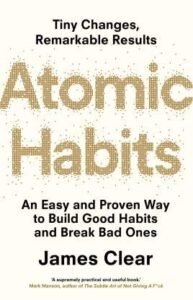

James Clear is an American writer, author, speaker, and entrepreneur known primarily for his work on habits, decision-making, continuous improvement, and human behavior. He is the author of Atomic Habits: An Easy & Proven Way to Build Good Habits & Break Bad Ones, a bestselling book that has become one of the most widely read modern works on habit formation and personal development.
Clear began publishing articles on habits and behavioral improvement on his website, JamesClear.com, in 2012. His writing gradually developed a large international readership, eventually leading to the publication of Atomic Habits in 2018. The book presents a framework for changing behavior through small, repeatable improvements and environmental design rather than relying primarily on motivation or willpower. (James Clear)
Clear is also the creator of the 3-2-1 Newsletter, a weekly email publication built around three ideas from Clear, two quotations from other thinkers, and one question for reflection. His website currently describes the newsletter as reaching more than three million subscribers. (James Clear)
His career is notable for an unusual progression: competitive athletics and academic study were followed by online writing, audience building, book publishing, and eventually a large-scale media and educational business centered on practical ideas about behavior.
Infobox
| James Clear | Details |
|---|---|
| Born | James Clear |
| Nationality | American |
| Occupation | Writer, author, speaker, entrepreneur |
| Fields | Habits, behavior, decision-making, continuous improvement |
| Known for | Atomic Habits, 3-2-1 Newsletter |
| Website | JamesClear.com |
| First major online writing | 2012 |
| Major book | Atomic Habits |
| Book publication | 2018 |
| Education | Denison University |
| College sport | Baseball |
| Position | Pitcher |
| Newsletter | 3-2-1 Thursday |
| Languages of Atomic Habits | More than 60 |
| Worldwide sales of Atomic Habits | More than 30 million copies, according to Clear’s official website |
| Primary themes | Habit formation, systems, identity, consistency, improvement |
Sales and audience figures are those reported by Clear’s official website and therefore may change over time. (James Clear)
Early life and education
Public biographical information about James Clear places an important part of his early development in athletics. He played baseball at Denison University, where he was a pitcher.
Clear has frequently connected his athletic background with his later interest in habits and deliberate practice. His own writing contains recollections of learning baseball mechanics through repetitive practice from childhood, illustrating an idea that later became central to his work: meaningful improvement is often the result of repeated small actions rather than a single dramatic breakthrough. (James Clear)
At Denison, Clear was named to the ESPN Academic All-America team in 2008. In 2024, he was selected for the Academic All-America Hall of Fame, according to his official biography. (James Clear)
His athletic career also gave him practical experience with training, performance measurement, consistency, setbacks, and incremental improvement. These themes later became recurring subjects in his writing.
The development of James Clear’s ideas
Clear did not begin his career as the author of a major bestselling book. His influence developed gradually through online publishing.
He began writing on JamesClear.com in 2012, initially focusing on habits, decision-making, productivity, and personal improvement. (James Clear)
Rather than presenting self-improvement primarily as a question of motivation, Clear increasingly examined the mechanisms behind everyday behavior.
A recurring question in his work is essentially:
How can small changes in ordinary behavior produce meaningful long-term results?
This became the intellectual foundation for Atomic Habits.
His approach combines ideas from behavioral psychology, learning, performance science, decision-making, and practical experience. One of the distinctive features of his writing is the translation of relatively abstract behavioral concepts into concrete actions.
Atomic Habits
Main article: Atomic Habits
Clear’s most important published work is Atomic Habits: An Easy & Proven Way to Build Good Habits & Break Bad Ones.
The book was published in 2018 and became an international bestseller. Clear’s official biography states that it has sold more than 30 million copies worldwide and has been translated into more than 60 languages. (James Clear)
The central proposition of the book is that significant behavioral change can emerge from the accumulation of small improvements.
Clear’s framework emphasizes four stages in the formation of a habit:
Cue → Craving → Response → Reward
He also presents four corresponding principles for behavior change:
- Make it obvious
- Make it attractive
- Make it easy
- Make it satisfying
For breaking an undesirable habit, the framework is reversed:
- Make it invisible.
- Make it unattractive.
- Make it difficult.
- Make it unsatisfying.
Identity-based habits
One of the most prominent ideas associated with Clear is identity-based habit formation.
Instead of beginning exclusively with an outcome—such as losing weight, writing a book, or exercising regularly—Clear encourages readers to consider the identity they wish to reinforce.
The distinction can be expressed as:
Outcome → Process → Identity
For example:
“I want to write a book.”
can become:
“I am a writer.”
The practical implication is that repeated behavior becomes evidence supporting a desired identity.
This concept has helped distinguish Clear’s framework from approaches that focus primarily on setting goals.
Goals versus systems
Another important theme in Clear’s work is the distinction between goals and systems.
A goal describes an intended result.
A system describes the repeated process used to produce that result.
Simplified model
Goal
↓
Desired outcome
↓
System
↓
Repeated behaviors
↓
Habits
↓
Long-term results
Clear argues that focusing exclusively on goals can create a temporary burst of motivation without necessarily creating a sustainable process.
The system-oriented approach instead asks:
What should I repeatedly do if I want this result to become normal?
The compounding effect of habits
Clear frequently describes habits as a form of behavioral compounding.
The basic idea is mathematical as well as psychological.
If an improvement of 1% is compounded repeatedly, the result can be represented approximately as:
1.01³⁶⁵ ≈ 37.8
Conversely:
0.99³⁶⁵ ≈ 0.026
The calculation is an illustration rather than a literal prediction of human performance. Human behavior does not improve at a perfectly constant rate of 1 percent every day.
The more useful idea is that small repeated differences can become substantial over time.
Infographic: The habit-compounding concept
SMALL ACTION
     ↓
REPEATED ACTION
     ↓
BEHAVIORAL PATTERN
     ↓
HABIT
     ↓
IDENTITY REINFORCEMENT
     ↓
LONG-TERM RESULT
The plateau of latent potential
Clear also discusses the phenomenon in which effort appears to produce little visible progress for a considerable period before results become noticeable.
He describes this as a plateau of latent potential.
A person may therefore experience:
Visible Results
     │
     │                  /
     │                /
     │              /
     │            /
     │___________/
     │
     └──────────────────── Time
          Hidden progress
The model explains why people can abandon a useful behavior prematurely: the underlying change may be occurring before the outcome becomes obvious.
3-2-1 Newsletter
In 2019, Clear launched the 3-2-1 Newsletter.
Its format is deliberately compact:
3
Three short ideas from James Clear.
2
Two quotations from other thinkers.
1
One question for reflection.
The newsletter is sent weekly, generally on Thursdays. Clear’s official website states that the publication reaches more than three million subscribers. (James Clear)
The newsletter became an important extension of Clear’s writing philosophy: instead of requiring a reader to consume a long article or book, it delivers a small collection of ideas that can be considered during the week.
James Clear as a writer
Clear’s writing style is characterized by several recurring features:
- Short explanations
- Concrete examples
- Simple behavioral frameworks
- Analogies
- Scientific and historical references
- Practical exercises
- Emphasis on consistency
- Distinction between immediate outcomes and long-term processes
His writing generally avoids academic terminology when a simpler explanation will work.
This has allowed his ideas to travel beyond specialist audiences. His readers include people interested in education, business, fitness, productivity, leadership, entrepreneurship, and personal development.
His official website states that his work has appeared in outlets including Time, The New York Times, The Wall Street Journal, and CBS. (James Clear)
Athletic influence
Clear’s athletic background remains visible in his approach to improvement.
His official biography records personal strength-training achievements including:
| Lift | Personal best |
|---|---|
| Deadlift | 501 lb / 227 kg |
| Squat | 425 lb / 192 kg |
| Bench press | 305 lb / 138 kg |
| Clean | 315 lb / 143 kg |
These figures are supplied by Clear himself and are best understood as biographical details rather than independently verified performance records. (James Clear)
The connection between sport and his philosophy is significant because athletic training provides an intuitive model for gradual improvement: practice, feedback, repetition, recovery, and adaptation.
Philanthropy
Clear has also incorporated charitable giving into his business philosophy.
According to his official biography, beginning in 2017 he began donating 5% of after-tax profit to charitable causes. His primary charity partner is the Against Malaria Foundation.
Clear’s website states that these donations have funded mosquito nets intended to protect people from malaria, and reports that nets have been provided for more than 319,000 people. (James Clear)
Intellectual themes
Clear’s work can broadly be organized around several themes.
1. Small improvements
Large outcomes can emerge from repeated small actions.
2. Environment
Behavior is influenced not only by intention but also by the environment surrounding the individual.
3. Identity
Repeated behavior can reinforce a person’s sense of identity.
4. Systems
Sustainable results require repeatable processes.
5. Consistency
Returning to a behavior repeatedly can matter more than occasional bursts of extreme effort.
6. Feedback
Improvement depends upon observing results and modifying behavior.
7. Long-term thinking
Short-term outcomes can obscure the cumulative effect of repeated decisions.
Influence and reception
Atomic Habits has become a major international self-improvement title. Its reported sales of more than 30 million copies and translations into more than 60 languages indicate a substantial global readership. (James Clear)
Its popularity has also helped make terms such as identity-based habits, habit stacking, systems versus goals, and environment design familiar to a general readership.
The broader significance of Clear’s work lies less in introducing an entirely new scientific discipline than in synthesizing existing ideas into an accessible behavioral framework.
That distinction is important. Clear is primarily a popular writer and educator rather than a laboratory researcher whose work constitutes a standalone scientific theory of human behavior.
James Clear timeline
| Year | Event |
|---|---|
| Early life | Develops interest in baseball and athletics |
| 2008 | Named to ESPN Academic All-America team |
| 2012 | Begins writing regularly at JamesClear.com |
| 2017 | Begins donating 5% of after-tax profit to charity |
| 2018 | Atomic Habits published |
| 2019 | Launches 3-2-1 Newsletter |
| 2024 | Selected for Academic All-America Hall of Fame |
| 2026 | 3-2-1 Newsletter reported at more than 3 million subscribers; Atomic Habits reported at more than 30 million copies sold |
Selected works and projects
Books
- Atomic Habits: An Easy & Proven Way to Build Good Habits & Break Bad Ones (2018)
Digital publications
- JamesClear.com
- 3-2-1 Thursday Newsletter
- Articles on habits, decision-making and continuous improvement
Educational material
Clear’s website also offers a 30 Days to Better Habits email course consisting of 11 lessons and a workbook. (James Clear)
Legacy
James Clear’s influence is closely associated with the transformation of habit formation from a niche topic into a mainstream personal-development subject.
His distinctive contribution has been to present behavioral change as an engineering problem:
Design the environment → simplify the behavior → repeat it → receive feedback → improve the system.
That model has proved particularly adaptable because it can be applied to studying, exercise, writing, business, financial behavior, professional development, and everyday routines.
His career itself also reflects the philosophy he writes about. Rather than emerging overnight as a bestselling author, Clear spent years publishing, refining ideas, building an audience, and eventually converting that body of work into a major book and educational platform.
References
- James Clear, About James Clear, official website. (James Clear)
- James Clear, Atomic Habits, official website. (James Clear)
- James Clear, 3-2-1 Newsletter, official website. (James Clear)
- James Clear, How Experts Practice Better Than the Rest, JamesClear.com. (James Clear)
- James Clear, 2019 Annual Review, JamesClear.com. (James Clear)
Read more
- Atomic Habits
- Habit formation
- Behavioral psychology
- Deliberate practice
- Continuous improvement
- Decision-making
- Personal development
- Productivity
- Behavioral economics
Steve Jobs
2011 biography by Walter Isaacson
Overview
Steve Jobs is a biography of Apple co-founder and technology entrepreneur Steve Jobs, written by American journalist and biographer Walter Isaacson.
The book was published by Simon & Schuster in October 2011, shortly after Jobs’s death. The original hardcover edition is listed as 656 pages and carries ISBN 9781451648539. (Simon & Schuster Parents)
Unlike many authorized biographies, the book was notable for the breadth of access Isaacson received. The publisher states that Isaacson conducted more than 40 interviews with Jobs over two years, in addition to interviewing more than 100 family members, friends, adversaries, competitors, and colleagues. (Simon & Schuster)
The resulting biography attempts to connect Jobs’s personality, artistic interests, technological ambitions, business methods, relationships, and leadership style with the products and companies he helped create.
Infobox
| Steve Jobs | Details |
|---|---|
| Author | Walter Isaacson |
| Subject | Steve Jobs |
| Genre | Biography |
| Publisher | Simon & Schuster |
| Original publication | October 24, 2011 |
| Original edition | Hardcover |
| Length | 656 pages |
| ISBN | 9781451648539 |
| Subject’s lifespan | 1955–2011 |
| Primary subject | Steve Jobs |
| Major companies discussed | Apple, NeXT, Pixar |
| Research basis | 40+ interviews with Jobs; 100+ additional interview subjects |
| Related film | Steve Jobs (2015) |
| Screenwriter of film | Aaron Sorkin |
| Director of film | Danny Boyle |
Walter Isaacson
Author biography
Walter Isaacson is an American journalist, historian, professor, and biographer.
Born on May 20, 1952, in New Orleans, Isaacson studied at Harvard College and Pembroke College, Oxford, where he was a Rhodes Scholar. He began his journalism career at The Sunday Times in London and the Times-Picayune in New Orleans. (Tulane University School of Liberal Arts)
He joined TIME in 1978 and eventually became the magazine’s 14th editor in 1996. In 2001 he became chairman and CEO of CNN, and in 2003 became president and CEO of the Aspen Institute. He later became a professor of history at Tulane University. (Tulane University School of Liberal Arts)
His other biographies include:
- Kissinger: A Biography (1992)
- Benjamin Franklin: An American Life (2003)
- Einstein: His Life and Universe (2007)
- Steve Jobs (2011)
- The Innovators (2014)
- Leonardo da Vinci (2017)
- The Code Breaker (2021)
- Elon Musk (2023)
Isaacson received the National Humanities Medal in 2023. (Tulane University School of Liberal Arts)
His biographies frequently examine people working at the intersection of individual creativity, technology, institutions, and historical change.
Background to the book
Steve Jobs had become one of the most prominent figures in the technology industry by the time Isaacson began working on the biography.
The project developed during the final years of Jobs’s life. Jobs cooperated with Isaacson but, according to the publisher, did not demand editorial control over the finished work. He also encouraged people around him to speak openly to Isaacson. (Simon & Schuster)
This approach was important because Jobs had previously been the subject of numerous articles, interviews, corporate histories, and biographies.
Isaacson therefore attempted to construct a more comprehensive portrait by bringing together the perspectives of:
- Family members
- Friends
- Apple colleagues
- Former colleagues
- Competitors
- Business partners
- Technology executives
- Designers
- Engineers
- People who disagreed with Jobs
The book’s narrative consequently does not present Jobs simply as a technological success story.
It examines both achievement and conflict.
Structure and narrative
The biography follows Jobs’s life chronologically while repeatedly connecting personal experiences with developments at Apple and other organizations.
Its major narrative phases include:
- Childhood and adoption
- Education and early interests
- Steve Wozniak and the beginnings of Apple
- Apple I and Apple II
- The Macintosh project
- Jobs’s conflict within Apple
- His departure from Apple
- NeXT
- Pixar
- Return to Apple
- iMac
- iPod and digital music
- iPhone
- iPad
- Final years and legacy
Rather than treating these events as isolated episodes, Isaacson attempts to show how they influenced one another.
Steve Jobs’s early years
The biography begins with Jobs’s birth in 1955 and his adoption by Paul and Clara Jobs.
His biological parents were Abdulfattah Jandali and Joanne Schieble. The Jobs family subsequently raised him in California.
His childhood environment, education, interest in electronics, and exposure to Silicon Valley became important parts of the narrative.
Isaacson’s account also examines Jobs’s attraction to counterculture, spirituality, Eastern philosophy, technology, and design.
These interests later became part of the complex combination of engineering and aesthetics that characterized his professional life.
Steve Wozniak and Apple
One of the central relationships in the biography is that between Steve Jobs and Steve Wozniak.
Wozniak was primarily an engineering talent, while Jobs became increasingly interested in how technology could be packaged, designed, marketed, and presented to consumers.
The partnership eventually led to the creation of Apple.
The biography presents their relationship as an example of complementary skills:
Steve Wozniak
Engineering
     +
Steve Jobs
Design + Product vision + Marketing
     ↓
Apple
     ↓
Consumer technology
This distinction is one of the recurring themes in Isaacson’s interpretation of Jobs.
Apple and the Macintosh
The development of the Macintosh occupies an important position in the book.
Jobs became deeply involved in the product’s development and emphasized graphical user interfaces, typography, industrial design, ease of use, and the integration of hardware and software.
Isaacson’s narrative connects the Macintosh to Jobs’s broader belief that technology should not be viewed merely as machinery.
Instead, technology could combine:
Engineering + Design + Art + Human experience
The publisher specifically describes this connection between technology and creativity as a central theme of the biography. (Simon & Schuster Parents)
The Lisa and Macintosh era
The book also discusses the development of the Lisa and Macintosh projects.
The competing approaches inside Apple reflected larger questions about product design and organizational control.
Jobs increasingly wanted an integrated experience in which hardware, software, interface, packaging, and marketing worked together.
This philosophy later became one of Apple’s defining characteristics.
Departure from Apple
Jobs’s increasing conflicts with Apple’s management culminated in his departure from the company he had helped establish.
His removal from operational control marked one of the major turning points in the biography.
Rather than treating this episode merely as a personal defeat, Isaacson examines what happened afterward and how Jobs’s subsequent experiences affected his later return to Apple.
NeXT
After leaving Apple, Jobs founded NeXT.
The company developed high-end computer systems and operating-system technology.
Commercially, NeXT did not achieve the mass-market success Jobs had hoped for.
However, the company became historically important because its technology later formed the basis for Apple’s next-generation operating system after Apple acquired NeXT.
The biography therefore presents NeXT as an important part of Jobs’s development between his first and second periods at Apple.
Pixar
Another major part of Jobs’s story is Pixar.
Jobs acquired what became Pixar from Lucasfilm’s computer graphics division and became an important financial and strategic force behind the company.
Pixar subsequently developed into a major animation studio.
Its success demonstrated another aspect of Jobs’s career: his involvement extended beyond personal computers into animated film.
The biography treats Pixar as particularly important because it exposed Jobs to a different kind of creative organization—one built around storytelling, art, technology, and collaboration.
Return to Apple
Jobs eventually returned to Apple after Apple’s acquisition of NeXT.
His second period at Apple became the most commercially consequential phase of his career.
Under his leadership, Apple dramatically simplified its product strategy and introduced a sequence of products that reshaped several consumer industries.
The biography’s narrative eventually moves through:
iMac → iPod → iTunes → iPhone → iPad
These products illustrate the book’s recurring theme of integrating technology with design and user experience.
Product and industry transformation
The publisher identifies six areas that Jobs helped transform:
| Industry / field | Major Apple-related development |
|---|---|
| Personal computers | Macintosh |
| Animated movies | Pixar |
| Digital music | iPod and iTunes |
| Mobile phones | iPhone |
| Tablet computing | iPad |
| Digital publishing | Apple’s broader digital ecosystem |
This table should not be interpreted as meaning that Jobs personally invented each technology. The historical significance lies in Apple’s combination of existing and emerging technologies into integrated consumer products.
The intersection of technology and liberal arts
One of the book’s recurring intellectual themes is the relationship between technology and the humanities.
Jobs repeatedly emphasized the importance of combining technological capability with artistic sensibility.
Isaacson presents this as a central characteristic of Jobs’s approach:
              TECHNOLOGY
                  │
                  │
        ┌─────────┴─────────┐
        │                   │
   Engineering           Computing
        │                   │
        └─────────┬─────────┘
                  │
              DESIGN
                  │
                ART
                  │
             HUMAN USE
                  │
                  ▼
              PRODUCT
The idea is not simply that products should look attractive.
Rather, the complete experience—technology, interface, packaging, physical design, software, marketing, and interaction—should function as a coherent whole.
Design philosophy
Design is one of the strongest themes running through Steve Jobs.
Isaacson’s account describes Jobs as unusually attentive to details that other executives might consider peripheral.
These included:
- Product appearance
- Materials
- Fonts
- Packaging
- User interface
- Retail environments
- Advertising
- Internal organization
- Manufacturing details
The book’s interpretation is that Jobs viewed these details as interconnected rather than independent.
The “reality distortion field”
One of the most discussed concepts associated with the biography is the “reality distortion field.”
The expression was used by people around Jobs to describe his extraordinary ability to persuade others to accept extremely ambitious goals or expectations.
The concept has two sides.
Potentially productive aspect
- Encouraged ambitious targets
- Raised expectations
- Created urgency
- Made seemingly impossible projects appear achievable
Potentially destructive aspect
- Could create unrealistic demands
- Could produce conflict
- Could place enormous pressure on employees
- Could distort organizational decision-making
Isaacson treats the phenomenon as part of the contradiction surrounding Jobs’s leadership rather than as a simple leadership formula.
Leadership style
The book portrays Jobs as a highly demanding leader.
Accounts from colleagues describe a combination of:
- Intense attention to detail
- Strong product focus
- Direct criticism
- Rapid decision-making
- High expectations
- Strong personal control
- Willingness to reject work he considered inadequate
Kirkus Reviews similarly highlighted the biography’s treatment of Jobs’s difficult relationships with colleagues while describing the book as extensively researched and engaging. (Kirkus Reviews)
The biography therefore presents an important distinction:
A person’s effectiveness in creating products does not automatically validate every aspect of that person’s behavior.
The book’s value partly comes from leaving that tension visible rather than eliminating it.
Failure and learning
The biography places considerable importance on Jobs’s failures.
His first Apple period ended with his departure.
NeXT struggled commercially.
Some early product ambitions failed to find a mass audience.
Yet these experiences became part of the larger story of his development.
The publisher’s discussion guide explicitly draws attention to the relationship between Jobs’s NeXT and Pixar experiences and his later return to Apple. (Simon & Schuster Parents)
Simplified career cycle
APPLE
  │
  ▼
Success
  │
  ▼
Conflict
  │
  ▼
Departure
  │
  ├──────────► NeXT
  │
  └──────────► Pixar
          │
          ▼
     New experience
          │
          ▼
      Apple return
          │
          ▼
     iMac / iPod
          │
          ▼
     iPhone / iPad
Steve Jobs’s major product eras
Chart: Career and product timeline
1970s
Apple founded
   │
   ▼
1980s
Apple II / Macintosh
   │
   ▼
1985
Leaves Apple
   │
   ├── NeXT
   └── Pixar
   │
   ▼
1997
Returns to Apple
   │
   ▼
1998
iMac
   │
   ▼
2001
iPod
   │
   ▼
2007
iPhone
   │
   ▼
2010
iPad
   │
   ▼
2011
Steve Jobs dies
The final years
The closing section of the biography covers Jobs’s final years at Apple.
During this period Apple launched products that had substantial effects on computing, music, telecommunications, and consumer electronics.
Jobs resigned as Apple’s CEO in 2011 and died on October 5, 2011, at the age of 56.
The book’s publication followed later that month.
This unusual proximity between the subject’s death and publication contributed to the extraordinary public attention surrounding the biography.
Publication history
The original hardcover edition was published by Simon & Schuster on October 24, 2011. The publisher lists the original edition at 656 pages. (Simon & Schuster Parents)
Subsequent editions have included:
- Hardcover
- Trade paperback
- E-book
- Unabridged audiobook
- Abridged audiobook
- Compact-disc editions
The currently listed trade paperback edition contains 672 pages. (Simon & Schuster)
Reception
The biography received substantial attention from reviewers and readers.
Kirkus Reviews described it as an extensively researched biography and emphasized that it presents both Jobs’s extraordinary achievements and difficult interpersonal behavior. (Kirkus Reviews)
The book also became a major bestseller. Publishers Weekly’s historical bestseller data records Steve Jobs appearing on its lists for many weeks following publication. (PublishersWeekly.com)
Its reception has nevertheless not been entirely uniform.
Later biographies, including Becoming Steve Jobs by Brent Schlender and Rick Tetzeli, sought to present a somewhat different interpretation of Jobs’s personality and development. Kirkus described that book as a reframing of the biographical narrative and noted its intention to challenge simplified portrayals of Jobs. (Kirkus Reviews)
This difference is useful for readers because biographies are interpretations built from evidence; different authors can emphasize different aspects of the same historical figure.
The book’s central themes
1. Creativity and technology
The book argues through its narrative that technological innovation is often strongest when engineering is combined with artistic and humanistic thinking.
2. Product focus
Jobs repeatedly attempted to reduce complexity and concentrate resources on a relatively small number of products.
3. Integration
Apple’s hardware-and-software integration is treated as both a technical and organizational philosophy.
4. Perfectionism
Jobs’s extreme standards are presented as a source of both exceptional products and interpersonal conflict.
5. Control
The desire to control the entire product experience appears repeatedly throughout the biography.
6. Failure
The NeXT period demonstrates that failure can become part of a longer developmental trajectory.
7. Personality and product
One of Isaacson’s central interpretive ideas is that Jobs’s personality and the products he created cannot be completely separated.
Six industries associated with Jobs’s transformation
Infographic
                 STEVE JOBS
                     │
       ┌─────────────┼─────────────┐
       │             │             │
   COMPUTER        MUSIC         MOBILE
     Mac           iPod          iPhone
       │             │             │
       ├─────────────┼─────────────┤
       │             │             │
   ANIMATION       TABLETS      DIGITAL MEDIA
     Pixar          iPad        iTunes/
                                  publishing
The publisher explicitly identifies personal computers, animated movies, music, phones, tablet computing, and digital publishing among the industries transformed by Jobs’s work. (Simon & Schuster)
Relationship between the book and the subject
One of the unusual features of Steve Jobs is that Jobs himself participated in the research process.
According to Simon & Schuster, he did not ask to control what Isaacson wrote and encouraged people who knew him to speak honestly. (Simon & Schuster)
This does not make the book an autobiography. It remains Isaacson’s biography, constructed from interviews and other research.
The distinction matters because the book combines:
Jobs’s own testimony + testimony of others + Isaacson’s interpretation
That combination is one reason the biography has remained an important source for readers trying to understand Jobs beyond the mythology surrounding Apple.
Why the biography remains significant
More than a corporate history, Steve Jobs is a study of the relationship between:
- Individual personality
- Creativity
- Technology
- Product design
- Corporate organization
- Leadership
- Failure
- Entrepreneurship
- Consumer culture
Its central historical question can be expressed simply:
How did one individual help turn technological capabilities into products that changed the way millions of people interacted with technology?
The book does not reduce the answer to a single quality. Instead, Isaacson presents a combination of artistic taste, technical understanding, ambition, organizational decisions, persistence, interpersonal conflict, timing, collaboration, and circumstance.
Key ideas at a glance
| Theme | What the biography examines |
|---|---|
| Innovation | Combining existing technologies in new ways |
| Design | Treating the complete user experience as a product |
| Leadership | High standards and intense management |
| Integration | Hardware, software and services working together |
| Creativity | Interaction between technology and the humanities |
| Failure | Lessons from Apple, NeXT and other setbacks |
| Entrepreneurship | Building and rebuilding companies |
| Personality | The relationship between character and work |
| Collaboration | Jobs’s relationships with engineers, designers and executives |
| Legacy | Long-term effects on several industries |
Adaptation into film
The biography later became one of the inspirations for the 2015 film Steve Jobs.
The film was directed by Danny Boyle, written by Aaron Sorkin, and starred:
- Michael Fassbender as Steve Jobs
- Kate Winslet as Joanna Hoffman
- Seth Rogen as Steve Wozniak
- Jeff Daniels as John Sculley
Simon & Schuster identifies the film as being inspired by Isaacson’s biography. (Simon & Schuster)
The film, however, is not a straightforward screen adaptation of the entire book. It uses a highly dramatized structure centered on product launches and backstage interactions.
Critical perspective
The enduring interest in Isaacson’s Steve Jobs partly comes from the tension between admiration and criticism.
Jobs’s achievements in product development and business are documented alongside accounts of difficult relationships and controversial management behavior.
This makes the biography more complicated than a conventional success story.
Kirkus characterized the book as a “warts-and-all” portrait, while later writers such as Schlender and Tetzeli offered interpretations that placed greater emphasis on Jobs’s development and complexity. (Kirkus Reviews)
For readers, the most productive way to approach the book is therefore not simply as a manual for emulating Jobs, but as a historical account of a highly consequential entrepreneur whose strengths and weaknesses were intertwined.
Walter Isaacson’s biography timeline
1952 ── Walter Isaacson born in New Orleans
   │
1970s ── Journalism career begins
   │
1978 ── Joins TIME
   │
1996 ── Becomes TIME editor
   │
2001 ── Becomes CNN chairman and CEO
   │
2003 ── Becomes Aspen Institute CEO
   │
2007 ── Publishes Einstein biography
   │
2011 ── Publishes Steve Jobs
   │
2014 ── The Innovators
   │
2017 ── Leonardo da Vinci
   │
2021 ── The Code Breaker
   │
2023 ── Elon Musk
   │
2023 ── Receives National Humanities Medal(Tulane University School of Liberal Arts)
Selected bibliography
Walter Isaacson
- Kissinger: A Biography — 1992
- Benjamin Franklin: An American Life — 2003
- Einstein: His Life and Universe — 2007
- Steve Jobs — 2011
- The Innovators — 2014
- Leonardo da Vinci — 2017
- The Code Breaker — 2021
- Elon Musk — 2023
(Tulane University School of Liberal Arts)
References
- Simon & Schuster, Steve Jobs by Walter Isaacson, official publisher page. (Simon & Schuster Parents)
- Simon & Schuster, Steve Jobs, current trade paperback edition and reading guide. (Simon & Schuster)
- Kirkus Reviews, Steve Jobs by Walter Isaacson, October 2011 review. (Kirkus Reviews)
- Publishers Weekly, historical bestseller data for Steve Jobs. (PublishersWeekly.com)
- Tulane University, Walter Isaacson biography. (Tulane University School of Liberal Arts)
- Tulane University, National Humanities Medal announcement, 2023. (Tulane University News)
- Kirkus Reviews, Becoming Steve Jobs, for subsequent biographical interpretation. (Kirkus Reviews)
Read more
- Steve Jobs
- Apple Inc.
- Steve Wozniak
- Macintosh
- NeXT
- Pixar
- iPod
- iPhone
- iPad
- Walter Isaacson
- The Innovators
- Leonardo da Vinci
- Einstein: His Life and Universe
- Becoming Steve Jobs