


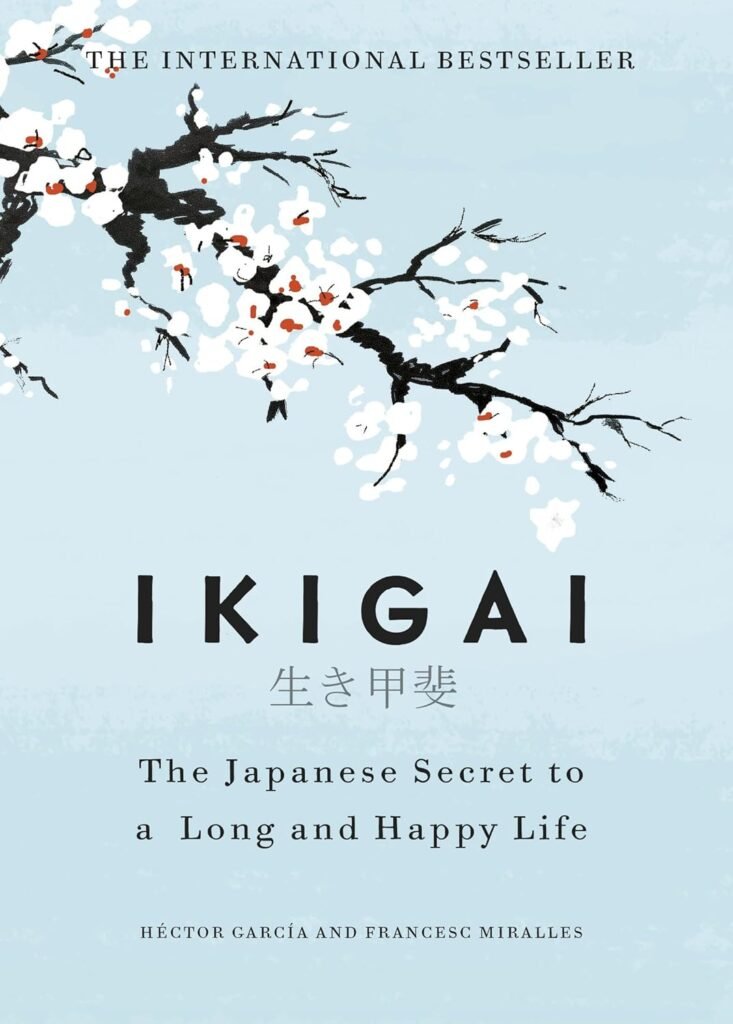
Ikigai: The Japanese Secret to a Long and Happy Life is a 2016 Japanese-culture and personal-development book written by Héctor García and Francesc Miralles. The English edition was published by Penguin in 2017. Combining travel writing, interviews, philosophy, psychology, lifestyle advice, and observations about longevity, the book explores the Japanese concept of ikigai—roughly, a sense of purpose, meaning, or a reason that makes life worth living.
The authors’ central argument is that a fulfilling life is not necessarily built around spectacular achievements. Instead, it can emerge from ordinary activities, relationships, meaningful work, continued activity, social connection, healthy habits, and the pursuit of things that make a person feel that life is worth living.
A substantial portion of the book focuses on Okinawa, particularly the village of Ogimi, which the authors visited to interview older residents about their approach to life. The book connects their observations of Okinawan longevity with broader ideas including staying active, finding flow, maintaining strong social relationships, eating moderately, exercising gently, cultivating resilience, and accepting the imperfect nature of life.
The book became an international bestseller and helped introduce the word ikigai to a worldwide popular audience. It also contributed significantly to the modern global association between ikigai, purpose, happiness, longevity, and self-development.
At the same time, the popular Western interpretation of ikigai should be distinguished from the broader Japanese concept. In particular, the familiar four-circle diagram involving what you love, what you are good at, what the world needs, and what you can be paid for is a modern Western framework rather than a traditional Japanese representation of ikigai.
Book information
| Field | Details |
|---|---|
| Title | Ikigai: The Japanese Secret to a Long and Happy Life |
| Authors | Héctor García and Francesc Miralles |
| Original language | Spanish |
| Original publication | 2016 |
| English edition | 2017 |
| English publisher | Penguin |
| Genre | Self-help, personal development, Japanese culture, longevity, philosophy |
| Subject | Ikigai, purpose, happiness, longevity and well-being |
| English edition length | 208 pages |
| ISBN (U.S. Penguin edition) | 9780143130727 |
| Main geographical focus | Japan, particularly Okinawa |
| Principal location discussed | Ogimi, Okinawa |
| Major themes | Purpose, flow, longevity, diet, movement, social connection, resilience and wabi-sabi |
Overview
At first glance, Ikigai appears to be a book about the secret to living a long life.
Its deeper subject is more interesting.
It is about why a person wants to get up in the morning.
The authors travel to Okinawa, one of the places historically associated with unusually high longevity, and attempt to understand the habits and attitudes of older residents. Rather than looking only for a medical explanation, they explore the relationship between physical activity, social relationships, purpose, food, emotional resilience and everyday routines.
The book’s approach is deliberately accessible.
It does not ask the reader to completely redesign life.
Instead, it repeatedly returns to relatively simple questions:
- What gives your life meaning?
- What makes you want to keep going?
- What activities make you lose track of time?
- Who are the people you can depend on?
- Are you physically active?
- How do you respond to stress?
- Can you appreciate ordinary experiences?
- Are you still learning and participating in life as you age?
The resulting philosophy is less about discovering one extraordinary destiny and more about building a life that remains worth participating in.
What does “ikigai” mean?
The Japanese word ikigai (生きがい) is commonly translated into English using expressions such as:
- reason for living,
- purpose in life,
- something that makes life worth living,
- meaning in life,
- or a source of value and joy in everyday existence.
The English phrase “reason to jump out of bed in the morning” became particularly popular in connection with the modern international presentation of the idea.
However, ikigai is broader than a career purpose.
An individual’s ikigai can involve:
- family,
- friendship,
- work,
- hobbies,
- creative activity,
- community,
- learning,
- nature,
- craftsmanship,
- caring for others,
- or small everyday pleasures.
This is an important distinction.
Ikigai is not necessarily a job
A common modern interpretation assumes:
“Your ikigai is the perfect career.”
That is too narrow.
A person can have a deeply meaningful life without converting their passion into a profession.
For some people, meaningful work may be central.
For others, ikigai may be found in:
- raising children,
- caring for grandchildren,
- gardening,
- cooking,
- making art,
- maintaining friendships,
- volunteering,
- teaching,
- practicing a craft,
- or simply participating actively in community life.
The concept becomes much richer when it is not reduced to career optimization.
The central idea of the book
The philosophy of Ikigai can be represented as a chain:
                 IKIGAI
                   │
                   ▼
            Sense of meaning
                   │
                   ▼
           Daily engagement
                   │
                   ▼
        Healthy social connection
                   │
                   ▼
          Physical + mental activity
                   │
                   ▼
             Greater well-being
                   │
                   ▼
        A more satisfying life
The authors do not present this as a simple mathematical formula.
Rather, the book suggests that a meaningful life emerges from many reinforcing habits and attitudes.
The Okinawa connection
One of the book’s most important settings is Okinawa, a group of Japanese islands in the Ryukyu archipelago.
Okinawa became internationally famous through research and popular writing about exceptional longevity.
Within Okinawa, the authors pay particular attention to Ogimi, a rural community in the northern part of Okinawa’s main island.
The book describes conversations with older residents and examines their daily routines, social relationships, food, physical activity, attitude toward work and approach to aging.
The authors’ interviews provide the book with its most human material.
Instead of presenting longevity as an abstract statistic, the book introduces readers to older people who continue to:
- work,
- cultivate gardens,
- practice crafts,
- socialize,
- exercise,
- participate in community activities,
- and maintain relationships.
The important observation is not simply:
“These people live a long time.”
It is:
“What does everyday life look like for people who remain engaged with life into old age?”
The five major dimensions of the book
The book’s ideas can be organized into five broad dimensions:
                    IKIGAI
                       │
       ┌───────────────┼────────────────┐
       ▼               ▼                ▼
     PURPOSE         PEOPLE           ACTIVITY
       │               │                │
       ▼               ▼                ▼
     Meaning        Community          Flow
       │               │                │
       └───────────────┼────────────────┘
                       ▼
                  BODY & MIND
                       │
                       ▼
                  RESILIENCE
                       │
                       ▼
                 LONGER, RICHER LIFE
These dimensions overlap throughout the book.
Chapter-by-chapter exploration
Prologue: Ikigai — a mysterious word
The book begins by introducing the concept of ikigai and positioning it as a possible way of thinking about a fulfilling life.
Rather than treating happiness as a temporary emotional state, the authors connect it with meaning, activity and participation.
The opening idea is deceptively simple:
A person needs something that makes life worth living.
Chapter 1: Ikigai — the art of staying young while growing old
The first major chapter examines aging.
The authors challenge the idea that aging should automatically mean withdrawal from activity.
Their observations of older Okinawans suggest a different model:
Traditional view

Work → Retirement → Reduced activity

             versus

Active-aging view

Work / Purpose
      ↓
Activity
      ↓
Social connection
      ↓
Learning
      ↓
Contribution
      ↓
Continued engagement
The underlying principle is not that people should literally work forever.
It is that continued participation in life can be psychologically important.
Retirement may change the form of activity, but it does not necessarily need to end meaningful participation.
Chapter 2: Antiaging secrets
The book then turns toward lifestyle.
The authors discuss habits associated with healthy aging, including:
- remaining physically active,
- avoiding prolonged inactivity,
- eating moderately,
- maintaining social relationships,
- reducing unnecessary stress,
- getting adequate rest,
- spending time outdoors,
- and continuing to engage with meaningful activities.
The important feature of this section is its emphasis on accumulation.
No single habit is presented as a magical longevity solution.
Instead:
Small habit
   +
Small habit
   +
Small habit
   +
Small habit
   +
Years
   ↓
Cumulative effect
This is one of the book’s most useful practical ideas.
Chapter 3: From logotherapy to ikigai
One of the book’s most interesting intellectual connections is between ikigai and logotherapy, the therapeutic approach associated with Austrian psychiatrist Viktor Frankl.
Frankl’s work emphasized the importance of meaning in human life, particularly in the face of suffering and difficult circumstances.
The authors use this connection to explore a broader proposition:
Human beings are often strengthened when they have a reason to live.
This does not mean that Japanese ikigai and Frankl’s logotherapy are identical concepts.
They arise from different intellectual and cultural traditions.
The book uses them as complementary ways of thinking about meaning.
Meaning and resilience
Challenge
   ↓
Question of meaning
   ↓
Reason to continue
   ↓
Psychological resilience
   ↓
Ability to keep moving forward
This becomes particularly important in the later discussion of resilience and adversity.
Chapter 4: Find flow in everything you do
The concept of flow is central to the book.
Flow describes a state of deep concentration in which a person becomes highly absorbed in an activity.
During flow:
- attention becomes focused,
- distractions decrease,
- self-consciousness can fade,
- time may seem to pass differently,
- and the activity itself becomes rewarding.
The book encourages readers to identify activities that naturally produce this state.
Examples might include:
- writing,
- painting,
- gardening,
- programming,
- playing music,
- cooking,
- sports,
- craftsmanship,
- teaching,
- reading,
- or solving difficult problems.
The flow cycle
Challenge
    ↓
Focused attention
    ↓
Skill engagement
    ↓
Deep absorption
    ↓
Enjoyment
    ↓
Learning / mastery
    ↓
Greater engagement
Flow therefore becomes more than a productivity technique.
It becomes a way of experiencing life more fully.
Multitasking and modern distraction
The authors contrast flow with fragmented attention.
Modern life constantly competes for attention through:
- smartphones,
- notifications,
- social media,
- email,
- advertisements,
- multitasking,
- and continuous information consumption.
The book’s response is straightforward:
Deep attention requires protecting attention.
This principle has relevance far beyond Japanese culture.
A person cannot easily experience deep engagement while repeatedly interrupting themselves.
Chapter 5: Masters of longevity
The authors explore the experiences of people who have reached advanced ages.
Rather than treating centenarians as biological curiosities, the book asks what can be learned from their attitudes.
Several recurring themes emerge:
- staying active,
- maintaining friendships,
- having something to do,
- avoiding unnecessary stress,
- maintaining curiosity,
- enjoying simple pleasures,
- and remaining connected to other people.
The book’s portrait of longevity is therefore social as much as biological.
Chapter 6: Lessons from Japan’s centenarians
The interviews with older Japanese people give the book its human voice.
Their observations suggest that longevity is experienced not as a medical project but as ordinary life.
Older people continue to:
- meet friends,
- cultivate food,
- work on crafts,
- participate in local activities,
- maintain traditions,
- celebrate events,
- and contribute to family and community.
This produces one of the book’s most appealing ideas:
A long life is not necessarily about adding years to life; it is about continuing to add life to those years.
Moai: the power of social connection
The book discusses the Okinawan tradition of moai, a long-term social support network.
A moai can be understood as a group of people who provide one another with:
- friendship,
- emotional support,
- practical assistance,
- companionship,
- and sometimes financial or material help.
The concept illustrates a broader principle:
Individual
    │
    ▼
Family + Friends
    │
    ▼
Community
    │
    ▼
Belonging
    │
    ▼
Support during difficulty
    │
    ▼
Resilience
Modern societies often emphasize individual independence.
The moai idea reminds readers that human well-being is also relational.
Chapter 7: The ikigai diet
The book examines eating patterns associated with Okinawan life.
Among the themes discussed are:
- eating a wide variety of foods,
- emphasizing vegetables,
- consuming nutrient-rich foods,
- drinking tea,
- eating moderate portions,
- and avoiding excessive consumption.
One concept highlighted is hara hachi bu, the traditional Okinawan expression associated with stopping eating before becoming completely full.
The broader lesson is moderation rather than dietary perfection.
Food philosophy
Variety
  +
Moderation
  +
Mostly whole foods
  +
Mindful eating
  +
Traditional dietary patterns
  ↓
A sustainable relationship with food
The book should not, however, be interpreted as establishing a single Okinawan diet that guarantees longevity.
Diet interacts with genetics, socioeconomic conditions, physical activity, healthcare, environment and many other factors.
Chapter 8: Gentle movements, longer life
The authors discuss forms of movement associated with Japanese and East Asian traditions.
Examples include:
- walking,
- yoga,
- tai chi,
- qigong,
- stretching,
- breathing exercises,
- and radio taisō.
The philosophy is deliberately accessible.
Exercise does not have to mean intense gym training.
For many people, regular moderate movement may be easier to sustain.
Movement principle
Intense exercise occasionally
             │
             ▼
       Limited consistency

Gentle movement regularly
             │
             ▼
        Greater consistency
             │
             ▼
       Long-term activity
The book’s emphasis is therefore on continuity.
Radio taisō
One particularly interesting Japanese practice mentioned in the book is radio taisō, a short group exercise routine traditionally broadcast over radio.
It demonstrates a cultural principle that is easy to overlook:
Exercise can become a social ritual, not merely an individual health task.
When an activity is embedded in everyday life, it becomes easier to repeat.
Chapter 9: Resilience and wabi-sabi
The final major section introduces the idea of resilience and the Japanese aesthetic concept of wabi-sabi.
Wabi-sabi is commonly associated with appreciating:
- imperfection,
- impermanence,
- simplicity,
- age,
- asymmetry,
- and transience.
The concept provides a philosophical counterweight to perfectionism.
Life changes.
Bodies age.
Objects deteriorate.
Plans fail.
People leave.
Nothing remains exactly the same.
The book suggests that accepting this reality can reduce unnecessary psychological resistance.
Wabi-sabi and modern life
A simplified modern interpretation is:
PERFECTIONISM
      ↓
Expectation
      ↓
Disappointment
      ↓
Resistance

WABI-SABI
      ↓
Acceptance of imperfection
      ↓
Adaptation
      ↓
Appreciation
This does not mean accepting harmful circumstances passively.
It means recognizing that imperfection and change are unavoidable parts of human existence.
The philosophy of resilience
The book repeatedly returns to the idea that a meaningful life is not necessarily an easy life.
Resilience involves the capacity to:
- experience difficulty,
- adapt,
- continue,
- learn,
- and remain connected to meaning.
A useful representation is:
DIFFICULTY
    ↓
Acceptance
    ↓
Adaptation
    ↓
Meaning
    ↓
Action
    ↓
Growth / resilience
This is particularly important because the book does not define happiness as constant pleasure.
A meaningful life can include discomfort, loss, uncertainty and effort.
The role of stress
The book discusses the damaging effects of chronic stress and contrasts this with a calmer, more deliberate way of living.
The goal is not to eliminate all stress.
Some stress is unavoidable and can even accompany challenge and growth.
The concern is prolonged, unmanaged stress that becomes the background condition of daily life.
The book therefore emphasizes:
- relaxation,
- social connection,
- physical activity,
- meaningful engagement,
- rest,
- and living with greater awareness.
The “secret” is not really a secret
The title promises a “secret.”
Ironically, the book’s philosophy does not ultimately depend on a hidden trick.
There is no single:
- miracle food,
- exercise,
- supplement,
- productivity hack,
- or philosophical formula.
Instead, the book presents a collection of ordinary practices.
Purpose
  +
Movement
  +
Moderation
  +
Community
  +
Flow
  +
Resilience
  +
Curiosity
  +
Gratitude
  ↓
A life with greater meaning and well-being
That is perhaps the most appealing feature of the book.
The answer is ordinary.
The challenge is consistency.
The popular four-circle Ikigai diagram
Few images have become as strongly associated with ikigai as the famous four-circle diagram.
It normally contains four questions:
        ┌─────────────────┐
        │ What you LOVE   │
        └────────┬────────┘
                 │
                 ▼
        ┌─────────────────┐
        │ What you're     │
        │ GOOD AT          │
        └────────┬────────┘
                 │
                 ▼
        ┌─────────────────┐
        │ What the WORLD  │
        │ NEEDS            │
        └────────┬────────┘
                 │
                 ▼
        ┌─────────────────┐
        │ What you can    │
        │ BE PAID FOR     │
        └─────────────────┘
                 │
                 ▼
              IKIGAI
A more accurate representation of the popular model is:
                 WHAT YOU LOVE
                      ╲   ╱
                       ╲ ╱
                        ●
                       ╱ ╲
                      ╱   ╲
          WHAT YOU ARE       WHAT THE WORLD
             GOOD AT             NEEDS
                      ╲   ╱
                       ╲ ╱
                        ●
                        │
                WHAT YOU CAN
                   BE PAID FOR
However, an important historical clarification is necessary.
The four-circle diagram is not an ancient Japanese diagram
The familiar four-circle model did not originate as a traditional Japanese representation of ikigai.
Its modern form can be traced to a Western purpose diagram associated with Andrés Zuzunaga, which was subsequently adapted and relabeled by Marc Winn in 2014.
The diagram became widely associated with ikigai through popular self-development literature and online culture.
This does not make the diagram useless.
It simply means that it should be described accurately:
The four-circle model is a modern Western interpretation of ikigai, not the original Japanese concept itself.
This distinction is particularly important for an encyclopedia article because the diagram is now frequently presented online as if it were an ancient Japanese teaching.
Japanese ikigai versus the Western career model
| Japanese concept | Popular Western interpretation |
|---|---|
| Broad sense of meaning or value in life | Finding one’s ideal purpose |
| Can involve ordinary daily pleasures | Often centered on career |
| Can involve relationships and family | Often centered on work |
| Does not require financial reward | Includes “what you can be paid for” |
| Can be small and personal | Often presented as a grand life mission |
| Embedded in everyday life | Often treated as a decision framework |
| Not necessarily a single fixed goal | Often presented as a destination |
Both interpretations can be useful.
But they should not be confused.
What makes the book distinctive?
Many personal-development books ask readers to set goals.
Ikigai asks a somewhat different question:
What makes life worth continuing to participate in?
That is a deeper and more existential question.
The book combines several traditions:
Japanese culture
       +
Okinawan longevity
       +
Western psychology
       +
Viktor Frankl
       +
Flow theory
       +
Mindfulness
       +
Lifestyle practices
       +
Personal development
       ↓
     IKIGAI
The result is a hybrid work rather than a strictly academic study of Japanese philosophy.
The book’s view of happiness
The book does not reduce happiness to pleasure.
Instead, it associates a satisfying life with:
- meaning,
- engagement,
- connection,
- contribution,
- activity,
- and acceptance.
This produces an important distinction:
Pleasure
“What feels good now?”
Meaning
“What makes my life worth living?”
Ikigai
“What gives me a continuing reason to participate in life?”
These can overlap, but they are not identical.
Ikigai and flow
The connection between ikigai and flow is one of the book’s most practical ideas.
Suppose a person has an activity that:
- matters to them,
- challenges them,
- uses their abilities,
- and absorbs their attention.
That activity can become an important part of a meaningful life.
The flow–ikigai relationship
Interest
   ↓
Practice
   ↓
Skill
   ↓
Challenge
   ↓
Flow
   ↓
Mastery
   ↓
Satisfaction
   ↓
Meaning
This helps explain why ikigai does not necessarily have to be something dramatic.
It can be a craft practiced quietly for decades.
Ikigai and aging
The book’s treatment of aging is one of its most distinctive features.
Instead of treating old age as a period of decline followed by withdrawal, the authors emphasize continued engagement.
This can include:
- working,
- volunteering,
- gardening,
- teaching,
- crafting,
- caring for family,
- participating in community life,
- and maintaining hobbies.
The underlying principle is:
Do not retire from meaning merely because you retire from employment.
Ikigai and community
Another major theme is that meaning does not always come from individual achievement.
It can emerge from belonging.
Individual purpose
        +
Close relationships
        +
Community participation
        +
Contribution
        ↓
Social meaning
This is particularly relevant in an age when digital connectivity can coexist with social isolation.
The book’s emphasis on real-world relationships therefore remains highly relevant.
The 10 principles of the book
The book can be condensed into ten broad principles:
1. Stay active
Continue doing meaningful things throughout life.
2. Take it slowly
Avoid unnecessary haste and constant urgency.
3. Don’t fill yourself completely
Practice moderation rather than excess.
4. Surround yourself with good people
Relationships contribute substantially to well-being.
5. Get in shape
Maintain the body through regular movement.
6. Smile
Cultivate a positive and approachable attitude.
7. Reconnect with nature
Spend time away from artificial environments and constant stimulation.
8. Give thanks
Recognize the people and circumstances that make life meaningful.
9. Live in the moment
Pay attention to the present rather than permanently living in past regret or future anxiety.
10. Follow your ikigai
Identify and continue the activities and relationships that give your life meaning.
A visual summary of the ten principles
                  A LONG, MEANINGFUL LIFE
                           │
       ┌───────────────────┼───────────────────┐
       ▼                   ▼                   ▼
    Stay active        Eat moderately      Move regularly
       │                   │                   │
       ▼                   ▼                   ▼
    Good people           Smile          Connect with nature
       │                   │                   │
       └───────────────────┼───────────────────┘
                           ▼
                      Give thanks
                           │
                           ▼
                     Live presently
                           │
                           ▼
                       IKIGAI
                           │
                           ▼
                  Meaningful engagement
The book’s treatment of longevity
It is important to distinguish between association and causation.
The book observes characteristics associated with long-lived populations.
That does not establish that each characteristic individually causes longevity.
For example, a population may have:
- strong social relationships,
- traditional dietary habits,
- high physical activity,
- cultural continuity,
- relatively low sedentary behavior,
- and particular environmental conditions.
It is difficult to isolate one factor and declare:
“This is the secret to living longer.”
Modern longevity research is correspondingly more cautious.
The book is most useful when read as a collection of lifestyle observations and philosophical reflections rather than as a scientific prescription for extending lifespan.
What science says about ikigai
Research on ikigai has expanded beyond popular self-help writing.
Researchers have investigated the relationship between having a sense that life is worth living and outcomes involving:
- psychological well-being,
- social functioning,
- health,
- and mortality.
A 2025 rapid literature review in Age and Ageing identified 266 research articles published between 2015 and 2024 in a broad search of the literature on ikigai and aging.
This growing research base suggests that ikigai is a legitimate subject of psychological and health research.
However, the evidence should not be interpreted as proving that “finding your ikigai” independently guarantees a longer life.
The relationship between purpose, health and longevity is complex.
Factors such as socioeconomic status, healthcare, physical activity, diet, social support, genetics and environment can all interact.
The importance of ordinary pleasures
One of the most attractive aspects of the concept is its scale.
A person’s ikigai does not have to change the world.
It may be:
- preparing breakfast for family,
- caring for a garden,
- teaching children,
- writing,
- making pottery,
- meeting friends,
- walking every morning,
- caring for an animal,
- practicing music,
- or continuing a craft learned decades ago.
This gives the concept an important human quality.
Meaning does not always announce itself.
Sometimes it is simply the activity that makes an ordinary Tuesday worth looking forward to.
Ikigai as a daily practice
A useful interpretation of the book is that ikigai should not be treated as a one-time discovery.
It can be viewed as something practiced repeatedly.
Notice what matters
        ↓
Do it
        ↓
Become engaged
        ↓
Build relationships
        ↓
Improve
        ↓
Contribute
        ↓
Experience meaning
        ↓
Repeat
In this interpretation, ikigai is not a treasure hidden somewhere inside the personality.
It is something that can become visible through the way a person lives.
Ikigai and the modern workplace
The book’s ideas have been widely adopted in discussions about:
- career satisfaction,
- employee engagement,
- leadership,
- entrepreneurship,
- purpose-driven organizations,
- and work-life balance.
The popular career version of ikigai encourages people to examine four questions:
- What do I enjoy?
- What am I capable of doing?
- What does society or other people need?
- What can provide economic support?
These questions can be useful for career reflection.
But they should not be treated as a rigid formula.
A meaningful life does not require every meaningful activity to become a source of income.
Ikigai and entrepreneurship
For entrepreneurs, the framework can be useful as a way to think about alignment.
PERSON
│
├── Interest
├── Skills
├── Values
└── Experience
        │
        ▼
      Problem
        │
        ▼
    People who need a solution
        │
        ▼
    Sustainable economic model
The important word is sustainable.
Passion alone does not guarantee a successful business.
Likewise, market demand alone does not guarantee personal satisfaction.
A sustainable entrepreneurial life may require some combination of:
- competence,
- interest,
- usefulness,
- economic viability,
- and personal sustainability.
Ikigai and retirement
The book is particularly relevant to retirement because it challenges the assumption that retirement should mean inactivity.
A healthier question may be:
“What am I retiring from, and what am I retiring toward?”
Employment can provide:
- structure,
- social contact,
- identity,
- challenge,
- contribution,
- and purpose.
When employment ends, those functions do not necessarily disappear.
They must often be replaced deliberately.
Retirement redesign
EMPLOYMENT
   │
   ├── Structure
   ├── People
   ├── Purpose
   ├── Challenge
   └── Contribution
          │
          ▼
       RETIREMENT
          │
          ▼
Rebuild these elements differently
          │
          ▼
     Meaningful aging
This is one of the book’s most practically useful applications.
Author: Héctor García
Héctor García, also known as Kirai, is a Spanish-born author who has lived in Japan for more than two decades.
Before becoming a full-time writer, García worked as a software engineer and spent part of his professional career at CERN in Switzerland. He later moved to Japan, where he worked in the technology industry and became involved with the early development of Twitter’s presence in Japan.
His blog about Japanese culture eventually developed into his first major book, A Geek in Japan.
He subsequently became internationally known as the co-author of Ikigai: The Japanese Secret to a Long and Happy Life.
García’s work frequently combines:
- Japanese culture,
- travel,
- philosophy,
- technology,
- photography,
- everyday observations,
- and practical approaches to living well.
His later books include works concerning ichigo ichie, Japanese culture and other aspects of Japanese philosophy.
According to his official biography, writing has become his principal occupation after leaving the corporate technology world.
Author: Francesc Miralles
Francesc Miralles is a Spanish author, journalist, editor and speaker known for books on personal development, philosophy, well-being and fiction.
He was born in Barcelona in 1968.
Miralles studied German Philology and later completed postgraduate studies in publishing at the University of Barcelona. He worked as a translator and editor before developing his career as an author.
He has written novels as well as nonfiction books dealing with:
- personal growth,
- philosophy,
- spirituality,
- creativity,
- happiness,
- and self-development.
He is also a journalist and has contributed to Spanish media.
Miralles and García subsequently collaborated on several books, with Ikigai becoming their most internationally recognized joint work.
The authors’ collaboration
The collaboration between García and Miralles combines two different perspectives.
Héctor García
Brings:
- long-term experience living in Japan,
- knowledge of Japanese culture,
- technology and international experience,
- observation of Japanese daily life.
Francesc Miralles
Brings:
- experience in personal-development writing,
- philosophy,
- psychology,
- storytelling,
- and European cultural perspectives.
Their collaboration therefore creates a bridge:
Japanese experience
        +
Western interpretation
        +
Interviews
        +
Philosophy
        +
Lifestyle observations
        ↓
      IKIGAI
This cross-cultural character is one reason the book became accessible to readers outside Japan.
Publication history
The book was originally published in Spanish in 2016.
The English-language edition appeared in 2017, published by Penguin.
The English edition contains approximately 208 pages and includes an illustrated presentation of the material.
The book was subsequently translated into numerous languages and became an international bestseller.
The Japanese government’s Kizuna publication reported in 2022 that the book had been translated into 63 languages and had sold more than three million copies at that point.
Héctor García’s current author biography reports an even larger translation footprint, describing the book as translated into 70 languages.
These figures vary by edition and reporting date, but they illustrate the scale of the book’s international reach.
Table of contents
The book is organized around the following major sections:
- Prologue: Ikigai: A Mysterious Word
- Ikigai: The Art of Staying Young While Growing Old
- Antiaging Secrets: Little Things That Add Up to a Long and Happy Life
- From Logotherapy to Ikigai: How to Live Longer and Better by Finding Your Purpose
- Find Flow in Everything You Do: How to Turn Work and Free Time into Spaces for Growth
- Masters of Longevity
- Lessons from Japan’s Centenarians
- The Ikigai Diet
- Gentle Movements, Longer Life
- Resilience and Wabi-Sabi
- Epilogue: Ikigai: The Art of Living
Major concepts at a glance
| Concept | Meaning in the book |
|---|---|
| Ikigai | A reason for living or source of value and meaning |
| Purpose | Something that gives life direction and significance |
| Flow | Deep absorption in an activity |
| Moai | Long-term social support network |
| Hara hachi bu | Eating until roughly 80% full |
| Wabi-sabi | Appreciation of imperfection and impermanence |
| Resilience | Ability to adapt and continue through adversity |
| Longevity | Long life combined with continued activity and engagement |
| Gentle movement | Sustainable physical activity integrated into daily life |
| Social connection | Relationships as a component of well-being |
| Present moment | Attention to current experience rather than constant future or past orientation |
The book’s complete philosophy in one infographic
╔══════════════════════════════════════════════════╗
║                 THE IKIGAI MODEL                 ║
║        THE JAPANESE SECRET TO A GOOD LIFE       ║
╠══════════════════════════════════════════════════╣
║                                                  ║
║                   PURPOSE                        ║
║                     │                            ║
║                     ▼                            ║
║                  IKIGAI                          ║
║                     │                            ║
║       ┌─────────────┼─────────────┐              ║
║       ▼             ▼             ▼              ║
║    FLOW          COMMUNITY       ACTIVITY        ║
║       │             │             │              ║
║       └─────────────┼─────────────┘              ║
║                     ▼                            ║
║                  HEALTH                          ║
║                     │                            ║
║                     ▼                            ║
║                RESILIENCE                        ║
║                     │                            ║
║                     ▼                            ║
║              LONGEVITY + JOY                    ║
║                     │                            ║
║                     ▼                            ║
║            MEANINGFUL LIFE                      ║
║                                                  ║
╚══════════════════════════════════════════════════╝
A practical “Ikigai map”
For readers who want to use the book as a reflection exercise, the following framework is useful—but should be understood as a modern self-reflection tool, not a literal traditional Japanese diagram.
                    YOUR IKIGAI MAP

             WHAT DO I LOVE?
                    │
                    ▼
            What activities
            energize me?
                    │
                    │
WHAT AM I GOOD AT? ──┼── WHAT HELPS OTHERS?
                    │
                    │
                    ▼
            WHAT GIVES ME
              MEANING?
                    │
                    ▼
          HOW CAN I EXPRESS
             IT IN DAILY LIFE?
The most useful question is not necessarily:
“What is my one purpose?”
It may be:
“What can I do regularly that makes my life feel more worthwhile?”
The book’s most important lesson
If the entire book had to be reduced to one idea, it would be this:
A good life is built through meaningful daily engagement, not merely through the achievement of large goals.
The person who wakes up every morning with something meaningful to do may experience life very differently from someone who has achieved financial success but has no idea what to do with the next twenty years.
This is why the book connects:
- purpose,
- work,
- hobbies,
- relationships,
- physical activity,
- food,
- attention,
- aging,
- and resilience.
They are not separate subjects.
They are parts of one question:
What makes life worth living?
Criticism and limitations
An encyclopedia-style treatment should also recognize the limitations of the book.
1. It is not a scientific longevity manual
The book uses observations from Okinawa and other sources to construct a lifestyle philosophy.
It should not be interpreted as proving that adopting every habit described will produce a particular lifespan.
Longevity is multifactorial.
2. Correlation is not causation
The fact that long-lived populations share certain characteristics does not establish that each characteristic independently causes longevity.
3. Okinawa is more complicated than the popular story
The image of Okinawa as a timeless longevity paradise can oversimplify a complex society that has undergone enormous social, economic and dietary changes.
Historical Okinawan lifestyles should not automatically be assumed to describe contemporary Okinawa.
4. The four-circle diagram is culturally simplified
The popular “love + skill + world need + money” diagram is useful for career reflection, but it should not be presented as the traditional Japanese definition of ikigai.
5. The book mixes different intellectual traditions
Japanese cultural concepts, Western psychology, Viktor Frankl, flow research, lifestyle advice and longevity observations appear together.
This makes the book accessible, but it also means that it should not be treated as a systematic academic study of any one of those disciplines.
6. “Purpose” can become another source of pressure
A modern reader can easily turn ikigai into another performance target:
“I must discover my purpose.”
That can ironically create anxiety.
The broader Japanese concept can be understood more gently—as something found in ordinary activities and relationships rather than as one grand mission that must be discovered before life can begin.
Why the book became so popular
The global appeal of Ikigai can be understood through several factors.
Simplicity
The central idea can be expressed in a single question:
What makes life worth living?
Cross-cultural appeal
It presents Japanese ideas in a form that Western readers can easily approach.
Longevity
People everywhere are interested in living longer and healthier lives.
Purpose
Modern work culture has created widespread interest in meaning and career satisfaction.
Minimalism
The book’s emphasis on simple pleasures fits comfortably alongside global interest in mindfulness and minimalist living.
Human stories
The interviews with older Okinawans make the subject personal rather than purely theoretical.
Legacy
Ikigai played a major role in bringing the Japanese word ikigai into mainstream international personal-development culture.
The concept subsequently appeared in:
- corporate workshops,
- career coaching,
- productivity literature,
- university programs,
- social media,
- wellness programs,
- leadership training,
- entrepreneurship,
- and popular psychology.
Its four-circle diagram became especially widespread.
The global popularity of the book also helped generate broader interest in Japanese concepts such as:
- wabi-sabi,
- ichigo ichie,
- kaizen,
- mindfulness,
- simplicity,
- and Japanese approaches to aging.
Ikigai in the modern world
The modern world creates a peculiar problem.
People have more choices than many previous generations, yet choice does not automatically create meaning.
A person can have:
- hundreds of entertainment options,
- thousands of online connections,
- constant information,
- multiple career possibilities,
- and endless opportunities for consumption,
while still asking:
“What am I actually living for?”
This is where ikigai remains relevant.
Its answer is not necessarily “find a better job.”
It may instead be:
- build stronger relationships,
- learn something,
- create something,
- help someone,
- stay physically active,
- develop a craft,
- spend time in nature,
- participate in community,
- or become absorbed in something worth doing.
Ikigai and the meaning of a long life
The book ultimately asks a question that is more profound than longevity itself.
Suppose a person could live to 100.
What would make those 100 years meaningful?
The answer cannot simply be “more years.”
The years need:
- relationships,
- activity,
- curiosity,
- purpose,
- contribution,
- pleasure,
- resilience,
- and moments worth remembering.
Thus:
LONG LIFE
    +
MEANINGFUL LIFE
    ↓
A LIFE WORTH LIVING
This is the deeper philosophical message behind the title.
Frequently asked questions
What is Ikigai: The Japanese Secret to a Long and Happy Life about?
It is a book by Héctor García and Francesc Miralles exploring the Japanese concept of ikigai, along with ideas about longevity, purpose, flow, diet, movement, social connection, resilience and happiness.
Who wrote Ikigai?
The book was written by Héctor García and Francesc Miralles.
When was Ikigai published?
The original Spanish edition was published in 2016. The English edition was published in 2017.
What does ikigai mean?
It can broadly mean a reason for living, a source of meaning, or something that makes life feel worth living.
Is ikigai the same as purpose?
Not exactly. “Purpose” is one useful English approximation, but the Japanese concept can include ordinary activities, relationships and sources of joy rather than only a grand life mission.
Is the four-circle ikigai diagram Japanese?
No. The popular four-circle diagram is a modern Western interpretation that became associated with the word ikigai. It should not be presented as an ancient Japanese diagram.
Does ikigai have to be a career?
No. Family, hobbies, relationships, creative activities, community participation and everyday routines can all contribute to a person’s sense of ikigai.
What is the connection between ikigai and Okinawa?
The book uses Okinawa—particularly Ogimi—as an important case study because of its historical reputation for longevity and the authors’ interviews with older residents.
What is a moai?
A moai is a long-term social support group associated particularly with Okinawan culture. Members provide companionship and mutual support.
What is hara hachi bu?
It is a traditional expression associated with stopping eating before becoming completely full, often interpreted as eating until roughly 80% full.
What is wabi-sabi?
Wabi-sabi is a Japanese aesthetic and philosophical idea associated with imperfection, impermanence, simplicity and transience.
What is flow?
Flow is a state of deep absorption in an activity in which attention becomes highly focused and the activity itself becomes intrinsically rewarding.
Does the book prove that ikigai makes people live longer?
No. The book presents observations and a lifestyle philosophy. Research has found associations between sense of meaning or ikigai and various health and well-being outcomes, but that does not establish a simple causal formula guaranteeing longevity.
Is Ikigai a medical book?
No. It is primarily a popular personal-development and cultural book.
Is the book only for older people?
No. Although longevity and aging are major themes, its ideas about purpose, relationships, attention, activity and resilience apply across the lifespan.
See also
- Ikigai
- Okinawa
- Longevity
- Blue Zones
- Flow
- Wabi-sabi
- Kaizen
- Mindfulness
- Positive psychology
- Viktor Frankl
- Logotherapy
- Japanese philosophy
- Healthy aging
- A Geek in Japan
- Ichigo Ichie
- Same as Ever
- The Psychology of Money
Read more
Readers interested in the ideas presented in Ikigai may explore the following subjects:
Japanese concepts of meaning
Research into the Japanese use of ikigai provides a more culturally grounded understanding than the simplified career diagram commonly found online.
Okinawan longevity
Scientific and demographic research can help distinguish historical Okinawan lifestyle patterns from popular claims about “the secret” to longevity.
Flow
Psychological research on flow provides a deeper scientific framework for understanding intense engagement in activities.
Logotherapy
The work of Viktor Frankl offers a different philosophical and psychological approach to meaning and purpose.
Wabi-sabi
Japanese aesthetics provide a broader cultural context for the book’s discussion of imperfection, impermanence and acceptance.
References
- García, Héctor; Miralles, Francesc. Ikigai: The Japanese Secret to a Long and Happy Life. Penguin, 2017.
- García, Héctor. Official author biography and bibliography.
- Miralles, Francesc. Official author biography and bibliography.
- Google Books. Bibliographic record and table of contents for Ikigai.
- Government of Japan, Kizuna. “Ikigai: The Japanese Secret to a Joyful Life.”
- Kamiya, Mieko. Ikigai ni Tsuite (On the Meaning of Life), 1966.
- Frankl, Viktor E. Man’s Search for Meaning.
- Research literature on ikigai, purpose in life, health and aging.
- Age and Ageing. Rapid literature review on ikigai and research into aging, health and well-being.
- Research on Okinawan longevity, diet, social networks and physical activity.
- Literature on flow and optimal human experience.
- Literature on Japanese aesthetics and the concept of wabi-sabi.
Editorial note
Ikigai: The Japanese Secret to a Long and Happy Life is best read neither as a scientific prescription nor as a literal instruction manual for discovering one perfect purpose.
Its real strength is more human.
It asks readers to look at ordinary life differently.
A meaningful life may not require extraordinary success. It may require only that a person has something worth doing, people worth caring about, activities worth becoming absorbed in, and enough curiosity to remain engaged with the world.
The book’s most enduring question is therefore not:
“What is my ultimate purpose?”
It is a quieter question:
“What makes my life worth living today—and what can I keep doing tomorrow?”
That is perhaps the most useful way to understand ikigai.
In one sentence
Ikigai: The Japanese Secret to a Long and Happy Life presents a cross-cultural philosophy of meaningful living in which purpose, activity, relationships, moderation, attention and resilience can help people approach life—and aging—with greater engagement and satisfaction.