


What Is This Article About?
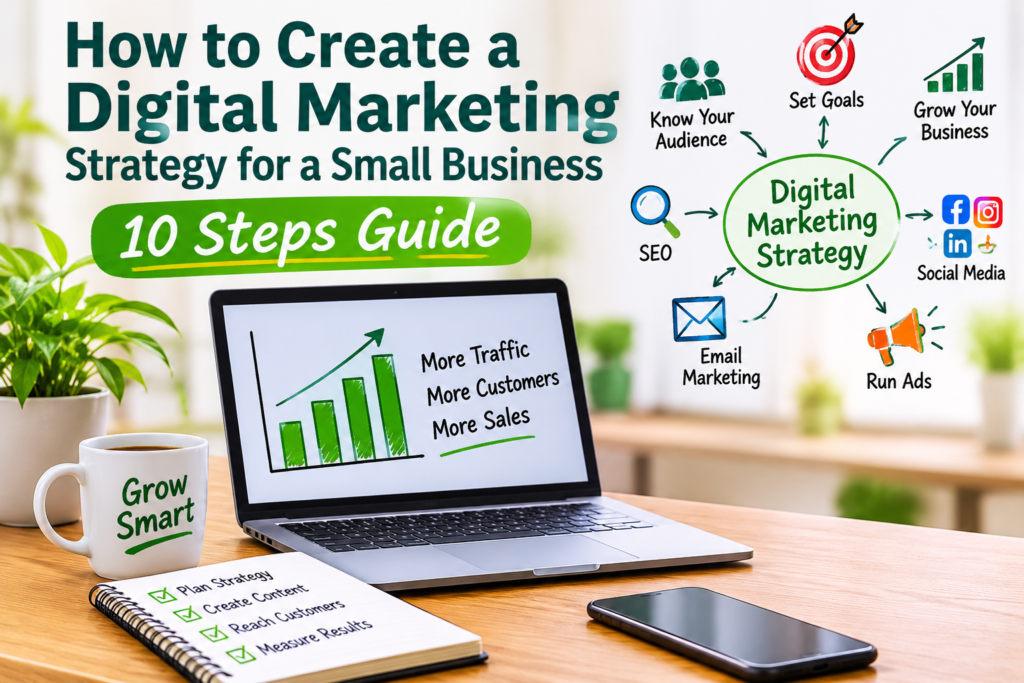
A digital marketing strategy helps a small business attract potential customers, build brand awareness, generate enquiries, and increase sales through online channels.
Instead of randomly posting on social media or spending money on advertisements, a well-planned digital marketing strategy gives every marketing activity a clear purpose.
It identifies your target audience, defines your business goals, selects the right marketing channels, and establishes how you will measure results.
Whether you operate a local shop, professional service, home-based business, or online company, digital marketing can help you reach customers without requiring a large advertising budget.
This guide explains how to create a practical digital marketing strategy in 10 manageable steps, with five actionable activities under each step.
The 10-Step Guide to Creating a Digital Marketing Strategy
Define Your Digital Marketing Goals and Objectives


The first step in creating a digital marketing strategy is deciding exactly what you want your marketing activities to achieve. Your business may need more website visitors, customer enquiries, online orders, local visibility, or repeat purchases. Each objective requires a different approach and different performance measurements. Without clear goals, you may spend time creating social media posts, publishing content, or running advertisements without knowing whether these activities contribute to business growth. Establish specific and measurable objectives that connect your digital marketing efforts to actual business results.
- Identify your primary business objective: Decide whether your main priority is increasing sales, generating leads, building brand awareness, attracting website traffic, or improving customer retention.
- Set SMART marketing goals: Create goals that are specific, measurable, achievable, relevant, and time-bound. For example, aim to generate 30 qualified enquiries per month within six months.
- Establish measurable targets: Decide how many new customers, enquiries, website visitors, or online sales you want to generate during a specific period.
- Set short-term and long-term objectives: Establish initial 30-day and 90-day targets along with broader six-month or one-year business growth objectives.
- Prioritize your goals: Focus on one or two important objectives first instead of trying to achieve everything through multiple marketing campaigns simultaneously.
Identify and Understand Your Target Audience

Successful digital marketing begins with understanding the people most likely to purchase your products or services. Your target audience determines which platforms you should use, what content you should publish, and what messages are most likely to attract attention. A local restaurant, an online clothing store, and a professional consulting firm will not necessarily reach customers through the same channels. Understanding customer demographics, interests, problems, purchasing behaviour, and online habits helps you create relevant marketing campaigns instead of promoting your business to everyone.
- Define your ideal customer: Identify the age group, location, occupation, income range, interests, or business characteristics of people most likely to buy from you.
- Understand customer problems: Identify the specific needs, difficulties, frustrations, and requirements that your products or services can address.
- Research online behaviour: Discover whether your potential customers use Google Search, Instagram, Facebook, YouTube, LinkedIn, email, or other digital platforms.
- Create customer personas: Develop two or three simple profiles representing your ideal customers, including their goals, challenges, preferences, and purchasing motivations.
- Study the customer journey: Understand how people discover your business, compare alternatives, evaluate your offer, make purchasing decisions, and become repeat customers.
Research Your Competitors and Their Digital Marketing Strategies

Competitor research helps you understand how other businesses attract customers and position themselves in the digital marketplace. Studying their websites, search engine rankings, social media accounts, advertisements, content, and customer reviews can reveal useful marketing opportunities. You do not need to copy competitors. Instead, identify what they do effectively, where their marketing efforts appear weak, and how your business can communicate a more relevant or distinctive value proposition. This research can help you make better decisions before spending money on marketing campaigns.
- Identify your main competitors: List at least three to five businesses that offer similar products or services to the same target audience.
- Examine their websites: Study their website structure, product pages, pricing information, landing pages, calls to action, and customer experience.
- Analyze their social media presence: Review the platforms they use, the frequency of their posts, audience engagement, video content, and promotional activities.
- Study their search visibility and advertisements: Examine the keywords they target, their search engine presence, and any publicly visible advertising messages or offers.
- Identify market opportunities: Look for customer complaints, unanswered questions, underserved audiences, and services that your business could communicate or deliver more effectively.
Develop Your Brand Identity and Unique Value Proposition

Your brand identity determines how customers recognize and perceive your business online. A strong digital brand communicates what your business offers, whom it serves, and why customers should consider choosing it over alternatives. Your website, advertisements, social media profiles, emails, and marketing content should communicate a consistent identity and message. A clear unique value proposition (UVP) helps potential customers understand the main benefit of your products or services without having to guess what makes your business different.
- Clarify your brand positioning: Decide how you want customers to perceive your business, such as affordable, premium, convenient, specialized, innovative, or customer-focused.
- Create a clear value proposition: Write a short statement explaining what you offer, whom you help, and what meaningful benefit customers receive.
- Establish a visual identity: Select a business logo, brand colours, typography, and image style that can be used consistently across digital platforms.
- Develop your brand voice: Decide whether your communication should be professional, friendly, educational, conversational, or authoritative, depending on your audience.
- Maintain consistent messaging: Use the same core brand message, business information, and visual identity across your website, social profiles, advertisements, and email communications.
Build and Optimize Your Business Website

A professional business website acts as a central destination for your digital marketing activities. It gives potential customers a place to learn about your products or services, understand your benefits, explore your business, and take the next step towards purchasing. Sending advertising traffic or social media visitors to a poorly designed website can waste marketing opportunities. Your website should be mobile-friendly, easy to navigate, fast-loading, informative, and designed to convert visitors into enquiries, leads, or customers.
- Choose a suitable domain and website platform: Select a memorable domain name and a website-building platform appropriate for your business requirements and technical skills.
- Create essential website pages: Develop a homepage, about page, product or service pages, contact page, and other useful pages that help customers understand your business.
- Make your website mobile-friendly: Ensure that text, images, navigation menus, forms, and important buttons display properly on smartphones and tablets.
- Improve website conversion: Add clear calls to action, useful contact information, relevant customer testimonials where genuine and permitted, and simple enquiry or purchasing processes.
- Install measurement tools: Set up Google Analytics 4 and Google Search Console, and configure appropriate conversion tracking to understand how visitors interact with your website.
Improve Search Engine Optimization and Local Online Visibility

Search engine optimization (SEO) helps your business become more visible when potential customers search online for relevant products, services, or information. Unlike many paid advertising campaigns, organic search visibility can continue attracting visitors over time when your website provides useful and relevant information. Local SEO is especially important for businesses serving customers in specific cities, neighbourhoods, or geographical areas. A combination of keyword research, useful website content, technical improvements, and accurate business information can strengthen your online presence.
- Research relevant keywords: Identify the search terms your potential customers use when looking for your products, services, or solutions.
- Optimize website pages: Use relevant keywords naturally in page titles, headings, URLs, descriptions, image alt text, and useful page content.
- Publish helpful search-focused content: Create informative articles, service explanations, guides, and answers to common customer questions.
- Improve local search visibility: If your business serves a local area, create and maintain an accurate Google Business Profile, including correct contact details, categories, business hours, and relevant photographs.
- Build website authority and trust: Earn relevant backlinks, maintain accurate business information, provide a good user experience, and encourage genuine customer reviews in accordance with applicable platform policies.
Create a Content Marketing Strategy
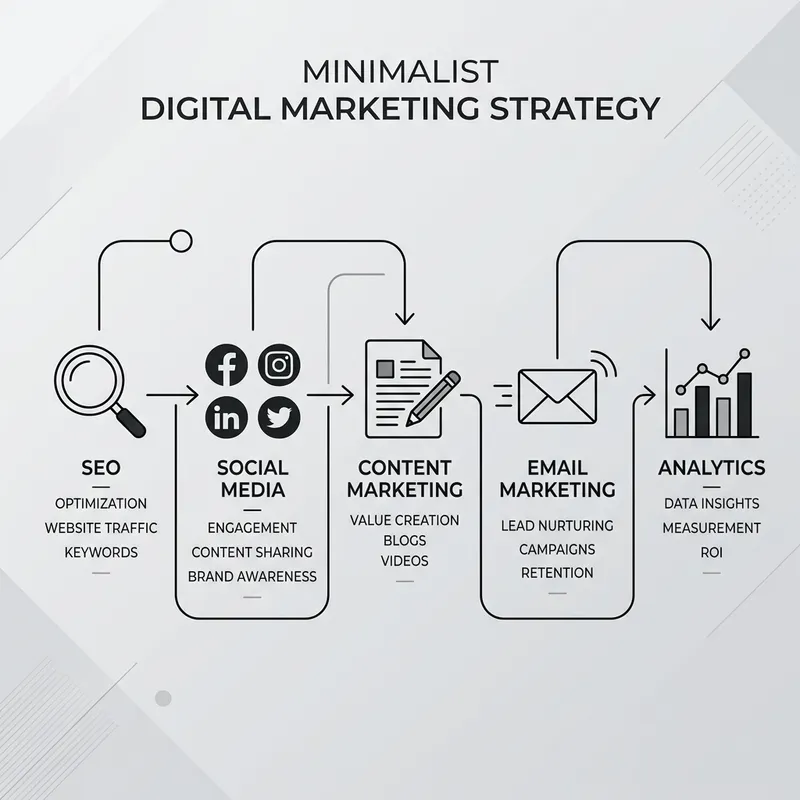
Content marketing involves creating and distributing useful information that attracts, educates, and engages your target audience. Instead of relying entirely on promotional messages, you can publish articles, videos, tutorials, infographics, case studies, and other resources that answer customer questions and demonstrate your expertise. A consistent content strategy helps build brand awareness, supports search engine optimization, and gives your business useful material to share across multiple digital channels. The best content should address genuine customer needs while connecting naturally with your products or services.
- Identify customer content needs: List common questions, problems, interests, buying concerns, and information gaps relevant to your target audience.
- Choose suitable content formats: Decide whether articles, step-by-step guides, short videos, tutorials, infographics, newsletters, or downloadable resources best suit your customers.
- Plan educational and promotional content: Balance informative material that builds trust with relevant content that explains your products, services, features, and benefits.
- Create a content calendar: Schedule topics, publishing dates, content formats, responsible persons, and distribution channels for the coming month.
- Repurpose useful content: Turn a detailed article into social media posts, short videos, email content, infographics, or other formats to extend its usefulness.
Build a Consistent Social Media Marketing Strategy

Social media marketing allows small businesses to communicate directly with potential and existing customers through platforms such as Facebook, Instagram, YouTube, LinkedIn, and other relevant networks. However, creating accounts on every platform does not automatically produce business results. Your social media strategy should focus on the platforms your target audience actually uses and the type of content they find useful. Consistent publishing, meaningful interaction, and a recognizable brand identity can help you develop an engaged audience over time.
- Select the right social media platforms: Choose one or two networks that match your target audience, business category, content format, and marketing objectives.
- Optimize your business profiles: Add a recognizable logo, suitable cover image, accurate business information, relevant description, and website link where appropriate.
- Publish a variety of content: Share educational posts, short videos, product information, demonstrations, useful tips, customer stories, and relevant business updates.
- Engage with your audience: Respond appropriately to comments, questions, and messages, and participate in relevant online conversations.
- Maintain a consistent posting schedule: Establish a realistic weekly publishing routine and review engagement, enquiries, and other meaningful results instead of focusing only on follower counts.
Use Email Marketing and Paid Advertising to Generate Leads

Email marketing and paid advertising can complement your organic marketing activities by helping you reach potential customers and maintain relationships with people who have already shown interest in your business. Email marketing allows you to share useful information, updates, offers, and follow-up messages with subscribers who have given appropriate permission. Paid advertising through platforms such as Google Ads and Meta Ads can provide targeted visibility and generate traffic or enquiries more quickly. Both methods require clear objectives, relevant messaging, controlled budgets, and performance tracking.
- Build a permission-based email list: Collect email addresses through appropriate website forms, newsletter subscriptions, enquiries, and other transparent methods with suitable consent.
- Create useful email campaigns: Send relevant newsletters, educational information, business updates, product announcements, and offers that match subscriber interests.
- Set up email automation: Use suitable email marketing software to organize welcome emails, enquiry follow-ups, and other relevant automated communication.
- Choose suitable advertising platforms: Consider Google Search Ads for people actively looking for solutions and Meta Ads for reaching relevant audiences through Facebook and Instagram.
- Control advertising expenditure: Start with a manageable test budget, define campaign objectives, create relevant landing pages, and monitor cost per lead, conversions, and return on advertising spend where applicable.
Measure Marketing Performance and Continuously Improve Your Strategy

A digital marketing strategy should be evaluated regularly to determine which activities produce meaningful business results. Website traffic, social media engagement, advertising impressions, and email opens can provide useful information, but they do not always translate into revenue. Small businesses should focus on performance indicators that connect marketing activities to enquiries, conversions, customer acquisition, sales, and profitability. By reviewing results and testing improvements, you can gradually move your marketing budget and time towards the channels that deliver the greatest value.
- Track website performance: Monitor website visitors, traffic sources, important landing pages, user behaviour, and conversions using appropriate analytics tools.
- Measure lead generation and conversions: Record enquiries, form submissions, phone calls, purchases, bookings, and other meaningful customer actions.
- Monitor marketing costs: Calculate relevant metrics such as cost per lead, customer acquisition cost (CAC), conversion rate, and return on advertising spend (ROAS).
- Compare channel performance: Evaluate whether SEO, social media, content marketing, email, and paid campaigns are producing the results expected from each channel.
- Test and improve campaigns: Experiment with headlines, content formats, landing pages, audience targeting, offers, and campaign budgets. Retain effective approaches and revise activities that consistently underperform.
Practical Tips for Creating a Digital Marketing Strategy
- Start with clear objectives: Connect your marketing activities to measurable business outcomes rather than focusing only on online visibility.
- Understand your customers: Create content and campaigns based on actual customer needs, preferences, and purchasing behaviour.
- Focus on fewer channels: Start with one or two suitable marketing channels and expand only when you can manage them consistently.
- Invest in your website: Make sure your website is mobile-friendly, informative, fast-loading, and easy to navigate.
- Prioritize useful content: Answer customer questions and provide information that helps people make informed purchasing decisions.
- Maintain brand consistency: Use a recognizable visual identity and consistent messaging across your digital platforms.
- Set a realistic budget: Allocate money according to your business objectives, available resources, and expected returns.
- Avoid chasing every trend: Select marketing tools and platforms based on their relevance to your target audience.
- Measure meaningful results: Track leads, customers, conversions, acquisition costs, and revenue instead of relying entirely on likes and followers.
- Review your strategy regularly: Evaluate performance every month and make improvements based on reliable results and customer feedback.
Conclusion
Creating a digital marketing strategy for a small business does not require a large marketing department or an unlimited advertising budget. It requires a clear understanding of your business goals, target customers, competitors, brand positioning, and the online channels most suitable for reaching your audience.
The 10 steps in this guide provide a practical framework for building a connected digital marketing system. Start by defining measurable objectives and understanding your customers. Develop a professional website, improve your search visibility, publish useful content, build a consistent social media presence, and use email marketing and paid advertising where appropriate. Finally, measure the results and improve your approach continuously.
Remember that effective digital marketing is not about being present on every online platform. It is about reaching the right people, communicating the right message, and turning marketing activity into measurable business results. Begin with a manageable strategy, execute it consistently, learn from your results, and gradually expand the activities that contribute to sustainable business growth.
10 FAQs: How to Create a Digital Marketing Strategy for a Small Business
-
What is a digital marketing strategy for a small business?
A digital marketing strategy is a structured plan that helps a small business promote its products or services online. It combines methods such as SEO, social media marketing, content marketing, email campaigns and online advertising to reach potential customers and increase sales.
-
Why does a small business need a digital marketing strategy?
A digital marketing strategy helps small businesses reach their target audience, build brand awareness, generate leads and compete with larger companies. It also allows business owners to track marketing performance and use their budgets more effectively.
-
How do I create a digital marketing strategy for my small business?
Start by setting clear marketing goals, identifying your target audience and researching competitors. Then develop your brand identity, build a business website, improve SEO, create useful content, use social media, explore email marketing and paid advertising, and measure your results.
-
How much does digital marketing cost for a small business?
The cost depends on the business's goals, industry and marketing channels. A small business can begin with low-cost or free methods such as organic social media, SEO and content marketing. Paid advertising, professional website development and marketing services require additional investment.
-
Which digital marketing channels are best for small businesses?
The most useful channels depend on the target audience and business type. Common options include Google Search, local SEO, Facebook, Instagram, LinkedIn, YouTube, email marketing and business websites. Businesses should focus on channels where their potential customers are most active.
-
How can a small business identify its target audience?
Identify your ideal customers by studying their age group, location, interests, needs, purchasing behaviour and problems. Existing customer feedback, surveys, competitor research and website analytics can provide useful insights into your target audience.
-
Is SEO important for a small business digital marketing strategy?
Yes. Search engine optimization (SEO) helps a business website appear in relevant search results. Local SEO is particularly useful for businesses serving a specific geographical area because it can improve visibility among nearby potential customers.
-
Should small businesses use social media marketing or paid advertising?
Both can be effective. Social media marketing helps build relationships, brand awareness and customer engagement, while paid advertising can generate targeted traffic and leads more quickly. Small businesses can combine organic social media activity with carefully controlled advertising campaigns.
-
How long does it take to see results from digital marketing?
Results depend on the marketing channel, competition, budget and consistency. Paid advertising may generate traffic and leads relatively quickly, while SEO and content marketing generally require several months of consistent effort to produce meaningful organic results.
-
How can I measure the success of my digital marketing strategy?
Track measurable key performance indicators (KPIs), including website traffic, search engine rankings, social media engagement, leads, conversion rate, customer acquisition cost and revenue. Use tools such as Google Analytics 4 and Google Search Console to understand performance and improve your strategy.
More Guides from Clickerrr Guides

How to Find a Profitable Business Niche
Learn how to identify a profitable niche, evaluate market demand, and choose the right business opportunity.
Read the Full Guide →

How to Increase Small Business Revenue
Discover practical strategies to attract customers, increase sales, and improve your business revenue.
Read the Full Guide →
How to Start a Service-Based Business
Follow practical steps to select a service, find your first clients, and build a sustainable business.
Read the Full Guide →

How to Write a Business Plan
Understand how to prepare a business plan, define your goals, and create a practical roadmap for your business.
Read the Full Guide →

How to Find a Profitable Business Niche
Getting your first 100 customers is one of the most important milestones when starting a new business. Whether you run an online business, a local shop, a service-based company, a freelance venture, or a startup, your first customers help you turn an idea into a real business.
Read the Full Guide →

How to Use AI to Grow a Small Business
Artificial intelligence (AI) is changing the way small businesses operate, market their products, serve customers, and compete in the digital marketplace.
Read the Full Guide →

How to Start an Online Business with No Experience
Starting an online business can be an exciting way to turn your skills, knowledge, interests, or business ideas into an income-generating opportunity. Unlike many traditional businesses, an online business can often be started from home with a computer, an internet connection, and a small initial investment.
Read the Full Guide →

How to Start a Small Business
Starting a small business can be an excellent way to turn your skills, knowledge, and ideas into a source of income. Whether you want to open a local shop, provide professional services, sell products online, or start a home-based business, the right approach can help you build a strong foundation. However, starting a business requires more than having a good idea.
Read the Full Guide →