


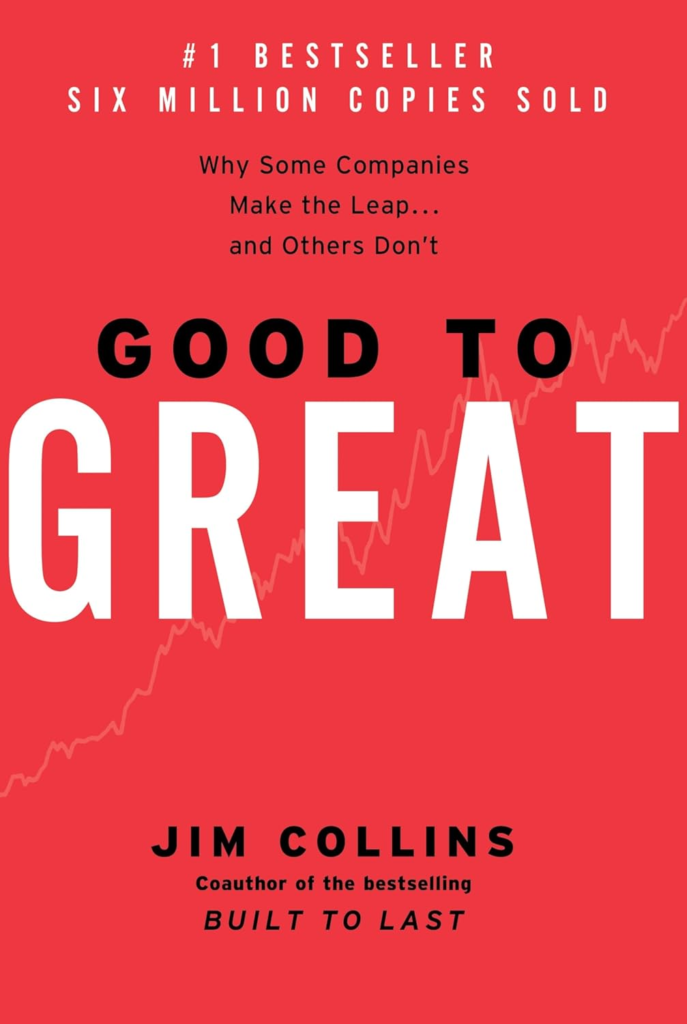
Good to Great: Why Some Companies Make the Leap… and Others Don’t is a management and business book by American author and researcher Jim Collins, first published on October 16, 2001, by HarperBusiness. The book examines why some companies make a substantial and sustained transition from merely good performance to exceptional performance, while comparable companies operating in the same broad business environment fail to make the same transition.
Rather than beginning with a management theory and searching for companies that confirm it, Collins and his research team attempted to identify companies that had already demonstrated an unusual transition in performance and then investigate what differentiated them from comparable companies.
The resulting study produced a framework built around several concepts that have since become widely associated with Collins’s work, including Level 5 Leadership, First Who, Then What, the Hedgehog Concept, the Culture of Discipline, and the Flywheel Effect.
The book’s central argument is that organizational greatness is not primarily the product of a single charismatic leader, a spectacular innovation, a lucky market opportunity, or a dramatic corporate transformation. Instead, Collins argues that exceptional performance tends to emerge from the cumulative interaction of disciplined people, disciplined thought and disciplined action.
The book became one of the most influential management titles of the early 21st century. Collins’s own research website continues to present Good to Great as a major component of his broader body of work on organizational performance. (Jim Collins)
Bibliographic information
| Field | Details |
|---|---|
| Title | Good to Great: Why Some Companies Make the Leap… and Others Don’t |
| Author | Jim Collins |
| Country | United States |
| Language | English |
| Subject | Business management, corporate strategy, leadership |
| Genre | Non-fiction |
| Publisher | HarperBusiness |
| Publication date | October 16, 2001 |
| Pages | 320 |
| ISBN | 978-0-06-662099-2 |
| Research period | Approximately five years |
| Central question | Why do some companies make the transition from good to great while comparable companies do not? |
The original edition was published in 2001 and is generally catalogued as a 320-page management book. (Wikipedia)
Background
Good to Great grew out of a research project conducted by Jim Collins and a team of researchers at his management research laboratory.
The project began with a deceptively simple question:
Can a good company become a great company, and if so, how?
Collins’s team examined the performance histories of 1,435 Fortune 500 companies. From that population, they identified a much smaller group that met their criteria for a transition from good performance to exceptional performance.
The research ultimately identified 11 companies that made what Collins called a “good-to-great” transition.
Each of these companies was then compared with one or more companies that had similar circumstances but did not demonstrate the same transition.
Collins describes the research as an effort to build explanations from systematic comparisons rather than beginning with a predetermined management theory. His research team reported reading thousands of articles, conducting interviews and developing extensive databases and coding documents during the project. (Jim Collins)
The central question
The book is concerned with the difference between being good and becoming great.
That distinction is important because Collins does not begin by asking why unsuccessful companies fail.
Instead, he examines companies that were already performing reasonably well and asks:
What caused some of them to make a sustained leap in performance?
The book therefore focuses on transformation, rather than simply survival or growth.
A simplified representation of Collins’s research question is:
              MANY COMPANIES
                    │
                    ▼
          1,435 FORTUNE 500
              COMPANIES
                    │
                    ▼
        Identify unusual long-term
             performance
                    │
                    ▼
          11 "GOOD-TO-GREAT"
              COMPANIES
                    │
                    ├───────────────┐
                    │               │
                    ▼               ▼
             COMPARE WITH      UNSUSTAINED /
             DIRECT PEERS      NON-TRANSITION
                    │               │
                    └───────┬───────┘
                            ▼
                     ASK "WHAT'S
                       DIFFERENT?"
                            │
                            ▼
                    IDENTIFY PATTERNS
The research design is one of the defining characteristics of the book.
The eleven good-to-great companies
Collins identified eleven companies that met the study’s criteria for a good-to-great transition.
They were:
| Good-to-great company | Comparison company |
|---|---|
| Abbott Laboratories | Upjohn |
| Circuit City Stores | Silo |
| Fannie Mae | Great Western |
| Gillette | Warner-Lambert |
| Kimberly-Clark | Scott Paper |
| Kroger | A&P |
| Nucor | Bethlehem Steel |
| Philip Morris | R. J. Reynolds |
| Pitney Bowes | Addressograph |
| Walgreens | Eckerd |
| Wells Fargo | Bank of America |
The comparison companies were selected to provide a basis for examining what differentiated the good-to-great companies from businesses facing broadly comparable competitive environments. (Wikipedia)
Some of these companies subsequently experienced major difficulties or changed substantially, an issue that later became important in discussions about the book’s methodology and conclusions.
The research methodology
One of the most important parts of Good to Great is not a management principle at all: it is the method Collins says his team used to identify the principles.
The research team attempted to use a matched comparison approach.
The researchers first identified companies that had achieved an unusual long-term transition in performance.
They then looked for comparison companies that had not made the same transition.
The researchers subsequently examined the histories of both groups.
Collins describes the process as involving extensive reading, interviews, financial analysis and systematic coding of information. The research project reportedly consumed approximately 10.5 person-years of effort, involved nearly 6,000 articles, more than 2,000 pages of interview transcripts, and a large collection of coded data. (University of Manchester)
Research logic
          COMPANY PERFORMANCE
                  │
                  ▼
       Identify transition point
                  │
                  ▼
       Select comparison company
                  │
                  ▼
       Study both histories
                  │
                  ▼
        Look for differences
                  │
                  ▼
      Identify recurring patterns
                  │
                  ▼
          Develop concepts
Collins describes this as an attempt to derive concepts from the evidence rather than beginning with a theory that the researchers wanted to prove. (University of Manchester)
The five-stage framework
The major findings of Good to Great can be organized into several related ideas.
At the broadest level, Collins presents the transformation as involving:
- Level 5 Leadership
- First Who, Then What
- Confront the Brutal Facts
- The Hedgehog Concept
- Culture of Discipline
- Technology Accelerators
- The Flywheel Effect
The first three are associated with disciplined people and thought; the middle concepts deal with disciplined thought and action; and the Flywheel provides Collins’s metaphor for how sustained transformation actually develops.
Level 5 Leadership
The book’s first major concept is Level 5 Leadership.
Collins describes a Level 5 leader as someone who combines two apparently contrasting qualities:
- personal humility, and
- professional will.
Such leaders are not necessarily charismatic public figures.
According to Collins’s research, the leaders associated with the good-to-great transitions were often relatively understated personalities. Their ambition was directed primarily toward the organization rather than toward personal fame.
Collins emphasizes that Level 5 leadership is not simply about being modest or quiet. It also involves determination and an unwillingness to compromise on what the leader believes is necessary for the organization’s long-term success. (Jim Collins)
Level 5 leadership model
                LEVEL 5 LEADER
                      │
          ┌───────────┴───────────┐
          │                       │
          ▼                       ▼
   PERSONAL HUMILITY       PROFESSIONAL WILL
          │                       │
          │                       │
          ▼                       ▼
   Gives credit to others   Takes responsibility
   Avoids celebrity         for difficult decisions
   Focuses on organization  Maintains determination
          │                       │
          └───────────┬───────────┘
                      ▼
             SUSTAINED RESULTS
Collins’s description is important because it challenges the popular image of the transformational CEO as a larger-than-life personality. (Jim Collins)
First Who, Then What
A second major principle is expressed through the metaphor:
“First Who, Then What.”
The idea is that organizations should first get the right people on the team before deciding exactly where the organization should go.
Collins uses the metaphor of getting the right people on the bus and then determining where to drive it.
The concept contains three related ideas:
- Get the right people.
- Remove people who are consistently wrong for important roles.
- Put the right people in the right positions.
The underlying argument is that capable people can adapt when circumstances change.
A company with the wrong people may have difficulty executing even an excellent strategy.
The bus metaphor
        RIGHT PEOPLE
             │
             ▼
      RIGHT SEATS
             │
             ▼
      SHARED DISCIPLINE
             │
             ▼
       STRATEGIC CLARITY
             │
             ▼
        RIGHT DIRECTION
The idea is particularly significant because Collins does not treat strategy as the first question.
He asks who will be responsible for carrying out the strategy.
Confront the Brutal Facts
Another major theme of the book is the need to confront unpleasant realities rather than protecting organizational optimism.
Collins argues that organizations can maintain hope while simultaneously acknowledging difficult facts.
This becomes the Stockdale Paradox, named after Admiral James Stockdale, whom Collins interviewed in connection with his broader research.
The paradox can be summarized as:
Maintain faith that you can ultimately prevail while confronting the most difficult facts of your current reality.
The concept rejects both blind optimism and hopeless pessimism.
The Stockdale Paradox
              REALITY
                 │
       ┌─────────┴─────────┐
       │                   │
       ▼                   ▼
  FACE THE FACTS       MAINTAIN FAITH
       │                   │
       └─────────┬─────────┘
                 ▼
          DISCIPLINED ACTION
This principle connects directly with Collins’s later discussion of the Hedgehog Concept.
A company cannot identify what it can realistically become if it refuses to acknowledge what is actually happening.
The Hedgehog Concept
The Hedgehog Concept is probably the most widely recognized idea from Good to Great.
It is derived from an essay by philosopher Isaiah Berlin, The Hedgehog and the Fox, which in turn draws on an ancient Greek idea about the hedgehog and fox.
Collins uses the metaphor to distinguish between organizations that pursue many directions and those that develop a clear, coherent understanding of their business.
The Hedgehog Concept consists of the intersection of three circles:
- What you can be the best in the world at
- What drives your economic engine
- What you are deeply passionate about
It is important to note that “best in the world” does not necessarily mean literally being the world’s largest company.
The question is about understanding what an organization can realistically excel at.
The three circles
                 ┌──────────────────────┐
                 │                      │
                 │  WHAT YOU CAN BE     │
                 │  BEST IN THE WORLD   │
                 │          ○           │
                 │         / \          │
                 │        /   \         │
                 └───────/─────\────────┘
                        /       \
                       /         \
              ┌───────/───────────\───────┐
              │     ○           ○          │
              │ PASSION     ECONOMIC       │
              │             ENGINE         │
              └────────────────────────────┘
                         │
                         ▼
                HEDGEHOG CONCEPT
The important point is that the Hedgehog Concept is not simply a mission statement.
It is intended to emerge from a deeper understanding of the organization’s capabilities, economics and motivation.
Collins notes that the good-to-great companies often took considerable time to crystallize their Hedgehog Concept. In his discussion of the research, he reports an average period of approximately four years for the concepts to become clear. (Jim Collins)
The Economic Denominator
The second circle of the Hedgehog Concept asks:
What drives your economic engine?
Collins argues that companies should identify the economic denominator that best explains their economic model.
Depending on the organization, this might be:
- profit per customer,
- profit per employee,
- cash flow per customer,
- recurring revenue per customer,
- or another meaningful economic measure.
The purpose is to find the variable that provides the clearest understanding of how the organization generates economic value.
This concept encourages managers to move beyond vague objectives such as “increase revenue” and instead understand the underlying economic mechanism.
The Culture of Discipline
Collins’s concept of discipline is different from bureaucratic control.
A culture of discipline means that disciplined people consistently follow disciplined thought and disciplined action.
The organization does not necessarily need excessive rules.
Instead, it needs people who are capable of exercising judgment within clearly understood boundaries.
        DISCIPLINED PEOPLE
                │
                ▼
        DISCIPLINED THOUGHT
                │
                ▼
         DISCIPLINED ACTION
                │
                ▼
        CONSISTENT EXECUTION
                │
                ▼
          GREAT RESULTS
Collins therefore distinguishes between:
discipline imposed from above
and
discipline internalized by the organization.
The “Stop Doing” List
One practical implication of the Culture of Discipline is that companies should not only decide what they will do.
They should decide what they will stop doing.
This is an important but sometimes overlooked aspect of strategic focus.
If every new opportunity becomes another priority, organizational attention becomes fragmented.
The Hedgehog Concept therefore has a negative dimension as well as a positive one:
What should we refuse to pursue?
Technology Accelerators
Collins does not argue that technology is unimportant.
Instead, he proposes that technology should be viewed as an accelerator, not as the primary cause of transformation.
The good-to-great companies, according to his research, tended not to begin their transformation simply by adopting the latest technology.
They first understood their core direction and then used appropriate technology to accelerate it.
Technology principle
             CLEAR CONCEPT
                   │
                   ▼
             RIGHT PROCESS
                   │
                   ▼
              TECHNOLOGY
                   │
                   ▼
              ACCELERATION
This differs from a common business tendency to adopt technology because it is fashionable.
Collins’s argument is essentially:
Technology can accelerate a direction, but it cannot determine the right direction.
The Flywheel Effect
The Flywheel Effect is the book’s principal metaphor for organizational transformation.
Collins asks readers to imagine a massive flywheel.
At first, pushing the flywheel produces almost no visible movement.
But each push adds momentum.
Eventually, the flywheel begins turning faster and faster.
The key point is that there is no single dramatic moment when the organization suddenly becomes great.
Instead, greatness emerges from accumulated effort.
Jim Collins’s own explanation emphasizes that good-to-great transformations do not normally occur through one dramatic program, miracle innovation or defining event. Rather, they develop through repeated, consistent pushes that build momentum. (Jim Collins)
The Flywheel
              ┌──────────────────┐
              │      VISION      │
              └────────┬─────────┘
                       ▼
                 SMALL ACTION
                       │
                       ▼
                CONSISTENT RESULT
                       │
                       ▼
                ANOTHER ACTION
                       │
                       ▼
                GREATER MOMENTUM
                       │
                       ▼
                REINFORCING CYCLE
                       │
                       ▼
                  FLYWHEEL
                 ↻ ↻ ↻ ↻ ↻
                       │
                       ▼
                 BREAKTHROUGH
The metaphor is one of the book’s most enduring ideas because it provides a useful explanation for why major organizational transformations can appear sudden even though they are usually the product of years of accumulated work.
The Flywheel and the Doom Loop
Collins contrasts the Flywheel with what he calls the Doom Loop.
The Flywheel represents consistency.
The Doom Loop represents organizations that repeatedly change direction:
New strategy
    ↓
New leader
    ↓
New program
    ↓
Limited results
    ↓
Abandon program
    ↓
New strategy
    ↓
New leader
    ↓
Repeat
The problem is not change itself.
The problem is inconsistent change without accumulated momentum.
An organization may repeatedly restart before any strategy has enough time to produce meaningful results.
Good-to-great transformation model
The major concepts can be assembled into a single model:
                  LEVEL 5
                  LEADERSHIP
                      │
                      ▼
               FIRST WHO
               THEN WHAT
                      │
                      ▼
              BRUTAL FACTS
                      │
                      ▼
             HEDGEHOG CONCEPT
                      │
                      ▼
           CULTURE OF DISCIPLINE
                      │
                      ▼
           TECHNOLOGY ACCELERATORS
                      │
                      ▼
                 FLYWHEEL
                      │
                      ▼
               GREAT RESULTS
This sequence should not be interpreted as a mechanical checklist.
The concepts reinforce one another.
The eleven companies and their stories
One of the strengths of Good to Great is that Collins does not rely exclusively on abstract principles.
He illustrates his ideas through company histories.
Abbott Laboratories
Abbott Laboratories is used as an example of a company that shifted its strategic focus and developed a clearer economic direction.
The story illustrates how disciplined strategic choices can gradually change an organization’s trajectory.
Circuit City
Circuit City is presented as an example of a company that developed disciplined practices and achieved a substantial transformation in performance.
Its subsequent decline also became relevant to later discussions about whether a company can sustain the conditions associated with greatness.
Fannie Mae
Fannie Mae is used in the book to illustrate leadership, disciplined management and strategic transformation.
Its later history became particularly important because the company experienced severe problems during the financial crisis of 2007–2008.
This illustrates an important distinction:
A company can demonstrate exceptional performance during one historical period without guaranteeing exceptional performance indefinitely.
Gillette
Gillette’s transformation illustrates disciplined strategic focus and leadership.
The company is discussed in relation to its ability to build a strong economic position around a clearly understood business model.
Kimberly-Clark
Kimberly-Clark is one of the book’s most prominent examples.
Collins describes the company’s decision to move aggressively into consumer products and away from some of its traditional business assumptions.
The case is used to illustrate courage, disciplined strategy and willingness to make difficult choices.
Kroger
Kroger is examined in comparison with A&P.
The case illustrates the importance of confronting changes in the competitive environment rather than assuming that historical success will automatically continue.
Nucor
Nucor is used to illustrate disciplined management and an unusual organizational culture.
The company became one of the book’s major examples of how an organization can develop strong performance without relying on traditional corporate hierarchy.
Philip Morris
Philip Morris is used as an example of a company that achieved a strong transition in performance despite operating in a controversial industry.
The case demonstrates that Collins’s research was focused primarily on organizational performance rather than on judging the social desirability of a company’s products.
Pitney Bowes
Pitney Bowes provides another example of a company that developed disciplined management practices and maintained a strong position in its industry during the research period.
Walgreens
Walgreens is particularly important in the book because Collins uses it to demonstrate the Hedgehog Concept.
The company is examined in relation to its focus on convenience, location and economic productivity.
Wells Fargo
Wells Fargo is used to illustrate strategic discipline and the ability to respond to major changes in the banking industry.
Collins describes the company’s transformation as an example of developing a simple organizing idea and adhering to it with discipline. (Jim Collins)
The “good-to-great” companies versus the comparison companies
A simplified visualization of the research design is:
GOOD-TO-GREAT GROUP                 COMPARISON GROUP

Abbott Laboratories  ────────────  Upjohn

Circuit City        ────────────  Silo

Fannie Mae           ────────────  Great Western

Gillette             ────────────  Warner-Lambert

Kimberly-Clark       ────────────  Scott Paper

Kroger               ────────────  A&P

Nucor                ────────────  Bethlehem Steel

Philip Morris        ────────────  R. J. Reynolds

Pitney Bowes         ────────────  Addressograph

Walgreens            ────────────  Eckerd

Wells Fargo          ────────────  Bank of America
The comparison structure is central to Collins’s argument because the book is not simply a collection of stories about successful companies.
The question is always:
What was different?
Unsustained comparisons
Collins also examined six companies that experienced periods of strong performance but did not sustain their transformation in the same way.
These were:
- Burroughs
- Chrysler
- Harris
- Hasbro
- Rubbermaid
- Teledyne
Collins used these cases to examine what happened when organizations appeared to achieve significant improvement but subsequently lost momentum. (Wikipedia)
This part of the research is important because it prevents the book’s argument from becoming simply:
successful companies have successful practices.
Instead, Collins attempts to investigate whether the pattern of transformation itself is sustainable.
The role of luck
One of the broader questions raised by Good to Great is the role of luck.
Collins’s framework places strong emphasis on disciplined action and organizational choices.
However, later research has questioned whether exceptional corporate performance can reliably be explained by management practices alone.
For example, research published in the Harvard Business Review argued that studies of exceptional companies can suffer from selection problems because companies identified as outstanding may partly reflect unusually favorable outcomes or luck. (Harvard Business Review)
This does not necessarily invalidate the managerial practices described in Good to Great. It does, however, caution against treating historical patterns as guaranteed formulas for future success.
Criticism and methodological debate
Good to Great has received substantial attention, but it has also been criticized by management scholars and other researchers.
The criticisms generally concern methodology, causal inference, selection effects and the sustainability of exceptional performance.
Survivorship and selection issues
A central question is whether researchers can identify the causes of success by starting with companies that have already succeeded.
Suppose a researcher identifies a group of unusually successful companies and then examines what they have in common.
The common characteristics may genuinely contribute to success.
But they might also be:
- consequences of success,
- correlated with success without causing it,
- products of industry conditions,
- or characteristics that became visible only after the companies had already begun performing well.
This is a classic challenge in retrospective organizational research.
The Halo Effect
Management scholar Phil Rosenzweig criticized Good to Great and related business research in his book The Halo Effect.
One of his central arguments is that evaluations of management practices can become contaminated by knowledge of organizational performance.
For example:
Company succeeds
      ↓
Observers perceive leadership
      ↓
Leadership is described as excellent
      ↓
Culture is described as excellent
      ↓
Strategy is described as excellent
But the causal direction may be much less clear.
The question becomes:
Did the company’s culture produce its success, or did its success cause observers to describe its culture more positively?
This is the broader halo effect problem.
Sustainability criticism
Another criticism concerns the later performance of the companies identified by Collins.
A 2008 study published in the Academy of Management Perspectives examined the subsequent performance of the eleven companies and argued that the original classification of “great” companies did not demonstrate the same durability in later periods. The authors reported that only one of the eleven continued to meet the superior-performance standard they examined, and they argued that the companies did not maintain the level of superiority implied by the book’s framework. (Academy of Management Journals)
A separate critique from the same publication argued that the evidence did not establish that applying Collins’s principles to other firms or periods would necessarily produce above-average results. (Academy of Management Journals)
These criticisms do not establish that the concepts in the book are useless. Rather, they challenge a stronger interpretation:
that the identified characteristics constitute a reliable causal recipe for creating sustained exceptional performance.
That distinction is important.
The problem of hindsight
Another methodological issue is hindsight.
Once a company has become highly successful, its history can appear more coherent than it actually was.
A sequence of decisions can be interpreted as a carefully designed strategy even when the managers themselves were operating with considerable uncertainty.
This creates a potential difference between:
what happened
and
why it happened.
Good to Great attempts to address this by using comparison companies and extensive historical research, but retrospective business research remains vulnerable to interpretation.
Later history of the featured companies
The subsequent history of several companies also complicates the book’s conclusions.
Examples include:
- Circuit City, which eventually entered bankruptcy;
- Fannie Mae, which suffered severe problems during the 2008 financial crisis;
- Wells Fargo, which later became involved in major regulatory and reputational controversies;
- and other companies whose business models or market environments changed considerably after publication.
These developments do not mean that the companies did not meet Collins’s historical criteria at the time of the study.
They do demonstrate why the phrase “great company” should be understood in historical context rather than as a permanent guarantee.
McKinsey’s later examination of companies featured in major business books similarly cautioned that even companies celebrated as exceptional can later be affected by technological, competitive and market changes. (McKinsey & Company)
Why the book remains influential
Despite methodological criticism, Good to Great has remained highly influential because it provides managers with memorable concepts that are relatively easy to communicate.
Among the most durable are:
- Level 5 Leadership
- First Who, Then What
- Stockdale Paradox
- Hedgehog Concept
- Culture of Discipline
- Technology Accelerators
- Flywheel Effect
The language is memorable because each concept translates a complicated organizational idea into a simple metaphor or question.
For example:
Who is on the bus?
What can we be the best at?
What is our economic denominator?
What facts must we confront?
What is our flywheel?
These questions can be useful even when the reader does not accept every conclusion of the underlying research.
A practical framework derived from the book
A manager applying the ideas of Good to Great could translate the book into a series of questions:
People
- Do we have the right people?
- Are important responsibilities assigned to appropriate individuals?
- Are we keeping people because they are genuinely valuable or simply because they have been with us for a long time?
Reality
- What facts are we avoiding?
- Which assumptions about our business are no longer true?
- What would the numbers say if we removed our optimism?
Focus
- What could we realistically become exceptionally good at?
- What are we deeply passionate about?
- What drives our economic engine?
Discipline
- What should we consistently do?
- What should we stop doing?
- Are our employees disciplined enough that excessive bureaucracy is unnecessary?
Technology
- Is technology solving a genuine strategic problem?
- Are we using technology as an accelerator rather than as a substitute for strategic clarity?
Momentum
- What repeated actions are creating momentum?
- Are we building a flywheel or repeatedly starting over?
Good to Great in one visual


                       GOOD TO GREAT
                            │
          ┌─────────────────┼─────────────────┐
          │                 │                 │
          ▼                 ▼                 ▼
       PEOPLE             THOUGHT           ACTION
          │                 │                 │
          ▼                 ▼                 ▼
     Level 5          Brutal Facts       Culture of
     Leadership                           Discipline
          │                 │                 │
          ▼                 ▼                 ▼
     First Who         Hedgehog           Consistent
      Then What         Concept            Execution
                            │
                            ▼
                     Technology as
                       Accelerator
                            │
                            ▼
                       FLYWHEEL
                            │
                            ▼
                    SUSTAINED MOMENTUM
The central lesson
The most important distinction in Good to Great is between dramatic change and cumulative improvement.
Many business stories are written around a dramatic event:
- a new CEO arrives,
- a revolutionary product launches,
- a company enters a new market,
- a major acquisition occurs,
- or a crisis forces transformation.
Collins’s research emphasizes something quieter.
A company may improve because it repeatedly makes sensible decisions, recruits capable people, maintains focus, confronts reality and keeps pushing in the same direction.
The visible breakthrough comes later.
That is the meaning of the Flywheel.
Good versus great
The book does not argue that being “good” is worthless.
Rather, Collins uses the distinction to describe a particular organizational problem:
Good performance can become comfortable enough that the organization stops asking whether something substantially better is possible.
This is why the title’s phrase “good is the enemy of great” became associated with the book.
The danger is not that good is bad.
The danger is that good can become a reason not to improve.
Legacy
Good to Great became one of the most widely discussed business books of the early 2000s.
Its concepts entered the vocabulary of management education, executive development and corporate strategy.
The book also became part of a larger sequence of Collins’s research:
BUILT TO LAST
      │
      ▼
GOOD TO GREAT
      │
      ▼
GOOD TO GREAT
AND THE SOCIAL SECTORS
      │
      ▼
HOW THE MIGHTY FALL
      │
      ▼
GREAT BY CHOICE
      │
      ▼
BE 2.0
Collins’s official bibliography includes these works and related research publications. (Jim Collins)
The book’s legacy therefore extends beyond its eleven featured companies. Its more enduring contribution may be its vocabulary for discussing organizational discipline, strategic focus and cumulative momentum.
About the author
Jim Collins
James C. “Jim” Collins is an American researcher, author and consultant known for studying organizational performance and business longevity.
His work focuses on the question of why some organizations perform exceptionally well over long periods while others do not.
Before Good to Great, Collins co-authored Built to Last: Successful Habits of Visionary Companies with Jerry I. Porras.
He subsequently wrote or co-authored several other works, including:
- Good to Great
- Good to Great and the Social Sectors
- How the Mighty Fall
- Great by Choice
- Turning the Flywheel
- BE 2.0
His official website describes his work as involving extensive research into leadership, organizations, strategy and self-management. (Jim Collins)
Jim Collins’s broader intellectual contribution
Collins’s work occupies an interesting position between academic research and popular management literature.
His books are written for a broad audience rather than exclusively for academic researchers.
At the same time, his books emphasize:
- longitudinal data,
- comparative cases,
- financial performance,
- historical analysis,
- interviews,
- research teams,
- and structured comparisons.
This combination has helped make his concepts accessible to executives while also generating debate among scholars about research design and causal inference.
The debate surrounding Good to Great is therefore itself part of the book’s significance.
It illustrates a broader question in management research:
Can historical patterns of successful companies be converted into general rules that reliably produce success elsewhere?
There is no simple consensus on that question.
What Good to Great can and cannot tell a reader
The book is most useful when its concepts are treated as questions and management hypotheses, rather than as guaranteed formulas.
For example:
Useful question:
Do we have the right people in the right roles?
Less defensible conclusion:
Hiring the right people will automatically make our company great.
Similarly:
Useful question:
What is our Hedgehog Concept?
Less defensible conclusion:
Every company that identifies a Hedgehog Concept will outperform its competitors.
The distinction matters because organizational outcomes depend on many factors beyond management practices, including:
- industry structure,
- technological change,
- regulation,
- competition,
- capital availability,
- macroeconomic conditions,
- timing,
- execution,
- and luck.
A concise summary of the framework
| Concept | Core question |
|---|---|
| Level 5 Leadership | What kind of leadership produces sustained organizational results? |
| First Who, Then What | Do we have the right people before deciding the direction? |
| Stockdale Paradox | Can we confront reality without losing hope? |
| Hedgehog Concept | What can we become exceptionally good at? |
| Economic Denominator | What single economic measure best explains our engine? |
| Culture of Discipline | Can disciplined people operate without excessive bureaucracy? |
| Technology Accelerators | Which technologies genuinely accelerate our strategy? |
| Flywheel | How can repeated actions build cumulative momentum? |
| Doom Loop | Are we repeatedly changing direction before momentum develops? |
The enduring idea of Good to Great
Perhaps the most human idea in the book is also the least glamorous.
Great organizations are rarely built in one heroic afternoon.
They are built through thousands of ordinary decisions:
- hiring one good person,
- removing one persistent problem,
- saying no to one distracting opportunity,
- confronting one uncomfortable fact,
- improving one process,
- making one disciplined investment,
- and repeating the right behavior when nobody is celebrating it.
The Flywheel is powerful precisely because it makes greatness look less like a miracle and more like accumulated momentum.
At the same time, the later history of many companies in the book reminds readers that no management framework can make greatness permanent.
Companies operate in changing environments. Strategies become obsolete. Technologies change. Markets shift. Leaders leave. Competitors adapt.
That is perhaps the most useful way to read Good to Great today:
not as a guarantee of greatness, but as a structured set of questions about people, leadership, focus, discipline, evidence and momentum.
References
- Collins, Jim. Good to Great: Why Some Companies Make the Leap… and Others Don’t. HarperBusiness, 2001.
- Collins, Jim. “Good to Great.” Fast Company, October 2001. Collins’s own discussion of the research and major concepts. (Jim Collins)
- Collins, Jim. “Level 5 Leadership.” Jim Collins official research website. (Jim Collins)
- Collins, Jim. “The Flywheel Effect.” Jim Collins official research website. (Jim Collins)
- Collins, Jim. Books and Research. Official Jim Collins website. (Jim Collins)
- Resnick, Bruce G., and Timothy L. Smunt. “Good to Great, or Just Good?” Academy of Management Perspectives, 2008. (Academy of Management Journals)
- Resnick, Bruce G., and Timothy L. Smunt. “From Good to Great to…” Academy of Management Perspectives, 2008. (Academy of Management Journals)
- Raynor, Michael E., Mumtaz Ahmed, and Andrew D. Henderson. “Are Great Companies Just Lucky?” Harvard Business Review, April 2009. (Harvard Business Review)
- Bradley, Chris. “What happened to the world’s ‘greatest’ companies?” McKinsey & Company, 2017. (McKinsey & Company)
Further reading
- Built to Last: Successful Habits of Visionary Companies — Jim Collins and Jerry I. Porras
- Good to Great and the Social Sectors — Jim Collins
- How the Mighty Fall: And Why Some Companies Never Give In — Jim Collins
- Great by Choice: Uncertainty, Chaos, and Luck—Why Some Thrive Despite Them All — Jim Collins and Morten T. Hansen
- Turning the Flywheel: A Monograph to Accompany Good to Great — Jim Collins
- BE 2.0: Turning Your Business into an Enduring Great Company — Jim Collins
- The Halo Effect… and the Eight Other Business Delusions That Deceive Managers — Phil Rosenzweig
See also
- Business strategy
- Corporate governance
- Organizational culture
- Leadership
- Strategic management
- Entrepreneurship
- Management science
- Organizational behavior
- Corporate performance
- Competitive advantage
- Built to Last
- Great by Choice
- How the Mighty Fall
External links
Jim Collins — Official Website
Jim Collins official website
Good to Great — Official Research and Concepts
Jim Collins: Good to Great
Level 5 Leadership — Official Concept Page
Level 5 Leadership
The Flywheel Effect — Official Concept Page
The Flywheel Effect
Editorial perspective
Good to Great is best understood as a research-driven management book rather than a scientific law of organizational success.
Its eleven-company study provides a fascinating historical comparison and its concepts—particularly Level 5 Leadership, the Hedgehog Concept and the Flywheel—have proved remarkably memorable. However, subsequent research has challenged whether the book’s findings demonstrate durable causal relationships or whether exceptional historical performance can be reliably reproduced by following the identified principles. (Academy of Management Journals)
For a modern reader, that tension is part of what makes the book worth studying. Its greatest value may not be that it supplies a universal formula for creating great companies, but that it forces managers to ask better questions about people, evidence, strategic focus, discipline and the cumulative nature of organizational change.
This version is intentionally structured as a reference/encyclopedia article rather than a conventional book summary, so it should fit the books-encyclopedia direction of your site much better.