
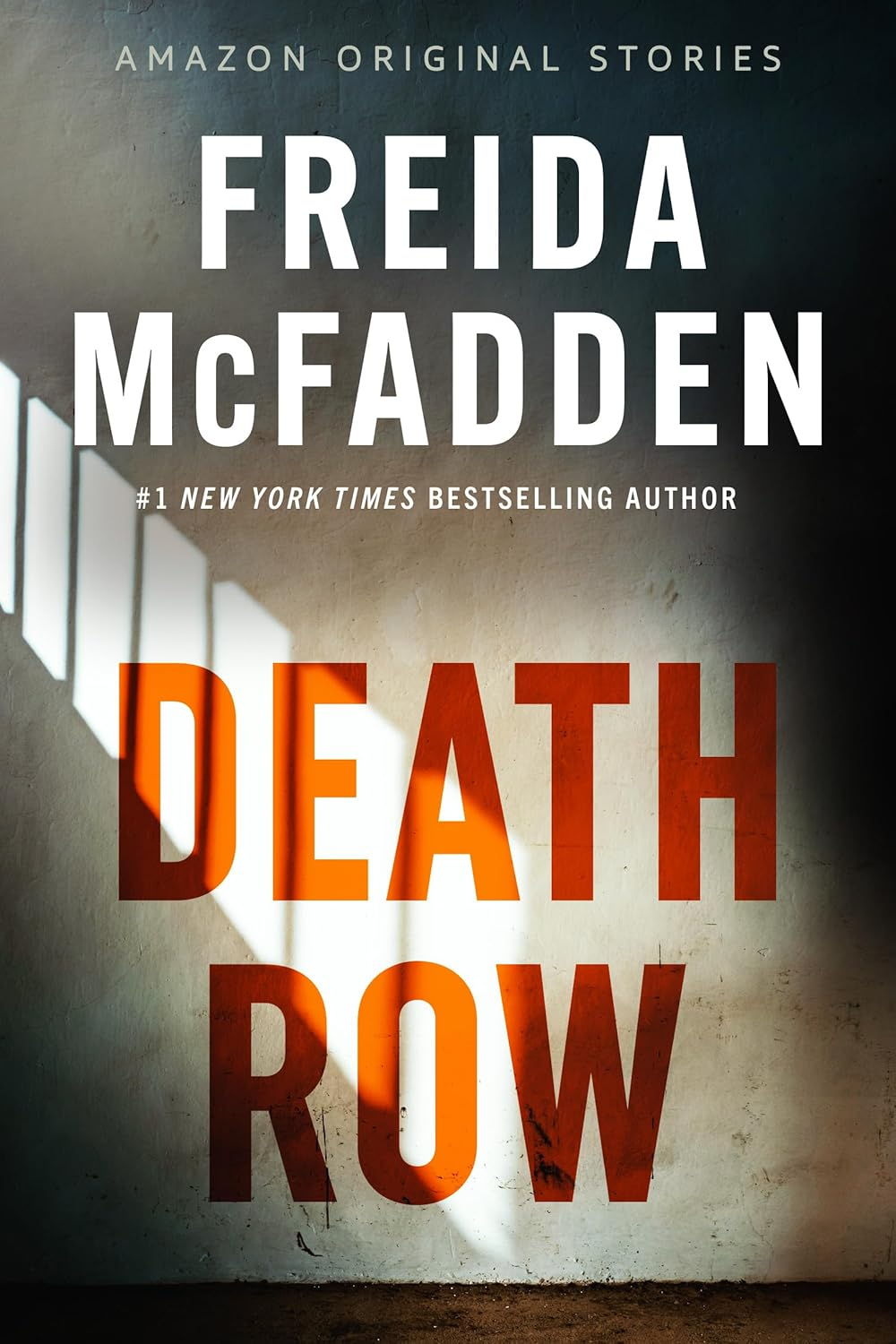
Death Row is a psychological thriller novella by American author Freida McFadden. It was originally published on June 1, 2025, by Amazon Original Stories as the first installment associated with the Alibis collection, a series of short suspense and mystery stories by several authors. The original edition was released in ebook and audiobook formats, with the audiobook narrated by Lauryn Allman.
The story follows Talia Kemper, a woman awaiting execution for the alleged murder of her husband, Noel. Talia maintains that she is innocent and insists that she had an alibi. Her situation becomes increasingly mysterious when she sees a man in the prison visiting area whom she believes to be her supposedly murdered husband.
The novella combines elements of psychological thriller, domestic suspense, mystery, unreliable narration and medical drama. Much of its tension comes from the uncertainty surrounding Talia’s memories and the question of whether the world she experiences is actually real.
A later print edition was published by Poisoned Pen Press in 2026. That edition is approximately 80 pages and carries a different ISBN from the original Amazon Original Stories edition.
Bibliographic information
| Field | Details |
|---|---|
| Title | Death Row |
| Author | Freida McFadden |
| Series/Collection | Alibis Collection |
| Collection position | Book 1 |
| Genre | Psychological thriller, mystery, suspense, domestic thriller |
| Original publisher | Amazon Original Stories |
| Original publication date | June 1, 2025 |
| Original language | English |
| Original ebook ISBN-13 | 978-1-66253-226-9 |
| Original ASIN | B0DRLJNHZJ |
| Original edition length | Approximately 74 pages |
| Audiobook narrator | Lauryn Allman |
| Audiobook length | Approximately 1 hour 44 minutes |
| 2026 print publisher | Poisoned Pen Press |
| 2026 print edition | 80 pages |
| 2026 ISBN-13 | 979-8-25651-039-8 |
The original edition’s publication information is documented by the author’s official website and library catalog records. The audiobook was released in unabridged form and runs approximately one hour and forty-four minutes.
Plot
Warning: This section contains major spoilers.
The protagonist, Talia Kemper, is imprisoned on death row after being convicted of murdering her husband, Noel Kemper. The circumstances surrounding the alleged murder are troubling. Talia insists that she did not intend to kill Noel, maintains that she had an alibi, and cannot understand why nobody believes her.
As the date of her execution approaches, Talia repeatedly revisits her relationship with Noel. Her memories reveal a marriage increasingly affected by suspicion and uncertainty. She becomes convinced that Noel may be having an affair, and apparently innocuous details begin to take on sinister significance.
The narrative alternates between Talia’s experiences on death row and memories of the events leading to her conviction. This structure encourages the reader to accept Talia’s version of reality while simultaneously questioning whether her memories can be trusted.
One of the story’s central mysteries emerges when Talia sees a man in the prison visiting area whom she believes is Noel. If the man really is her husband, the foundation of her conviction appears to collapse: how can a man whose murder supposedly resulted in a death sentence still be alive?
The closer Talia gets to execution, the more the boundaries between memory, perception and reality begin to break down.
Narrative structure
Death Row is deliberately constructed around uncertainty.
Rather than presenting the story as a straightforward murder investigation, McFadden places the reader inside Talia’s subjective experience. The reader receives information largely through Talia’s perceptions, memories and interpretations.
This creates three simultaneous questions:
- What happened to Noel?
- Why was Talia convicted?
- Can Talia’s perception of her circumstances be trusted?
The technique is particularly effective for a short thriller because the story does not need a large cast or an elaborate investigation to create suspense. Instead, uncertainty itself becomes the principal engine of the plot.
Major characters
Talia Kemper
Talia is the protagonist and central narrator of the story. She is a condemned prisoner awaiting execution for the murder of her husband.
Her insistence on her innocence forms the emotional foundation of the narrative. However, the story gradually complicates the reader’s understanding of Talia by revealing the difference between what she believes happened and what may actually have happened.
Talia’s character is therefore closely connected to the novella’s larger theme of guilt. Her apparent innocence at the beginning does not necessarily mean that she is psychologically free from responsibility.
Noel Kemper
Noel is Talia’s husband and the man whose supposed murder forms the central mystery.
Although much of his role is presented through Talia’s memories, Noel becomes increasingly important as Talia’s suspicions about her marriage develop.
His apparent death—and the possibility that he may still be alive—provides the story with its central mystery.
Rhea
Rhea is associated with Talia’s experience of imprisonment. In the story’s eventual explanation, her identity and function are connected to people and circumstances surrounding Talia’s real-world medical condition.
The prison and medical figures
Several secondary characters—including prison officials, legal representatives, medical personnel and religious figures—serve important structural purposes.
Rather than existing solely as independent characters, some of them operate as distorted counterparts to people interacting with Talia outside the imagined death-row environment.
This becomes significant when the ending is revealed.
Themes
Guilt and responsibility
One of the most important ideas in Death Row is the distinction between legal guilt and personal guilt.
A person may be legally innocent of a crime while nevertheless feeling responsible for having caused or attempted to cause harm.
Talia’s psychological state is built around this distinction. Her punishment is not simply something imposed on her by the justice system; it also becomes an expression of her own feelings about what happened.
Reality versus perception
The novella repeatedly asks whether what Talia sees can be accepted as objective reality.
Readers initially experience the prison through her perspective. The apparent physical details—the prison environment, the people around her, the sounds and sensations she experiences—seem real.
The later revelation forces those details to be reconsidered.
This makes Death Row an example of a thriller built around an unreliable or psychologically mediated narrative perspective.
Jealousy and suspicion
Talia’s relationship with Noel is influenced by her growing suspicion that he may be unfaithful.
The story demonstrates how ordinary details can become psychologically magnified when a person already believes that something is wrong.
A receipt, a smell, a change in routine or an unexplained event can become evidence when interpreted through suspicion.
The novel therefore treats jealousy not simply as an emotion but as a mechanism capable of altering perception.
Love and forgiveness
Beneath the mystery and thriller elements, Death Row is also concerned with the emotional consequences of guilt within a relationship.
The ending shifts the story away from the question of punishment and toward forgiveness.
The final emotional movement is therefore less about solving a conventional murder mystery than about whether Talia can escape the guilt that has trapped her psychologically.
Death and the boundary between life and death
The title has a literal meaning within Talia’s perceived reality, but it also functions symbolically.
Talia believes she is waiting for execution. In reality, her condition is connected to a medical crisis in which her life is already in jeopardy.
The story consequently creates a parallel between:
death row → execution
and
hospital → withdrawal of life support
The two realities eventually converge.
The central twist
The principal twist of Death Row is that Talia is not actually living in a prison awaiting execution in the way she believes.
According to McFadden’s own explanation of the ending, the “before” chapters represent real memories from Talia’s life. Talia did attempt to kill Noel, but she ultimately warned him, allowing him to survive.
On her way home, however, Talia was involved in a serious automobile accident and suffered a traumatic brain injury that left her in a coma.
The death-row world is therefore understood as a coma dream created from Talia’s memories, guilt and awareness of events occurring around her in the hospital.
The meaning of the prison imagery
McFadden has explained that several apparently unrelated details in the death-row narrative correspond to events in Talia’s actual medical environment.
| Death-row experience | Real-world counterpart |
|---|---|
| Prison guard | Hospital nurse |
| Lawyer | Doctor |
| Chaplain | Religious figure visiting the hospital |
| Prison visiting environment | Hospital environment transformed by Talia’s mind |
| Repeated beeping | Life-support monitoring |
| Throat discomfort | Endotracheal tube/ventilator |
| Execution | Withdrawal of life support |
This correspondence is the key to understanding the novella’s final chapters.
Ending and epilogue
In the final chapter, Talia’s apparent execution is revealed to be connected to the withdrawal of life support in the real world.
Noel is alive and is involved in the decision surrounding Talia’s life support.
McFadden’s explanation makes the death-row narrative a psychological representation of Talia’s guilt: she imagines herself being punished because she believes she deserves punishment for what she attempted to do to Noel.
The epilogue introduces another layer of ambiguity.
Talia dreams of an alternate reality in which she never experiences the fatal accident and her relationship with Noel continues. Yet the physical sensations associated with her real medical condition remain present in the dream.
When the beeping stops, the pain disappears.
McFadden has stated that she is comfortable with more than one interpretation of the epilogue. Her own possibilities include Talia entering an afterlife after life support is removed or occupying a transitional state between life and death. She has also noted that some readers interpreted Noel as dead, although she stated that this was not her personal intention.
Interpretation
The ending can therefore be understood on several levels.
Psychological interpretation
The death-row setting represents Talia’s guilt. Her mind converts the hospital environment into a prison because she believes she deserves punishment.
Symbolic interpretation
The execution represents the end of Talia’s physical life rather than a conventional state-sanctioned execution.
Metaphysical interpretation
The final dream can be interpreted as a possible transition between life and death.
Ambiguous interpretation
The story deliberately leaves room for readers to decide whether the epilogue represents an afterlife, a final dream, or a transitional mental state.
This ambiguity is consistent with the story’s broader concern with unreliable perception.
Infographic: How the story works
                    DEATH ROW
                        │
                        ▼
              Talia awaits execution
                        │
                        ▼
             "I did not kill Noel."
                        │
                        ▼
             Memories of her marriage
                        │
                        ▼
          Suspicion → jealousy → guilt
                        │
                        ▼
             Talia sees "Noel" alive
                        │
                        ▼
             Reality begins to fracture
                        │
                        ▼
              THE MAJOR REVELATION
                        │
                        ▼
             Talia is actually in a coma
                        │
                        ▼
       Death-row world = coma dream
                        │
                        ▼
              Life support withdrawn
                        │
                        ▼
                  THE EPILOGUE
                        │
              ┌─────────┴─────────┐
              ▼                   ▼
          Afterlife          Transitional
                            state / final dream
The story’s central psychological mechanism
A useful way to understand Death Row is to separate its narrative into two realities:
| Apparent reality | Underlying reality |
|---|---|
| Prison | Hospital |
| Death-row inmate | Comatose patient |
| Execution | Withdrawal of life support |
| Prison guard | Nurse |
| Lawyer | Doctor |
| Chaplain | Hospital religious figure |
| Prison sounds | Medical-monitor sounds |
| Throat pain | Ventilator tube |
| Guilt-driven punishment | Talia’s psychological processing |
The strength of the device is that the reader initially interprets every element literally. Once the explanation is supplied, earlier scenes acquire a second meaning.
Style and narrative technique
Death Row uses several conventions associated with Freida McFadden’s psychological thrillers.
Short-form pacing
The original edition is a very short work, making it possible to read or listen to the story in a single sitting. The audiobook runs approximately 1 hour and 44 minutes.
The compressed format places considerable emphasis on:
- short scenes;
- rapid revelations;
- recurring clues;
- psychological uncertainty;
- a strong central mystery;
- a late narrative reversal.
Unreliable perspective
The story’s most important structural technique is its dependence on Talia’s perspective.
The reader is encouraged to accept the prison as reality because Talia accepts it as reality.
Only after the central revelation does the reader recognize that apparently ordinary details had alternative explanations.
This is a familiar technique in psychological suspense, but Death Row applies it within a particularly compact narrative.
Relationship to the Alibis collection
Death Row forms part of Alibis, an Amazon Original Stories collection built around crime, deception, evidence and the idea of an alibi.
The larger collection includes works by several thriller and suspense writers, including Sally Hepworth, David Lagercrantz, Chris Bohjalian, Chad Zunker and Wanda M. Morris. The audiobook collection brings together six stories and runs approximately 7 hours and 52 minutes.
Death Row functions as a standalone story, meaning readers do not need to read another story in the collection to understand it.
The title Alibis is particularly appropriate to McFadden’s story because the concept of an alibi initially appears to be central to Talia’s defense. The story subsequently transforms the idea of an alibi into something much more psychologically complicated.
Publication history
Original Amazon edition
Death Row was published by Amazon Original Stories on June 1, 2025. The original ebook edition carries ISBN-13 978-1662532269 and ASIN B0DRLJNHZJ.
The audiobook was released at approximately the same time and was narrated by Lauryn Allman.
Library records identify the work as an installment in the Alibis Collection.
2026 print edition
A separate print edition was subsequently published by Poisoned Pen Press in August 2026. This edition is listed at 80 pages and uses ISBN 979-8256510398 in at least one international edition.
Because the page count and ISBN differ between editions, bibliographic references to Death Row should identify the edition being discussed.
Reception
Reader response has been substantial, particularly on Goodreads. The book’s Goodreads listing has accumulated hundreds of thousands of ratings, although numerical ratings are dynamic and should not be treated as a fixed assessment of the work.
The story’s reception has tended to focus on its short length, rapid pacing and twist ending. Some reader discussions have concentrated particularly on the ambiguity of the epilogue and the possibility of multiple interpretations.
Because Death Row is a short thriller designed to be consumed quickly, reader responses often depend heavily on whether the final twist feels satisfying. Reviews also illustrate an important distinction between appreciating the story’s central concept and evaluating the plausibility of every plot detail.
Audiobook
The audiobook edition is narrated by Lauryn Allman.
It is an unabridged production with a running time of approximately 1 hour and 44 minutes.
The audiobook format particularly suits the story’s compact structure because the narrative can be completed in one sitting.
Author
Freida McFadden
Freida McFadden is the pen name of an American physician and bestselling author known primarily for psychological and domestic thrillers.
Her official biography describes her as a physician who has written multiple bestselling psychological thrillers as well as medical humor novels. Her books have been translated into more than 45 languages.
McFadden’s medical background is relevant to Death Row because the story’s final revelation depends on medical circumstances involving coma, traumatic brain injury, ventilation and withdrawal of life support.
She is particularly associated with the international success of The Housemaid, which helped establish her as a major contemporary psychological-thriller author.
Selected works
McFadden’s bibliography includes:
- The Housemaid
- The Housemaid’s Secret
- The Housemaid Is Watching
- The Inmate
- The Teacher
- The Coworker
- The Perfect Son
- The Locked Door
- The Boyfriend
- The Crash
- The Tenant
- The Intruder
- Death Row
Her official biography identifies her as a physician and notes her recognition through the International Thriller Writers Award for Best Paperback Original and the Goodreads Choice Award for Best Thriller.
Freida McFadden’s medical background and the story
One of the more interesting aspects of Death Row is the intersection between McFadden’s medical career and her fiction.
The final act depends on a medical scenario rather than a conventional courtroom revelation. The apparent prison environment is revealed to be a mental reconstruction of Talia’s hospital surroundings.
The story therefore uses medical reality as a source of psychological suspense.
This is also consistent with McFadden’s broader bibliography, which frequently incorporates medical settings, physicians, hospitals and psychological vulnerability into thriller narratives.
Major motifs
The prison
The prison represents both literal punishment and psychological confinement.
The clock
The approaching execution emphasizes the limited amount of time available to Talia.
The beeping sound
The recurring sound initially belongs to the prison world but becomes a crucial clue to Talia’s actual condition.
The throat pain
A physical sensation that seems mysterious within the prison narrative is ultimately explained by the medical environment.
The visiting room
The visiting room is where Talia’s perception of Noel becomes particularly destabilizing.
The execution
The apparent execution serves as the narrative counterpart to the withdrawal of life support.
Narrative timeline
Talia's life with Noel
        │
        ▼
Growing suspicion and marital conflict
        │
        ▼
Talia attempts to cause Noel's death
        │
        ▼
Talia changes course / warns Noel
        │
        ▼
Automobile accident
        │
        ▼
Severe traumatic brain injury
        │
        ▼
Coma and life support
        │
        ▼
Talia's mind constructs "death row"
        │
        ▼
Imagined conviction and execution
        │
        ▼
Life support withdrawn
        │
        ▼
Ambiguous epilogue
This sequence follows McFadden’s own explanation of the ending rather than treating the prison narrative as a literal chronological account.
Critical discussion
The most distinctive feature of Death Row is its use of retrospective reinterpretation.
Early details are not necessarily false; instead, they are presented through a different frame of reference. Once the reader understands that Talia is in a coma, apparently mundane elements acquire new meanings.
This is an economical storytelling strategy. In a full-length novel, a similar twist could require hundreds of pages of setup. In a novella, McFadden has to establish character, conflict, mystery and resolution in a much smaller space.
The result is consequently closer to a psychological puzzle than to a traditional police procedural.
There is little emphasis on a detailed investigation, forensic evidence or courtroom procedure. The mystery is primarily internal: the reader is investigating Talia’s perception rather than investigating a conventional crime scene.
Why the ending is deliberately open to interpretation
Although McFadden has explained her intended interpretation, she has explicitly acknowledged alternative readings of the epilogue.
That distinction is important.
There are effectively two levels of interpretation:
Authorial explanation:
Talia is in a coma, the death-row environment is a coma dream, and the withdrawal of life support leads to the final transition.
Reader interpretation:
The final scene may be read as an afterlife, a transitional state, a final dream or another symbolic representation of Talia’s release from guilt.
The author’s explanation therefore clarifies the mechanics of the story without completely eliminating its ambiguity.
Significance of the title
The title Death Row initially refers to the literal prison environment in which Talia believes she is being held.
After the twist, the title gains a second meaning.
Talia is effectively waiting for death in the hospital just as she believes she is waiting for execution in prison.
The title consequently connects the story’s two realities:
Death row in the imagined world = life support in the real world
The title also reinforces the story’s recurring concern with punishment, guilt, mortality and release.
Infographic: Themes at a glance
                         DEATH ROW
                             │
        ┌────────────────────┼────────────────────┐
        ▼                    ▼                    ▼
      GUILT              DECEPTION             REALITY
        │                    │                    │
        ▼                    ▼                    ▼
   Self-punishment      False assumptions    Unreliable
                                             perception
        │                    │                    │
        └────────────────────┼────────────────────┘
                             ▼
                         FORGIVENESS
                             │
                             ▼
                           RELEASE
Adaptations and related media
The story has been released in audiobook form, narrated by Lauryn Allman. The audiobook is an unabridged production of approximately 1 hour and 44 minutes.
As of 2026, the documented editions include the original Amazon Original Stories ebook/audiobook release and subsequent print editions.
See also
- Freida McFadden
- The Housemaid
- Psychological thriller
- Domestic thriller
- Unreliable narrator
- Amazon Original Stories
- Alibis Collection
- Crime fiction
- Suspense fiction
References
- McFadden, Freida. “Death Row.” Freida McFadden official website. Publication information, synopsis and author’s explanation of the ending.
- Open Library. Death Row by Freida McFadden. Bibliographic record for the 2025 Amazon Original Stories edition.
- Brilliance Publishing. Death Row. Audiobook information, publication date, narrator and series information.
- Audible. Alibis Collection. Collection and audiobook information.
- Goodreads. Death Row by Freida McFadden. Reader-rating and bibliographic information.
- Google Books. Death Row, 2026 Sourcebooks/Poisoned Pen Press edition. Bibliographic information.
- Penguin Books. Death Row. 2026 edition information and author biography.
- McFadden, Freida. “About.” Official author website. Author biography and bibliography information.
Further reading
About the author
- Freida McFadden’s official author biography
- McFadden’s psychological thriller bibliography
- The Housemaid and its sequels
About the book
- Death Row — official author page
- Death Row — Open Library bibliographic record
- Alibis — audiobook collection
Related literary concepts
- Psychological thriller fiction
- Domestic suspense
- Unreliable narration
- Plot twist
- Crime fiction
- Medical fiction
External links
- Official Freida McFadden website: Freida McFadden
- Official Death Row page: Death Row — Freida McFadden
- Open Library record: Death Row — Open Library
Summary
Death Row is a compact psychological thriller built around a deceptively simple premise: a woman convicted of murdering her husband is awaiting execution while insisting that her husband may still be alive.
What initially appears to be a conventional wrongful-conviction mystery eventually becomes a story about guilt, perception, trauma, love and forgiveness. Its central twist transforms the prison setting into a psychological construction created by Talia while she lies in a coma.
The story’s final strength lies not simply in revealing that Talia is in a hospital rather than a prison, but in showing how the mind can transform physical sensations and fragments of reality into an entirely different narrative.
In that sense, Death Row is less a story about whether Talia will survive an execution than a story about whether she can finally escape the punishment she has imposed upon herself.